Showing posts with label John Giorno. Show all posts

Saturday, November 22, 2025

You're A Hook: The 15 Year Anniversary of Dial-A-Poem (1968-1983)


[Various Artists]
You're A Hook: The 15 Year Anniversary of Dial-A-Poem (1968-1983)
New York City, USA: Giorno Poetry Systems, 1983
12” vinyl record
Edition size unknown


A collection of authors, poets, musicians and composers collected to celebrate the 15th anniversary of the Dial-A-Poem project, and the (tenth, eleventh?) anniversary of the record label. 


Side One
1. John Giorno: (Last Night) I Gambled with My Anger and Lost (Greene Street Recording, New York, August 1983)
2. William S. Burroughs: “Old Man Bickford” from The Place of Dead Roads (Kabuki Theater, San Francisco, February 25, 1983)
3.  Laurie Anderson: Song from America on the Move (The Nova Convention, New York, April 29, 1977)
4. Philip Glass: A Secret Solo (Big Apple Studios, New York, April 29, 1977)

Side Two
1. Lenny Kaye: No Jestering (The Place, Eugene, Oregon, May 9, 1978)
2. Patti Smith: “7 Ways Of Going” from The Histories of the World (New York, January 1, 1975) / Fire of Unknown Origin (The Nova Convention, New York, December 1978)
3. Jim Carroll: From The Basketball Diaries (Giorno Poetry Systems, New York, March 30, 1969)
4. Frank Zappa:  The Talking Asshole (The Nova Convention, New York, December 2, 1978)
5. Allen Ginsberg: Father Death Blues (ZBS Media, Fort Edward, New York, February 28-March 1, 1981, courtesy of Hammon Music Enterprises


"In 1961 I was a young poet who hung out with young artists like Andy Warhol, Bob Rauschenberg and Jasper Johns, as well as with members of the Judson Dance Theatre. The use of modern mass media and technologies by these artists made me realize that poetry was 75 years behind painting and sculpture, dance and music. And I thought, if they can do it, why can't I do it for poetry. Why not try to connect with an audience using all the entertainments of ordinary life: television, the telephone, record albums, etc? It was the poet's job to invent new venues and make fresh contact with the audience. This inspiration gave rise to Giorno Poetry Systems” 
- John Giorno


Tuesday, June 17, 2025

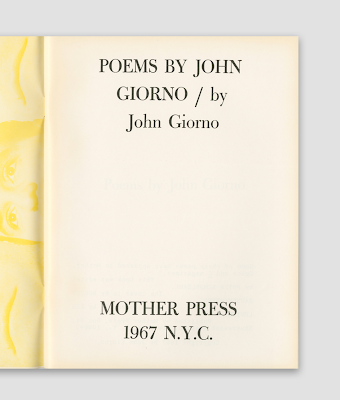
Poems by John Giorno


John Giorno
Poems by John Giorno
New York City, USA: Mother Press, 1967
64 pp., 8 × 6 1⁄4”, softcover
Edition of 1000


Giorno’s first book, edited by Peter Schjeldahl, features new poems, and pieces that had previously been published in Mother, Spice and C magazines. Titles include Paratrooper, Alone on a Beam, Leather, She Tasted Death and Pornographic Poem. 

The book’s cover are frontispiece are by Robert Rauschenberg and Les Levine, respectively. Both were close friends with Giorno. Of the thousand copies produced, fifty were signed and numbered by all three. 

The trade edition can be purchased by Giorno Poetry Systems, here, for $250 US. Granary Books has a copy of the edition signed by Giorno, Rauschenberg and Levine for $1000 US, here. 


Tuesday, June 27, 2023

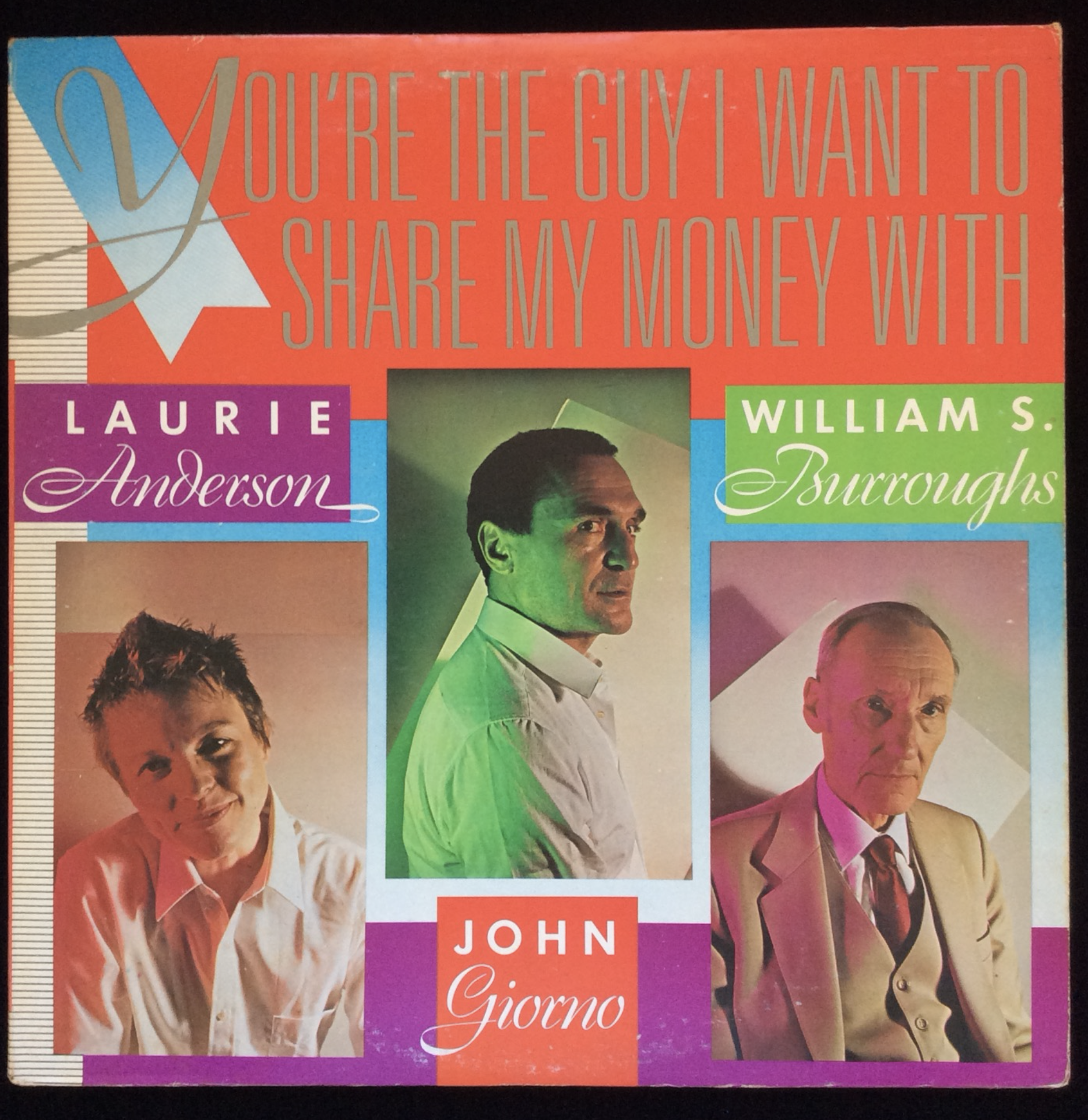
You're the Guy I Want To Share My Money With


Laurie Anderson/John Giorno/William S Burroughs
You're the Guy I Want To Share My Money With
New York City, USA: Giorno Poetry Systems, 1981
Vinyl LP/Audio Cassette
Edition size unknown


A cassette and double LP released in 1981, with the CD following in 1993 (with inconsistent track listing across the three formats). The recording was the tenth release from the Giorno Poetry Systems, and the second to feature Giorno and Burroughs. It was was recorded during the "Red Night" spoken word tour of 1981. Most of Anderson's material came from her magnum opus United States, and live versions of some tracks, such as "It Was Up in the Mountains", would also be included in her later 5-LP release, United States Live. This was Anderson's first major album release predating her solo debut, Big Science, by a year.

Whereas many of the Giorno Poetry Systems LPs had covers designed by visual artists (Les Levine, Keith Haring, Gary Panter, Robert Williams, etc.), this record was designed by George Delmerico, the late art director for the Village Voice newspaper.

Anderson's contributions to the LP include "Born, Never Asked", "Closed Circuits", "Dr. Miller", "It Was Up In The Mountains", "For Electronic Dogs", "Structuralist Filmmaking" and "Drums." Burroughs' tracks include "Introducing John Stanley Hart; He Entered The Bar With The Best Intentions", "Progressive Education", "The Wild Fruits", "Mr. Hart Couldn't Hear The Word Death" and others. Giorno is represented by two longer tracks: "Completely Attached To Delusion" and the epic "I Don't Need It, I Don't Want It, And You Cheated Me Out Of It".

The LP was a multi-grooved record, so depending on where the needle landed on the record listeners would hear either an Anderson, Burroughs or Giorno track.


"I toured with William Burroughs and John Giorno in 1981 when our collaborative double album, You’ re the Guy I Want To Share My Money With, was released and I loved hanging out with them. This is when I learned to talk to audiences directly. Burroughs was a master of this. In his Thanksgiving Prayer, he recites a litany of American acts of violence, ignorance and hatred, and at the very end intones in his most condescending voice, “You always were a headache and you always were a bore.” This sudden and jarring use of “you” was shocking. I began to try it out in my own work: This is your captain. Have you lost your dog? It suddenly opened new realms. Jump out of the plane. There is no pilot. Language that could boss, instruct and command. I was suddenly in touch with the audience in a whole new way."
- Laurie Anderson


Saturday, November 13, 2021

Sylvere Lotringer, RIP


Sylvere Lotringer, the French born literary critic and cultural theorist who founded the journal Semiotext(e) died last week, at the age of 83. 

Lotringer was in an editorial collective with Georges Perec, played chess with John Cage and published books about David Wojnarowitz, Nancy Spero and Antonin Artaud. 

In 1978 he hosted The Nova Convention, a tribute to William S Burroughs that featured John Giorno, Laurie Anderson, Philip Glass, Frank Zappa, Les Levine, Patti Smith, John Cage, and others (see earlier post, here). Three years prior Lotringer organized the Schizo Culture event. 

As a professor at Columbia for 35 years, his students included filmmaker Kathryn Bigelow, art critics Tim Griffin and John Kelsey, and poet Ariana Reines. 

He appears as a fictionalized version of himself in Kathy Acker's Great Expectations and My Mother: Demonology, in Eileen Myles' Inferno, and in I Love Dick, Alien & Anorexia and Torpor by Chris Kraus, his wife. He was portrayed by Griffin Dunne in the recent TV adaptation of I Love Dick. 

Lotringer died on Monday in Baja California, after a long illness.


"A sizeable portion of young artists are critical of the art institutions, and of the kind of life they offer, but do they really want to change the way their own world is being run? At this point it is being handed down to them ready-made and they struggle to fit in it as best they can. Today’s art world embodies all the excesses of private enterprise and the neo-liberalist economy. Whether or not the global acceleration and fragmentation that we are experiencing can be resisted is a moot question. Technological progress comes to us as a by-product of the military industry, and it seems to be irreversible. Resistance is preempted from the start and invoking it is at best a kind of mantra, a stance-a “resist-stance”-meant to assuage the general sense of powerlessness. Although Foucault indicated that every power relation is reversible, in Discipline and Punish he himself only mentioned the word “resistance” once, and without specifying it. There’s no such thing as resistance in general. One always resists something. When power is diffused throughout the entire society, everything becomes reversible and ambivalent. There is no easy way out. The question would be how could artists invent forms of resistance that would be specific to art, but not limited to it? Let’s take the example of Duchamp. He resisted the gallery system and came up with the idea of the ready-made. The ready-made was an active response to his own environment. Getting art out in the world, turning the world into a gallery. It was an impertinent idea. This was what Dada’s strategy was about. It was the end of gallery art. But the system jumped back and turned this iconoclastic idea into another fetish. The entire American art sprung out of this idea. It may not be what Duchamp had in mind, but this is what his idea became. It changed the way art was being made, but it also gave the art gallery system a new boost. The irreverent gesture was made reactive. That may explain why Duchamp stopped making art and became the “thin” artist, an artist who doesn’t make art. He was regaining the initiative and thumbing his nose again at the art world and its system of value. It was a disappearing act, but an act all the same. He kept his studio empty, and worked in his studio next door. Whether he actually stopped making art or not is irrelevant. He kept making art in his own terms. The end of art had already happened, but it took another half century to become a reality. The gallery system was a dead end, but it became all the more powerful for all that. Duchamp’s real art was staying below the radar. It was the art of resisting."


Tuesday, June 1, 2021

Andy Warhol | The Thirteen Most Wanted Men (Dossier No 2357)


Andy Warhol
The Thirteen Most Wanted Men (Dossier No 2357)
Paris, France: Sonnabend Gallery, 1967
27 × 18 cm.
Edition size unknown


Andy Warhol reportedly only produced a single public artwork in his lifetime, and it was on display for less than forty-eight hours. 

New York State Governor Nelson Rockefeller had invited architect Philip Johnson to design the New York State Pavilion for the 1964 New York World’s Fair. Johnson identified ten then-nascent artists and commissioned them to produce works to adorn the exterior of the Pavilion’s circular Theaterama: Peter Agostini, John Chamberlain, Robert Indiana, Ellsworth Kelly, Roy Lichtenstein, Alexander Lieberman, Robert Mallary, Robert Rauschenberg, James Rosenquist and Warhol. 

Lichtenstein contributed a laughing comic-strip woman leaning out a window, Rauschenberg created a collage of 1960's American history featuring President Kennedy called Skyway,  Kelly paired large curved monochromatic forms, and Indiana contributed a blinking sign that read “EAT.” 

Warhol proposed something a little more controversial. 

John Giorno attributes the idea to painter Wynn Chamberlain, who was dating an NYPD officer at the time. Chamberlain was said to have provided Warhol with a large envelope filled with various archival crime photographs and mug shots. 

Warhol elected to enlarge thirteen of them, which were silkscreened onto square Masonite panels, and tiled together. The work was installed on April 15, 1964, and triggered numerous objections. It was painted over two days later, before the event had opened. 

Press reports from the time initially suggested that Warhol was dissatisfied with the installation but it was later revealed that Rockefeller - no stranger to censoring artists - himself had demanded the work be removed. In addition to the piece featuring thugs and criminals (a baby killer among them) seven of the men were Italian and the governor balked at alienating that community while running for re-election. 

A 2014 exhibition commemorating the saga featured a telegram from Warhol to the NY State Dept of Public Works,  giving permission to paint over the canvas:

Gentlemen:

This serves to confirm that you are hereby authorized to paint over my mural in the New York State Pavilion in a color suitable to the architect.

Very truly yours,

Andrew Warhol

Other accounts cite Warhol's choice of silver paint being related to his tin foil and mirror covered walls at the Factory, which he was putting together at the time. 

Warhol also produced a replacement for the mural, 25 identical Masonite panels each depicting the smiling face of World’s Fair President Robert Moses, who was likely to have been thought of as the main censor to the project at the time. It was never installed and its whereabouts are currently unknown. 

A couple of years later he revisited the 13 Most Wanted screens, using them to produce a series of diptych paintings on canvas, which were exhibited at the Sonnabend Gallery in Paris. This publication - rare enough to not be included in the multi-volume catalogue raisonné - is from that exhibition. It includes six loose leaves featuring exhibition documentation, a text by Otto Hahn and a silkscreen portrait of Most Wanted Men No. 11, John Joseph H., Jr.

Warhol enjoyed a good double-entendre and the use of the word "Wanted" in the title undoubtedly referred not only to the criminals' fugitive status, but also their desirability and potential to be seen as 
heartthrobs. A later work,  the screen test film The Thirteen Most Beautiful Boys - makes the connection clearer. 

Morrissey carried this torch forward, with his use of vintage portraits repurposed as album cover art and band shirt graphics, as well as his glamorization of criminals such as the Kray Twins. 


Note: Robert Indiana's project was also 'censored' from the fair shortly after it opened. Apparently his EAT sign was misconstrued by fair goers as an announcement that the building contained a food court. 


Friday, February 14, 2020

This Week on Tumblr: I Love


In the mid-seventies in New York City crime was at an all-time high and tourism at an all-time low. The New York State Department for Economic Development tasked Madison Avenue ad firm Wells Rich Greene to develop a marketing campaign that would counter the negative coverage of riots, blackouts, muggings, fires, the Son of Sam killer, garbage strikes, a drug and crime epidemic, and neighbourhoods that had fallen into a state of disrepair.

The resulting 1977 campaign included the Steve Karmen song "I Love New York" as a commercial jingle and a now-ionic log by Milton Glaser (previously best known for a psychedelic poster of Bob Dylan). The logo was conceived in a taxi cab, with "I  ❤ NY" scribbled in crayon in a single line, which later changed to the present stacked letters (which Glaser later admitted might have been "subliminally" influenced by Robert Indiana's LOVE), and the serif typeface American Typewriter.

The campaign was truly a labour of love, with Karmen relinquished his publishing rights for the song, and Glaser also working pro bono. “You want to do things like that, where you feel you can actually change things,” he said in a recent interview in The Believer.

The campaign was launched forty-two years ago today, on Valentine's Day, with TV commercials featuring eighty Broadway actors, singers and dancers performing the "I Love New York" theme song. Originally intended as a five-week campaign, it continues to this day. 

Glaser's original concept sketch (above, top) and presentation boards are currently in the collection of the Museum of Modern Art, New York.

The New York State Empire State Development, New York’s chief economic development agency, holds the trademark to the “I Love New York” logo, and licenses its use. It's estimated that sales of merchandise such as mugs and t-shirts emblazoned with Glaser’s design generates more than $30 million a year. The state fights to uphold its trademark with over 3,000 objections against imitators so far, and an average of 100 trademark objections and cease-and-desist letters filed yearly.

The works above presumably fall under fair use. They are by Cary Leibowitz, David Shrigley, Mark Pawson, Sarah Nasby, Jeremy Deller, Claude Closky, Ross Sinclair, Adam Rolston and Ugo Rondinone (about Gertrude Stein, Andy Warhol, John Giorno, John Cage, Claude Closky, etc.)


Thursday, February 6, 2020

John Giorno | LIFE IS A KILLER


John Giorno
LIFE IS A KILLER
Paris, France: Cahiers d'Art, 2017
66 x 66 cm.
Edition of 75 signed, numbered and dated

An archival pigment print published by the gallery and publishing house that was founded in 1926 by Christian Zervos. The work was previously available, in a different colour scheme, in the boxed work POEM PRINTS from 1991 (see post, here).

The legendary Dial-A-Poet, Performance Artist, Activist and star of Warhol's Sleep died of a heart attack in October. Life is A Killer is the on the cover of the current Artforum magazine.

Wednesday, September 5, 2018

The John Giorno Band | I'm Rock Hard


The John Giorno Band
I'm Rock Hard
New York City, USA: Red Bull Arts, 2017
2 12" vinyl LPs
Edition of 200 signed copies

Released in collaboration with the Vinyl Factory, this double-LP features nine tracks from between the years 1982 and 1989, including Scum & Slime (1985); Stretching it Wider (1982); Life is a Killer (1982); Sucking Mud (1986); Exiled in Domestic Life (1983); It’s a mistake to think you’re special (1989); I gambled with my anger and lost (1983); The Strength of Pleasure (live) (1984); and Stretching it Wider (live) (1982).

It's available here, for $120 US.