Showing posts with label Steve Reich. Show all posts

Thursday, August 13, 2026

Steve Reich | Early Works


Steve Reich
Early Works
New York City, USA: Nonesuch, 1987
12” Vinyl LP
Edition size unknown


Early and influential tape-loop phase works including “Come Out”, "Piano Phase”, "Clapping Music"
and "It’s Gonna Rain.”


"I could easily talk for several hours just about this. It was particularly this piece called ‘It’s Gonna Rain’ that I heard with my friend Peter Schmidt, the painter. I’d met Peter while I was at art college and he was a very, very distinctive and unusual character. He was a German Jew who’d come over to England in the ’30s and was a very good poker player because it was impossible to know what he was thinking. He was a very inscrutable person. Most people found it very hard to be with him as you’d say something to him and he’d just look at you. But I liked him a lot and we got on very well, and it turned out we’d been thinking about a lot of similar things. One of the things we used to do was sit around at his place in Stockwell and explore new music. Generally it was he who would play things to me and one day he said, "Have you heard this?" and my life changed.

The first thing that happens when you’re listening to that is that the repetitive element of it gradually makes you start to lose focus of the pieces that keep repeating. You start hearing the little differences. It’s a little bit like the way a frog’s eye works. It doesn’t scan like ours do, it stays fixed on a scene and very quickly the rods and cones get saturated with everything that doesn’t move. So as soon as something does move, like a fly, that’s the only thing that the frog sees. I think the ears behave like that when they’re presented with something highly repetitive like this. Your ears quickly saturate or habituate with the common stuff and they start to pick up details. I remember the first time I heard ‘It’s Gonna Rain’, I started to zone in on the pigeons, because this was out in the street, it was a recording of a street preacher so you can hear cars and horns and then you start to hear these birds but only after a while, after the other stuff has cleared out of your consciousness. That’s amazing because what was making the music was my brain and that was the first time I’d realised that, as a composer, you could co-opt a listener’s brain. So suddenly, wow, that’s another 100 per cent of the universe opening up.

When you put something out into the world that is kind of incomplete and it takes your consciousness and the errors of your perceptual mechanism to actually make it into something, that totally changed my idea of what music could be. The actual amount of material used is tiny, the loop of "it’s gonna rain" is not even a second, and that’s the only element used in that section. You think, bloody hell, that’s economy, and I’ve always loved economy. At the time I first heard this we were in a period of maximum indulgence in pop music. Sixteen-track recorders had just appeared so suddenly so many people were just putting so much shit onto everything just because you could. Every spice in the cupboard. Suddenly I heard this and it was so stark and effective. The other thing about it is that within it is a mechanism that I’ve subsequently used a lot, which is the idea of having things running out of sync with each other. Again, your whole experience of music until then had been to do with synchronisation. Everything sticks together and then at this point everything changes together. What happens in this piece is that you get the same cycle but running so that on each repetition they’re in a slightly different place in relation to each other. So you have an automatic generator of variety and I use that on so much of my work. That became my go-to technique for making something interesting straight away.”
- Brian Eno


Monday, January 5, 2026

Steve Reich | Writings About Music


Steve Reich
Writings About Music
Halifax, Canada: NSCAD Press, 1974
80 pp., 19 × 24 cm., softcover
Edition size unknown


"Writings About Music is the first book by one of the most important and innovative composers working today. Steve Reich investigates the relation of Western composers to non-Western music, especially Balinese and African, and gives a musical analysis of some African music made during the composer’s visit to Ghana in 1970. He discusses the relation of music to dance both in our culture and in others and the development of his own music from the early tape pieces of the 1960’s to the instrumental pieces of the 1970's, stressing his movement away from electronics and towards live music. Writings About Music is fully illustrated with musical examples and photographs. It includes a list of works, important performances and recordings."
- publisher’s statement


Sunday, February 2, 2025

Moondog Yearbook 1


Moondog [Louis Thomas Hardin; June Hardin]
Moondog Yearbook 1
New York City, USA: Moondog Management, 1967
28 pp., 8vo., softcover
Edition size unknown


Moondog (born Louis Thomas Hardin) was an American composer, musician, theoretician, poet,  inventor and street performer, best known for his distinctive Viking garb, which included a horned helmet and cloak. 

His self-taught compositions drew from jazz, classical, Native American and Latin American music and would later influence composers of minimal music, such as Steve Reich and Philip Glass.

An accident involving explosives left him blind at the age of 16. 

In 1943, he moved to New York, where he met Leonard Bernstein, Arturo Toscanini, Charlie Parker and Benny Goodman. A few years later he adopted the name "Moondog" in honor of a dog "who used to howl at the moon more than any dog I knew.”

He eared a living busking, performing music and poetry, and by selling records and booklets such as this rare title. 

Moondog Yearbook 1 is exceedingly scarce, and information about it is inconsistent. I have seen it listed as having twenty-eight pages, sixteen pages and twelve pages. I’ve seen it described as being self-published, issued by Shoestring Press or Moondog Management. The date is sometimes 1967, other times ’68. 

If a Volume 2 ever existed, I can’t locate it.


Wednesday, January 11, 2023

Michael Snow Tribute #14


When Michael Snow died last Thursday I felt compelled to amass as many of our books, records, CDs, videos and bits of ephemera of his that I could unearth in the house. This involved going through six different book shelves, three different storage spaces for records and countless archival (and non-archival) boxes where I store things like this. Subsequently I've spend the last few days trying to return the items, or shovelling snow as I've taken to calling it*. 

Tomorrow will conclude the week of tribute posts. It took a while for obituaries to appear, but here are a few: 


“…I was just over 30 when we made the documentary about him. It's a summation in many ways, or an extension, of the work I was doing at the AGO in 1994-1995, organizing screenings, performances and public talks as part of The Michael Snow Project.  It was a really amazing time. I can’t overstate how singular the scale of the project was – major exhibitions at the AGO and The Power Plant, four companion publications (one that I edited), Walking Woman banners designed by Bruce Mau’s studio throughout the downtown core, and complementary exhibitions and programs in various corners of the city from City Hall to the Glenn Gould Studio. All for one living artist. It’s something that we aren’t likely to ever see again."
- Jim Shedden, Manager of Publishing at the Art Gallery of Ontario


"Concurrent with his filmmaking, Snow continued to work across various media, as exemplified by the 1974 artist’s book Cover to Cover, which can be read forward or backward, and his 1987 album The Last LP, which purported to contain field recordings of vanishing ethnic musics but in fact comprised multitracked fragments composed and performed by Snow. His 1979 Flight Stop, a flock of fiberglass geese in flight created from many photos of a single goose, remains on view today at Toronto’s Eaton Centre, with which it is inextricably identified; other public works include The Audience, 1989, a group of over-life-size sculptures of celebrating people painted gold at Toronto’s Rogers Centre; and The Windows Suite, 2006, a series of plasma screens on a downtown Toronto hotel showing “impossible” sequences.

Considered by many to be Canada’s most important artist, Snow is represented in the National Gallery of Canada by seventy-five works; he was made an Officer of the Order of Canada in 1981 and promoted to Companion in 2007 for his contributions to cinema. He has enjoyed retrospectives at multiple venues in Toronto and at the British Film Institute; his work was included in the reopening exhibitions at the Centre Pompidou, Paris, in 2000, and the Museum of Modern Art, New York in 2005.

Though he worked in a broad range of media, Snow’s own source of inspiration was not external but internal. “Cross-media pollination . . . doesn’t happen to me,” he told the National Gallery of Canada in 2014. “I have ideas, and the wish to attempt something; I muse about it, sometimes for a long time, and then finally ‘attempt’ it.”"


"Michael Snow was born in Toronto in 1928. He attended the Ontario College of Art and initially started out in the world of advertising design. Dissatisfied with his job, he went hitchhiking in Europe and then embarked on a career as a professional musician. He played in jazz clubs in Canada at night; during the day, he created paintings in his studio.

In 1961, he and his wife, the artist Joyce Wieland, moved to New York. Early on, he showed with Poindexter Gallery, the same space that also represented abstractionist painters like Jules Olitski and Willem de Kooning. But it was his ties to the New York film world that ultimately brought him fame.

Under the aegis of Jonas Mekas, Snow was able to screen his works for crowds that included artist Nam June Paik and filmmaker Shirley Clarke. It wasn’t until he screened Wavelength at a festival in Belgium and won the grand prize for it that he realized the following his work had gained."


*Groan at the pun all you like, but note that the purple invite at the bottom right is for a show called Fresh Snow. See also, Weather Report


Saturday, December 4, 2021

Alison Knowles and Pauline Oliveros | Postcard Theater


Pauline Oliveros (w/Alison Knowles)
Postcard Theater
New York City, USA: Aenjai Graphics, 1974
[6] pp., 10.5 x 14.5 cm., loose leaves
Edition size unknown


When Terry Riley's classic minimalist composition In C was performed for the first time in 1964, the composer and accordion player Pauline Oliveros was the only woman in the ensemble, performing alongside Riley, Steve Reich, Jon Gibson, Stuart Dempster, Morton Subotnick and Warner Jepson. The performance is regularly referred to as "seminal". 

Six years later, Oliveros contributed an article to the New York Times titled And Don't Call Them ‘Lady’ Composers, where she writes:

"Why have there been no “great” women composers? The question is often asked. The answer is no mystery. In the past, talent, education, ability, interests, motivation were irrelevant because being female was a unique qualification for domestic work and for continual obedience to and dependence upon men."1

Three years later after that she found herself having to make her point more clearly. For an article titled Divisions Underground2 for the Numus West journal3, Oliveros asked the question as a headline: "Why Haven't Women Composed Great Music?". A second headline counters: "Why Do Men Continue To Ask Stupid Questions?"

The article can be seen as a precursor to the Postcard Theater pieces she would produce a year later, both in its use of epithets and imagery. Accompanying the article is a photograph of a bust of Beethoven in a beret, his lipstick smeared. Following this is a list of over a hundred terms one might use to describe a woman: hooker, lady, queen, lesbian, girl, mother, daughter, bitch, harlot, nanny, gal, old maid, bridesmaid, matron, granny, old hen, etc. 

Beethoven Was A Lesbian was the first work Oliveros produced in the Postcard Theatre series. It features a black & white image of Oliveros sitting in a garden, reading. The book is the 1945 novel by Charles Williams It’s All Hallows’ Eve in which two deceased women roam around London. There's a scowl on Oliveros' face and to her right, another bust of Ludwig van Beethoven, this one seemingly made of papier-mâché. The card is captioned with the title. 

An additional five cards were made in collaboration with Fluxus artist Alison Knowles4. The artists both appear in the work, as do Knowles' twin daughters, alongside captions which make use of gendered and racist denigrating terms. 

Brahms Was a Two-Penny Harlot features Knowles at the beach and Oliveros with a toy dagger, both as children. Mozart was a Black Irish Washerwoman features Oliveros at the Zoo, atop an elephant.5 An image of Jessie Higgins with a flower is used for the Bach Was a Mother card. Chopin is domesticated with dishpan hands, with an image of Hannah and Jessie Higgins playing in Roaring Brook.5

By reframing famous male composers as marginalized figures (women, mothers, lesbians, Black, Irish) Oliveros and Knowles use a reimagined history to address unpleasant realities. 

Postcard Theater was reissued as a zine by Editions Acquaviva, Berlin, Germany, 2013 (see following post).


"My first postcard theatre in the 70s was a comment on the outsider status of women in the music world. Branding Beethoven as a lesbian was a way of turning the tables on the music establishment. I sent the card out to friends and to Alison Knowles. I invited her to join me in making a series of postcards that attribute epithets usually aimed at women to other composers of the traditional canon (...) this was a time about raising consciousness about women in music." 
- Pauline Oliveros


1. Decades later ex-Pixies player Kim Deal was asked when promoting her new band The Breeders (with Tanya Donnelly from Throwing Muses and Josephine Wiggs from Perfect Disaster) why there was a lack of female performers in indie rock. She replied "Women don't need to play in a band to get laid."

2. Both And Don't Call Them ‘Lady’ Composers and Divisions Underground can be found reprinted in the excellent Oliveros anthology Software For People: Collected Writings 1963 - 80

3. Canadian readers will find much to enjoy in this text, in which Oliveros writes about celebrating Juneteenth in Banff on the way to a teaching gig in Toronto (or "stick standing in the mud" or "the meeting place in Huron"). She describes walking in the Yonge Street mall as akin to John Cage's Theater Piece

4. Knowles, too, was aware of the lack of representation of women in the arts and shortly after this collaboration produced Womens Work with Annea Lockwood, and included Oliveros alongside Nye Ffarrabas, Simone Forti, Christina Kubisch, Ann Noël, Takako Saito, Carolee Schneemann, Mieko Shiomi, and many others. Primary Information reissued it two years ago in an edition of 1500 copies, and it is already sold out

5. The image would later be used as the cover graphic for Oliveros' 1984 LP The Wanderer

6. Hannah and Jessie Higgins are the daughters of Alison Knowles and Dick Higgins, who ran the Something Else Press together. Hannah Higgins is the author of Fluxus Experience, published in 2002 by the University of California Press and The Grid Book, which was published by MIT Press in 2009.


Sunday, October 10, 2021

Steve Reich | Conversations


Steve Reich—who celebrated his 85th birthday a week ago today—will release a new book in March of next year, titled Conversations. Published by Hanover Square Press (a subsidiary of Harper Collins), the volume will include interviews with "collaborators, fellow composers, musicians, and visual artists influenced by his work, to reflect on his prolific career as a composer as well as the music that inspired him and that has been inspired by him." These include Richard Serra, Radiohead's Jonny Greenwood, Kronos Quartet's David Harrington, Stephen Sondheim, Nico Muhly, Brian Eno, Elizabeth Lim-Dutton,  Micaela Haslam, Anne Teresa de Keersmaeker, and many others. 

Dust jacket blurb accolades include "a surprising, enlightening series of conversations that shed new light on the music and career of 'our greatest living composer'" (The New York Times) and "Through this series of insightful, wide-ranging conversations starting from his student days to the present pandemic, we gain a compelling glimpse into the mind of 'the most original musical thinker of our time'" (The New Yorker). 

The title is due to be released on March 22, 2022 and is available for pre-order now. 

Sunday, December 30, 2012

Aspen Magazine – Art/Information/Science (#8)


Dan Graham (editor)
Aspen Magazine – Art/Information/Science (#8)
New York City, USA: Aspen Communications Inc., 1970
28.5 x 28.5 cm
Printed folder containing fourteen numbered items

Aspen #8 is often referred to as “The Fluxus Issue”, presumably because George Maciunas was responsible for the design. Though, other than Maciunas, the only artists involved with the publication who were active in Fluxus were Jackson MacLow and La Monte Young, who contributed the recordings on the flexi-disc. MacLow’s Young Turtle Assymetries, chance-generated poems for five simultaneous readers, was the A-side, backed with Young’s Drift Study 31 1 69.

The folder also included a poster version of Ed Ruscha’s Thirty-four Parking Lots, a text by Robert Smithson, and scores by Eleanor & David Antin, Philip Glass and Steve Reich. Other featured artists included Dennis Oppenheim, Richard Serra, Robert Morris, and Yvonne Rainer.

Thursday, July 5, 2012

Steve Reich and Radiohead


Steve Reich talks about his forthcoming project based on Radiohead's songs Everything In It's Right Place from Kid A and Jigsaw Falling Into Place, from In Rainbows, at Pitchfork, here.

Thursday, April 26, 2012

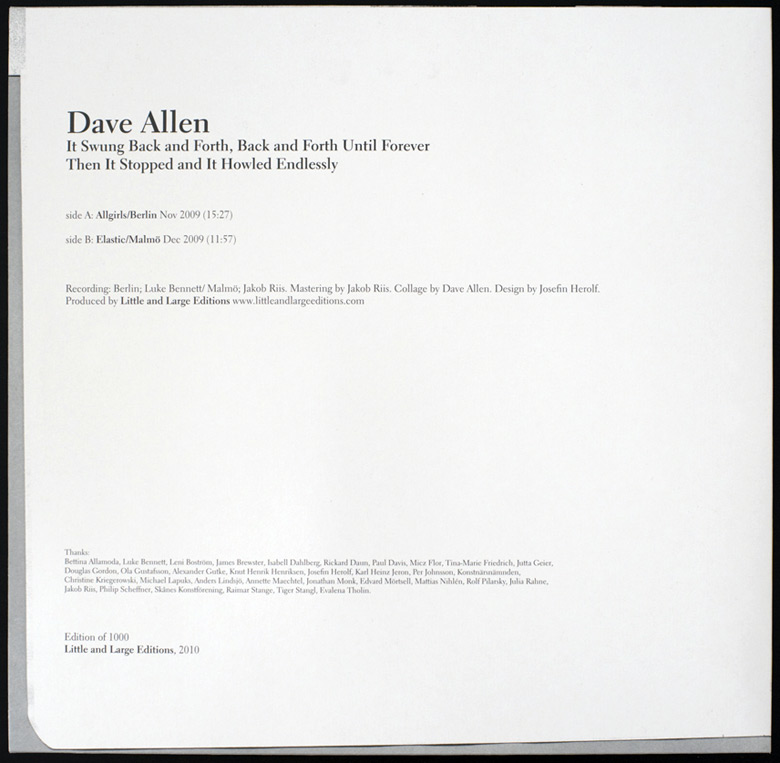
Dave Allen | It Swung Back and Forth, Back and Forth Forever, Then it Stopped and it Howled Endlessly


Dave Allen's It Swung Back and Forth, Back and Forth Forever, Then it Stopped and it Howled Endlessly is available from www.littleandlargeeditions.com/editions.html.


Below is the original handwritten score, from Reich's book Writings About Music (1974, the NSCAD Press) and Sonic Youth's Lee Ranaldo performing (with Alan Licht et al) the original Reich piece. Ranaldo lives in the same building as Reich and counts him as a major influence. Sonic Youth recorded a version of the work for their 1999 double LP SYR4: Goodbye 20th Century.


Tuesday, March 20, 2012

Lee Ranaldo | Torn Photograph (for SR and RS)


Black Box was released as an edition of 150 in October 2000, to coincide with Sonic Youth's weeklong stint at the Ystad Festival in Sweden. 100 copies were made available for sale, and 50 copies were set-aside for the participants. Priced at $500, the box contained a variety of sound and visual art projects, most of which were exclusive to the set.

"They will be real rarities", said Ystad Kontsmuseum director Thomas Millroth, in advance of the release. "The reason we don't press larger quantities is that we don't want to compete with the record companies. This is an artistic 
edition."

The contents included Thurston Moore’s fanzine What I like About Feminism, Kim Gordon’s VIP museum discount card, a five-track CD by Jim O’Rourke, a sixty-two minute CD and a 7” single by the band accompanied by tenor sax player Mats Gustafsson, prints by Carl Fredrik Reuterswärd, Sven-Åke Johansson, Clara Hall, Frauke Eckhardt, and David Stackenäs, a silhouette cut-out by Leah Singer (from her series of works utilizing discarded rubyliths that she saved while archiving the photographic collection of the New York Daily News) and various other artworks.

Lee Ranaldo’s visual contribution was a ripped photograph in a glassine envelope, called Four Organs (Torn) and later retitled as Torn Photograph (for SR and RS). The piece conflates works by two of Ranaldo’s favorite artists – Robert Smithson and Steve Reich. The original Smithson work was itself created for a boxed collection, the 1970 Multiples Inc. Artists& Photographs project, which featured nineteen contemporary artists, including Mel Bochner, Jan Dibbets, Dan Graham, Bruce Nauman, Robert Rauschenberg, and Ed Ruscha. Smithson's contribution, entitled Torn photograph from the 2nd stop (Rubble), was a snapshot of rubble, ripped into four square pieces, and presented in a glassine envelope.

In that same year, Reich’s Four Organs was first performed, at the Guggenheim Museum in New York City, on four Farfisa mini compact organs. The performance was recorded and released as an LP with a cover by Michael Snow, later that year.


Ranaldo recounts the origins of his work in an interview I conducted with him in October of 2011 for Magenta Magazine:

LR: [Steve] Reich’s Four Organs piece was very important to me when I first moved to New York. We were listening to his early tape pieces like Come Out and It’s Gonna Rain, but Four Organs just absolutely blew me away. When we moved into our apartment in 1995 I knew that Steve and Beryl lived there and I was in the basement one day – the building has this gigantic, really labyrinthian basement and everyone has a storage locker – and found, literally right outside of our locker, a big pile of musical gear, which I photographed because it looked interesting. Well, it turned out to be all of Steve’s stuff, and the four organs there were the four organs. So I took some more pictures, specifically of the organs and just had them laying around. At some point, I saw the Smithson torn photo and I thought it would be cool to pay homage to both of these people in one work.

The version that Paul + Wendy Projects has available came from a residency we were doing in Sweden in 2000 where they wanted to create a compilation boxed work of multiples called Black Box. I sent them a digital file for the work and the dimensions were wrong and they made a Spinal Tap ‘Stonehenge’ version out of it, considerably smaller than the Smithson piece that it was supposed to mimic! I finally had it printed myself at the correct size, in an edition of ten, a couple years later. Leah, for an anniversary present a few years ago, managed to find and buy one of the original Smithson pieces for me. I have them framed identically and when the Sonic Youth Sensational Fix show happened, we displayed the two works side by side, which was really cool.


Lee Ranaldo’s first song-oriented solo record, Between the Times and the Tides, is available today (on vinyl and CD) from Matador Records.


.