Showing posts with label Jonas Mekas. Show all posts

Sunday, February 23, 2025

Jonas Mekas | Artist’s Book


Jonas Mekas
Artist’s Book
New York Ciyy, USA: Onestar Press, 2003
144 pp., 22.5 x 14 cm, softcover
Edition of 1000


This 2003 title functions as a kind of scrapbook, filled with postcards, notes, drawings, and letters that the artist received over the years from friends such as Patti Smith, Allen Ginsberg, Paul Sharits, Michelangelo Antonioni, Joan Crawford, and others. 

Artist’s Book is published in an edition of 1000, with 200 copies signed, dated and numbered by Mekas. 


Saturday, July 6, 2024

Jonas Mekas | I Had Nowhere to Go


Jonas Mekas
I Had Nowhere to Go
Newfane, USA: Black Thistle Press, 1991
470 pp., 1.5 x 5.5 x 8.2", softcover
Edition size unknown


"I’m ashamed of how much space in my diaries I am giving to what we eat," writes Jonas Mekas in I Had Nowhere to Go, which covers the filmmaker's diaries from 1944 to 1955, " I know many a reader will put me down, because of that. But that is the reality of our lives, these days. You try to stick to the spirit, but the stomach wins."

This passage speaks both to the daily struggle for survival, with the rations supplied by International Relief Organizations being woefully insufficient, and also that the artist imagined himself writing for an eventual audience. It would be 47 years before the diaries were published.

The first entry is dated July 19th, 1944 - a year and six weeks before the end of the war. Mekas is twenty-two and aboard a train with many other refugees, fleeing Lithuania. His train is soon stopped in Germany and he and his brother Adolfas are imprisoned in a Nazi labor camp in Elmshorn for eight months. They eventually escaped but were detained near the Danish border where they hid on a farm until the end of the war. Mekas then lived in displaced person camps in Wiesbaden and Kassel.

He studied philosophy at the University of Mainz from 1946 to 1948, and before emigrating with his brother to the U.S. in 1949. They settled in Williamsburg, Brooklyn. He bought his first Bolex 16mm camera with borrowed money just two weeks after he arrived in New York, inspired by the avant-garde films he had seen at Amos Vogel's Cinema 16 film society.

In 1954, he and Adolfas founded Film Culture magazine. Later he would write an influential column for the Village Voice and start Anthology Films, one of the world’s largest and most important repositories of avant-garde film. He would collaborate with artists such as Andy Warhol, Nico, Allen Ginsberg, Yoko Ono, John Lennon, Salvador Dalí, and Fluxus impresario George Maciunas (a fellow Lithuanian).

The filmmaker's diaries begin with a year's worth of entries before he even mentions cinema: in October of 1945 he goes to see Charlie Chaplin’s The Goldrush. In 1947 he writes: “Everybody’s signing up for Canada. Mostly they are looking for tailors, shoemakers, professions like that. It’s enough to know how to sew a button on-you are hired. No requests for poets yet.”

In an entry from December 30th, 1951, Mekas tells a fable about a man who wishes to know what's at the end of the world and sets out on a multi-year long journey, only to discover nothing more than a pile of rabbit excrement. Twenty years later the same story would be recounted in the unfinished film The Rabbit Shit Haikus, extending the tale to follow the man's return home, where no one believes him.

Author, poet and film critic Phillip Lopate praised the diaries, noting the "aching honesty, puckish humor and quiet nobility of character." "I was enormously moved by it," wrote Allen Ginsberg.

Twenty-five years after it's publication, and sixty-one years after it's completion, Douglas Gordon has adapted the book into a film, which mades its North American debut at the Toronto International Film in 2016. The feature-length film (97 minutes) contains only ten minutes of visuals. The rest of I Had Nowhere to Go: Portrait of a Displaced Person features a black screen, with the accompanying audio tasked with telling the story. It is narrated by Mekas, 93 at the time.


Monday, May 20, 2024

Jonas Mekas | Just Like a Shadow


Jonas Mekas
Just Like a Shadow
Göttingen, Germany: Steidl, 2000
172 pp., 11.2 x 8.5”, hardcover
Edition size unknown


"Jonas Mekas's collection of film snippets is loaded with images of the famous -- like Jacqueline Kennedy Onassis and Caroline Kennedy, and John Lennon and Yoko Ono at their Montreal 'bed-in' -- but these are not conventional portraits. In JUST LIKE A SHADOW, sequences of three or four film frames, often sliced randomly midframe, are presented with sprocket holes and scratchy optical soundtracks intact. Mekas's images are jerky with movement, either washed out or underexposed, and seemingly shot from the hip, but all have a feeling of spontaneity and the immediacy of life. Norman Mailer's quizzical, pained expression is juxtaposed against the American flag; the ailing but indomitable George Maciunas, the founder of the Fluxus art movement that links many of the subjects in the book, is shown smiling in his hospital bed. There is a marvelous sense of intimacy to Mekas's art of simply filming experience: a sequence of his young son vying with a large ginger cat is an ephemeral yet timeless moment. 'My film work is one long film which is still continuing,' Mekas says in an interview with Jerome Sans. 'I don't really make films: I only keep filming. I am a filmer, not a filmmaker.'"
- The New York Times


Wednesday, August 16, 2023

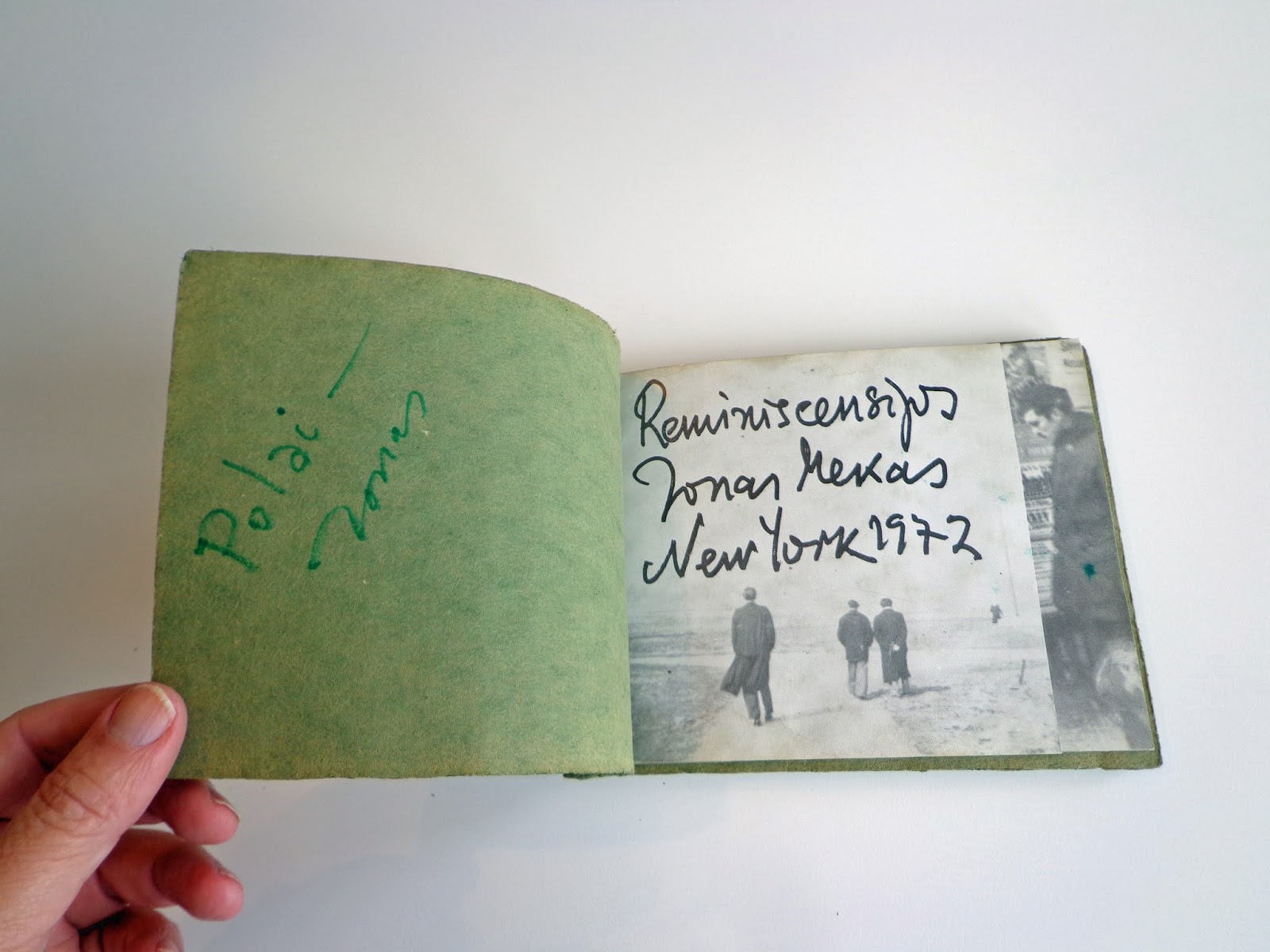
Jonas Mekas | Reminiscensijos (Reminiscences)


Jonas Mekas
Reminiscensijos (Reminiscences)
New York City, USA: Self-published, 1972
[unpaginated], 14 x 19.5 x 3 cm., hardcover
Edition of 250 copies. 


An exceedingly rare Artists' Book by two of the most important Lithuanians in the 1960's and 70's art world. Jonas Mekas and George Maciunas were close friends, with the former living in one of the Wooster Street lofts that Maciunas had converted into artist's cooperatives (thus inventing SoHo in the process). Mekas also ran his cinemathèque and film archive out of the same Fluxhouse Coop. 

In 1972, he made a film about his first return visit to Lithuania, Reminiscences of a Journey to Lithuania.   While the text is in Lithuanian, based on the similar title and same year, it's safe to assume the bookwork (which features images of travel: train stations, luggage, etc.) is a companion piece. 

Some listings have this published by Fluxus, though it's not included in Jon Hendricks very comprehensive catalogue raisonné, Fluxus Codex. Accordingly, I'm going to view it as self-published by Mekas and designed by Maciunas.  

The design is quintessential Fluxus, from the typesetting to the unusual binding. The pages* are sandwiched between two planks of quarter-inch wood and held together with bolt, with a brass hinge. The cover features no title or author name, just the edition number, stencilled. 

The title is scarce and signed copies are typically offered for between $2000 and $2500 US. 


*The book is unpaginated, and the number of pages may vary from copy to copy, as Printed Matter list 48, the Getty 52, and Harvard 26. A copy offered by Sotheby's is also listed as having 52 pages. 


Thursday, January 24, 2019

Jonas Mekas


Lithuanian Filmmaker Jonas Mekas - often called "the godfather of American Avant-garde cinema" died yesterday, at the age of 96. Below is a quickly cobbled together bio.


Mekas was born on Christmas eve, in Semeniškiai, Panevėžys, in 1922. When he was 18, the Germans invaded Lithuania. He joined the resistance, typing out news stories sourced from BBC broadcasts and distributing them clandestinely.

Mekas attempted to flee the country in 1944, but he and his brother Adolfas were removed from their train, and were imprisoned in a Nazi labour camp near Hamburg. They escaped after eight months and hid on a farm near the Danish border for the remaining two months of the war. They then spent time in displaced persons camps.

The pair decide to emigrate, and briefly considered Canada (1947 Diary entry: : “Everybody’s signing up for Canada. Mostly they are looking for tailors, shoemakers, professions like that. It’s enough to know how to sew a button on-you are hired. No requests for poets yet”) before settling on Williamsburg, Brooklyn.

The brothers founded Film Culture magazine, which quickly became one of the most important American film journals of the time. The magazine published 79 issues between 1954 and 1996. Many issues are rare and valuable now, but PDF selections can be viewed at Ubuweb, here.

In November, 1958, Mekas became the first film critic for the Village Voice newspaper, with a column titled Movie Journal. “I went to see Jerry Tallmer, at the Village Voice, and I asked him why there was no regular movie column in his paper. He said, why don’t you do one? I said, O.K., I’ll have it tomorrow.” His goal was to “become a self-appointed minister of defense and propaganda of the New Cinema”, he wrote in a recent reissue of these writings, “I couldn’t afford wasting any of my space writing on commercial cinema."

In 1962 Mekas founded the Film-Makers' Cooperative, and two years later the Film-Makers' Cinematheque, which eventually became Anthology Film Archives, one of the world's largest and most important repositories of avant-garde cinema, as well as a screening venue.

When the Film-Makers Cooperative screened Jack Smith's 1963 film Flaming Creatures (see post here), the police arrived, seized the film and arrested the projectionist on charges of obscenity. The Village Voice reported:

"Mekas, a founder and guiding light of the Film-Makers’ Cooperative, was not at the theatre at the time, but when he was notified of what was happening, he rushed down and demanded that he be arrested too. The police obliged.…"

His friends and collaborators included John Lennon and Yoko Ono, Salvador Dalí, Kenneth Anger, Allen Ginsberg, Jack Kerouac, William Burroughs, Nico, Jackie Kennedy (whose children he tutored), and Andy Warhol. “In my loft,” he told the Guardian, “Andy met film-makers and was inspired by them. That’s where he got the [filmmaking] bug. My loft was a gathering space for musicians, poets, film-makers.”

Mekas helped Warhol shoot the durational film Empire (1964), an eight-hour static view of the Empire State Building.

As a filmmaker, Mekas was awarded the Grand Prize at the Venice Film Festival in 1963 for a film called The Brig, about a military prison. Reminiscences of a Journey to Lithuania (1972) was added to the National Film Registry of the Library of Congress. Other films include Walden (1969), Lost Lost Lost (1975), Scenes from the Life of Andy Warhol (1990), Scenes from the Life of George Maciunas (1992), Letter from Greenpoint (2005), Sleepless Nights Stories (2011) and Out-takes from the Life of a Happy Man. In 2007, he produced a film a day, for 365 days, released on his website.

He is the author of over twenty books and his work has exhibited at galleries and museums around the world, including Serpentine Gallery, the Centre Pompidou, Musée d'Art moderne de la Ville de Paris, the Moderna Museet (Stockholm), PS1 Contemporary Art Center MoMA, Documenta of Kassel, the Museum Ludwig in Cologne, the State Hermitage Museum in St. Petersburg, and the Venice Biennale.

Saturday, September 10, 2016

Jonas Mekas | I Had Nowhere to Go


Jonas Mekas
I Had Nowhere to Go
Newfane, USA: Black Thistle Press, 1991
470 pp., 1.5 x 5.5 x 8.2", softcover
Edition size unknown


"I’m ashamed of how much space in my diaries I am giving to what we eat," writes Jonas Mekas in I Had Nowhere to Go, which covers the filmmaker's diaries from 1944 to 1955, " I know many a reader will put me down, because of that. But that is the reality of our lives, these days. You try to stick to the spirit, but the stomach wins."

This passage speaks both to the daily struggle for survival, with the rations supplied by International Relief Organizations being woefully insufficient, and also that the artist imagined himself writing for an eventual audience. It would be 47 years before the diaries were published.

The first entry is dated July 19th, 1944 - a year and six weeks before the end of the war. Mekas is twenty-two and aboard a train with many other refugees, fleeing Lithuania. His train is soon stopped in Germany and he and his brother Adolfas are imprisoned in a Nazi labor camp in Elmshorn for eight months. They eventually escaped but were detained near the Danish border where they hid on a farm until the end of the war. Mekas then lived in displaced person camps in Wiesbaden and Kassel.

He studied philosophy at the University of Mainz from 1946 to 1948, and before emigrating with his brother to the U.S. in 1949. They settled in Williamsburg, Brooklyn. He bought his first Bolex 16mm camera with borrowed money just two weeks after he arrived in New York, inspired by the avant-garde films he had seen at Amos Vogel's Cinema 16 film society.

In 1954, he and Adolfas founded Film Culture magazine. Later he would write an influential column for the Village Voice and start Anthology Films, one of the world’s largest and most important repositories of avant-garde film. He would collaborate with artists such as Andy Warhol, Nico, Allen Ginsberg, Yoko Ono, John Lennon, Salvador Dalí, and Fluxus impresario George Maciunas (a fellow Lithuanian).

The filmmaker's diaries begin with a year's worth of entries before he even mentions cinema: in October of 1945 he goes to see Charlie Chaplin’s The Goldrush. In 1947 he writes: “Everybody’s signing up for Canada. Mostly they are looking for tailors, shoemakers, professions like that. It’s enough to know how to sew a button on-you are hired. No requests for poets yet.”

In an entry from December 30th, 1951, Mekas tells a fable about a man who wishes to know what's at the end of the world and sets out on a multi-year long journey, only to discover nothing more than a pile of rabbit excrement. Twenty years later the same story would be recounted in the unfinished film The Rabbit Shit Haikus, extending the tale to follow the man's return home, where no one believes him.

Author, poet and film critic Phillip Lopate praised the diaries, noting the "aching honesty, puckish humor and quiet nobility of character." "I was enormously moved by it," wrote Allen Ginsberg.

Twenty-five years after it's publication, and sixty-one years after it's completion, Douglas Gordon has adapted the book into a film, which makes its North American debut at the Toronto International Film Festival tomorrow.

The feature-length film (97 minutes) reportedly contains only ten minutes of visuals. The rest of I Had Nowhere to Go: Portrait of a Displaced Person features a black screen, with the accompanying audio tasked with telling the story. It is narrated by Mekas, now 93.

The film premieres this Sunday, September 11, 2016, at 4:30pm. The book is still available from the publisher, here.