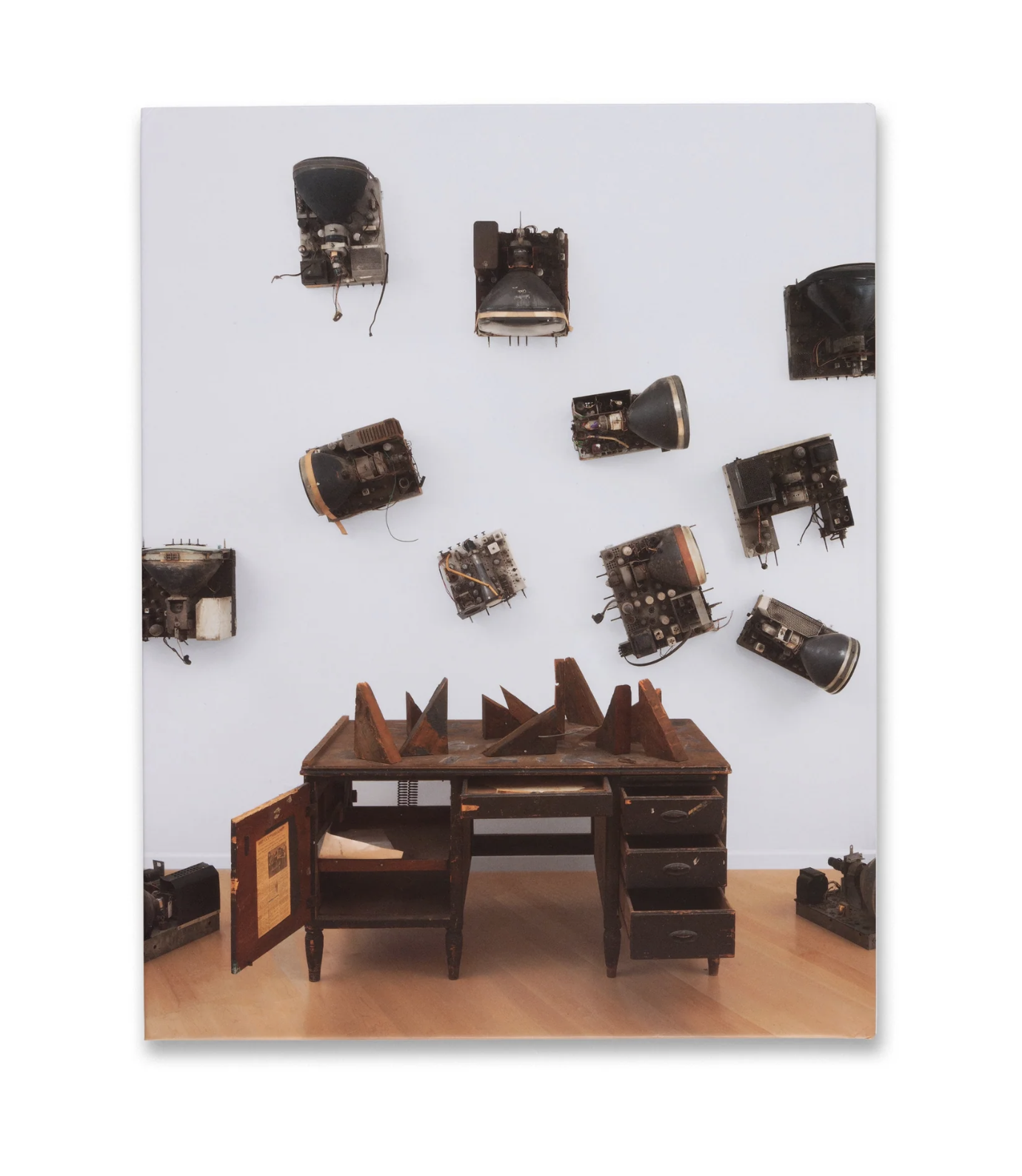
Nam June Paik died on this day in 2006, aged 73.
Showing posts with label Nam June Paik. Show all posts
Wednesday, January 29, 2025
Wednesday, December 11, 2024
Nam June Paik: Art in Process
[Nam June Paik]
Nam June Paik: Art in Process
Los Angeles, USA: Gagosian, 2022
180 pp., 23.5 × 30.2 cm., hardcover
Edition size unknown
Published on the occasion of the two-part exhibition of the same name, curated by John G. Hanhardt, this volume surveys Paik’s work and reflects on the artist’s working method and the ideas and materials that inspired his art practice.
As the title suggests, the book highlights the centrality of process across Paik’s career—from the manipulation of television sets in the early 1960s to live global satellite telecasts and large-scale video sculptures. It includes collaborations with Joseph Beuys and Charlotte Moorman.
Nam June Paik: Art in Process features essays by Hanhardt and Gregory Zinman, and extensive illustrations including numerous full-page plates and details, a foldout of the score for Paik’s Symphony for 20 Rooms (1961), as well as rarely seen archival photographs documenting Paik’s early performances by Peter Moore (1932–1993), dating from 1964 through 1977.
Friday, November 15, 2024
Joan Jonas | I Want to Live in the Country (And Other Romances)
[Joan Jonas] Susan Morgan
I Want to Live in the Country (And Other Romances)
London, UK: Afterall Books, 2007
112 pp., 8.5 × 6”, softcover
Edition size unknown
"In Joan Jonas’s 1976 video work I Want to Live in the Country (And Other Romances) the artist investigates a geography of displacement and irrefutable desires. The work veers constantly between two locations, the coastal landscape of rural Nova Scotia and a windowless New York City studio. Describing Jonas’s approach to video as a drawing tool, an endless mirror and a framing device, Susan Morgan takes us through the exterior and interior scenes that comprise this work and considers how Jonas has used performance and video since 1968 to explore ways of seeing, the inherent rhythms of ritual and the archetypal authority of objects and gestures.”
- publisher’s blurb
Yesterday it was announced that Joan Jonas was the eighth winner of the Nam June Paik Prize. The artist will receive KRW 50 million ($35,600 US) at a ceremony to take place at the art centre November 28th. A year from now, the institution will host an exhibition of Jonas' work, which will be the artist’s first solo show in Korea.
Saturday, July 20, 2024
Saturday, June 15, 2024
Nam June Paik | Television (ICA Edition)
Nam June Paik
Television (ICA Edition)
Cincinnati, USA: Carl Solway Gallery, 1990
61 x 61 cm.
Edition of 25 signed and dated copies
A silkscreen on canvas with added plastic elements and a TV antenna, with an estimated value of ten grand.
Wednesday, January 3, 2024
Joseph Kosuth and John Cale | Balzac's Solitude
Joseph Kosuth and John Cale
Balzac's Solitude
Cincinnati, USA: Solway Gallery, 1994
36 x 23 x 10 cm.
Edition of 12 signed and dated copies
Balzac's Solitude is a collaboration between one of the founding members of the Velvet Underground, and one of the earliest practitioners of Conceptual Art.1
The work consists of a leather-bound book housing a 144-note Reuge music box mechanism. Kosuth designed the work, mostly the inclusion of the quote from French novelist Honore de Balzac: “Solitude is fine, but you need someone to tell you that solitude is fine.” Cale composed the music.
He originally set out to create a low rumbling sound to be reproduced by the music box mechanism. When this proved impossible, he substituted an existing untitled composition he had written for a friend’s wedding. I haven’t heard it, but the LA Times described it as "a bland little piece of no particular distinction."
The work was created for the 1994 exhibition The Music Box Project, curated by Claudia Gould. Gould had co-founded Tellus Audio Cassette Magazine with Joseph Nechvatal and Carol Parkinson in 1983. When their audio periodical folded after a decade of activity, she revisited the idea of music boxes by artists, something originally conceived of as a fundraising edition for Tellus.
Other works in the show include Laurie Anderson's witty Tilt #1, which utilizes as a carpenter’s level. One of two short tunes by Anderson plays, depending on which ay the level is titled. The movement also activates either a bobbing boat or tiny floating balloon.
John Cage contributed Extended Lullaby, which features a dozen music boxes, each playing a fragment of a piece he composed for his partner Merce Cunningham's Dance Company a year before his death in 1992.
Kiki Smith transcribed a poem she wrote into Braille and then translated the raised patterns on the page into the pins of the revolving music box cylinder, creating a brief, atonal composition.
Other artists in the exhibition include John Armleder, Nam June Paik, Aminah Robinson and Haim Steinbach. David Byrne, Stevie Wonder, Peter Gabriel, and Glenn Branca all declined to participate.
1. Josuth Kosuth provided the cover graphic for John Cale’s live album, Fragments of a Rainy Season, two years prior. It also consisted solely of a quotation: two lines from Shakespeare’s Macbeth:
Banquo: It will rain tonight.
First murderer: Let it come down!
Tuesday, January 3, 2023
Willem De Ridder, RIP
Willem de Ridder died last week after a brief illness, on December 29th. The Dutch artist, anarchist, storyteller, publisher, composer, and "chairman" of Fluxus for Northern Europe was 83. His career stretched over seven decades, mostly avoiding the trappings of the art world (which has yet to publish an obituary for him).
De Ridder graduated from the Academy of Arts in Den Bosch, and shortly afterwards decided to stop painting. After meeting George Maciunas and Nam June Paik in the early sixties, de Ridder was invited to run the Fluxus European Mail-Order House.
"An enormous crate arrived by freight, delivered to my house," de Ridder told me in 2002. "There was a huge amount of things from Maciunas: suitcases, boxes, all kinds of work. I thought, "Shit, now I have to do something about it." So I arranged all the various editions beautifully and had a friend of mine take a photograph of the display. My girlfriend [Dorothy Meijer] at the time sat in the middle of display. The photo looked so great that I distributed it and made a catalogue of the work, which I also heavily distributed. It listed all of the Fluxus works for sale, with prices and a description. Of course, I didn’t sell anything. Not a single thing."
A recreation of the work (with a cardboard cut-out of Meijer) is now in the collection of the Museum of Modern Art, New York (above).
Together with Wim T. Schippers, de Ridder organized Dutch Fluxus festivals in 1963 and 1964 and, later, the Wet Dream Festival, the first international erotic film festival.
The latter was a spin-off from Suck: The First European Sex Paper, which he ran as part of the SELF group (Sexual Egalitarian and Libertarian Fraternity)1. Only eight issues were produced over a five year period of the periodical now called "an experimental amalgam of sexual liberation, feminist ferment, alternative visual culture, and literary ambition."2 De Ridder provided an office for the newspaper, and spearheaded the graphic design and artistic content, tapping his network for contributions by John Giorno, Valerie Solanas, Otto Muehl, Thomas Bayrle, Gunter Rambow, Ed van der Elsken, and others.
Previously, the artist had founded the music newspaper Hit Week, which published 32 issues between 1965 and 1969. He also co-founded the "counter culture" nightclubs Provadya and Paradiso.
“When I started at Paradiso, everyone could just jump on stage. And if you didn’t know what was going to happen, we didn’t either,” De Ridder recalled in 2018. “In no time it was packed and they came from all over the country.” The venue - operational for over fifty years - has hosted performances by Adele, Arcade Fire, David Bowie, James Brown, Nick Cave, Duran Duran, Guns ‘n’ Roses, Hole, Ice Cube, Curtis Mayfield, Willie Nelson, Nirvana, the Pixies, Prince, The Ramones, The Rolling Stones, Sonic Youth, U2, Frank Zappa, and countless others.3
De Ridder collaborated with performance artist and porn star/activist4 Annie Sprinkle, with whom he was also romantically involved, from 1978 to 1980.
A consummate story-teller, with a captivating voice, de Ridder hosted a weekly radio show on Amsterdam radio station Radio 100 for over twenty years.
“I was only interested in going into unknown territories, the insecure field of life. Most people are terrified of it. When I brought audiences into that state during my performances, there was panic, but there was always an idiot who said: “It’s ART!” The audience was immediately relieved. Oh… it’s art. Thank God. We were getting scared. The word “art” destroys all life. That’s why I step out of it. Museums are a sort of mausoleum.”
- Willem de Ridder 5
1. Other members of SELF included William Levy, Jim Haynes, Germain Greer and Heathcote Williams.
2. Alison M. Gingeras, Document Journal.
3. https://www.dutchnews.nl/features/2017/08/amsterdams-paradiso-from-flower-power-to-punk-and-beyond/
4. In 1996, Annie Sprinkle became the first porn star to get a doctoral degree, earning a PhD in human sexuality from the Institute for Advanced Study of Human Sexuality in San Francisco.
5. Flash Art, 2016
[Willem de Ridder, top right, with Ben Patterson, Geoffrey
Hendricks, Philip Corner, Eric Andersen and Alison Knowles]
[Willem de Ridder and Ben Patterson at CultClub, 2012]
[Willem de Ridder, Annie Sprinkle and unknown couple]
[Willem de Ridder and Myrto Semmoh in 2018]
Tuesday, May 10, 2022
Shigeko Kubota | Marcel Duchamp and John Cage / Reunion
Shigeko Kubota
Marcel Duchamp and John Cage / Reunion
Japan: Takeyoshi Miyazawa, 1970
174 pp., 16.2 x 21.9 cm., hardcover in slipcase
Edition of 500 numbered copies
On March 5th, 1968, at the Ryerson theatre in Toronto, Marcel Duchamp and John Cage played chess in front of an audience. The chess board - designed by Lowell Cross (see quote below) - was wired to transmit sound and light. Other musicians involved include David Tudor, Gordon Mumma, and David Behrman.
Duchamp reportedly quickly beat Cage, and the rest of the four-and-a-half-hour event featured his wife Teeny Duchamp playing against the composer. Towards the end the performers were said to have outnumbered the remaining audience.
William Littler, music critic for the Toronto Star ,declared the event “mighty boring" and his colleague Robert Fulford found it “infinitely boring”. Kenneth Winters, writing for the now defunct Toronto Telegram wrote that the “fusty, dusty, illustrious visitors are just about sufficiently fossilized for reverent immurement in a university". The Globe and Mail didn't consider the evening important enough to send a reviewer.
Subsequently, Reunion has gone on to become legendary - two giants of the 20th century appearing together, one of them for the last time on stage (Duchamp died a few months later, at the age of 81). One of my favourite pieces in my collection of ephemera is the yellow ticket for this event, though I wasn't able to track it down for this post.
Artist Shigeko Kubota's video practice included many works made in tribute to Marcel Duchamp (and her husband Nam June Paik made many in tribute to John Cage). Her documentation of this event was later developed into three works - this book, a videotape and a video sculpture, ranging from 1970 to 1975.
The book features a series of photographs she took during the night, a text by Cage titled "36 Acrostics re and not re Duchamp", and a flexi-disk with two short excerpts of the performance. These represent the only publicly released recordings of Reunion.
Released in an edition of 500 copies, the book is incredibly scarce and is valued at between three and five thousand dollars.
"One cold evening in late January or early February 1968, John Cage telephoned me at the Spadina Road apartment in Toronto where my wife Nora and I lived. He had already heard the results of electronic sound-motion produced by the circuitry of my “Stirrer”. Cage asked if I would build for him an electronic chessboard that would select and spatially distribute sounds around a concert audience as a game unfolded. Because I was in the process of completing my graduate work at the University of Toronto, at first I politely refused his request. He said, “Perhaps you will change your mind if I tell you who my chess partner will be.” After I said “OK – ,” Cage said, “Marcel Duchamp.”
Cage told me that he was naming the piece Reunion because he wanted to bring together artists with whom he had been affiliated in the past in a homey but theatrical setting. He and Duchamp would play chess at center stage, and the moves of the game would result in the selection of sound sources and their spatial distribution around the audience. Duchamp would sit in a comfortable easy chair (Cage would be content with an ordinary kitchen chair); Teeny would sit close by and watch; my “oscilloscopic” TV sets, on stage, should be in operation; and the chess aficionados at center stage would drink wine and smoke – Duchamp, cigars; Teeny and Cage, cigarettes. All the while, Cage’s composer-collaborators Behrman, Mumma, Tudor, and I would provide the electronic and electroacoustical sounds of the concert experience. Clearly, Reunion was to be a public celebration of Cage’s delight in living everyday life as an art form.
[...]
Chess had been part of Duchamp’s everyday life for decades, and in the 1960s it became part of Cage’s everyday life, too. The composer had revered Duchamp since their first meeting in 1942, but kept his distance “out of admiration.” Cage eventually found enough courage to ask Duchamp for chess lessons, essentially as a way of getting to know him [9]. The setting for Reunion on the Ryerson Theatre stage – with the imposing chair for Duchamp, the cigars and cigarettes, the wine and chess – was an obvious imitation of the scene at the Duchamp’s second-floor New York townhouse."
- Lowell Cross
“I met Duchamp on an American Airline flight to Buffalo for the opening of ‘Walkaround Time’ by Merce Cunningham. It was a cold winter in 1968. The airplane couldn’t land at the airport in Buffalo because there was a blizzard from Niagara Falls. We landed at the airport in Rochester, then took a bus to Buffalo. In Toronto later in 1968, I photographed Marcel and John Cage playing chess at the ‘Reunion’ concert.”
- Shigeko Kubota
Subscribe to:
Posts (Atom)