Showing posts with label Stanley Brouwn. Show all posts

Thursday, June 25, 2026

Stanley Brouwn


Stanley Brouwn was born on this day in 1935. 


Friday, April 24, 2026

Micah Lexier | I am Born


Micah Lexier
I am Born
Brescia, Italy: Tonini Editore, 2026
64 pp., 11.5 x 16.5 cm., softcover
Edition of 100


Last month Micah Lexier released his second book with the Italian imprint Tonini Editore. Both are small, bare-bone, minimal works, yet also strangely cinematic. 

The first is Autobiography, from 2022. It first appears to be entirely blank, part of a long lineage of blank conceptual artist books. The title suggests it might owe a debt to Piero Manzoni's Life and Works from 1963, which is also an entirely blank book. Closer inspection reveals that the pages of Autobiography are perforated. 

No stranger to the fetishization of printing techniques, Lexier could simply be celebrating the perforation for perforations' sake, or the circle and the hole, which have increasingly featured in his work of late. 

But given the dominant recurring theme of life-lived vs life still-to-come in Lexier’s practice, I’m inclined to see the pages akin to a wall calendar, which can be torn off and discarded. Specifically, the now-lampshaded trope from cinema, where calendar pages fall like autumn leaves to suggest the passing of time, in films like I Am a Fugitive from a Chain Gang, The Man They Could Not Hang, Phantom of the Paradise, and countless others. 

I am Born shares a size, page count and sensibility with Autobiography. But rather than blank, the book is entirely comprised of entirely of numbers - beginning on the front cover, continuing on the endpapers and throughout, and ending on the verso. The only colophon information is contained on the outer spine. 

The first number is 1, and the final is 11,520.

The book is clearly an homage to previous artists’ publications that utilized grids of numbers, perhaps most famously Stanley Brouwn’s 1 step-100000 steps from 1972 [see below], as well as the non-art book A Million Random Digits with 100,000 Normal Deviates [see previous post]. 

On Kawara’s One Million Years, from 1999 [see post, here] and Claude Closky’s satirical Three Thousand Four Hundred and Fifteen Friday the 13ths and The 365 Days of 1991 Classified By Size [see next post] are clearer precedents, as they count dates.  

The numbers in Lexier’s book are years, and all are printed the same, in grey. The lone exception is 1960, the year of Lexier’s birth, which is printed in black.

The impulse to identify your existence on a larger timeline might be viewed either as a self-aggrandizing or humbling gesture: seeing oneself as part of something much larger. It brings to mind the Sequoia Forest sequence in Vertigo where James Stewart and Kim Novak stand in front of a redwood cross-section showing its growth history by date and she points out when she was born [see below].  

With almost two thousand years before the protagonist enters the book, I’m also reminded of The Life and Opinions of Tristram Shandy, Gentleman by Laurence Sterne. Published from 1759 to 1767, in nine volumes, the novel purports to be a memoir, but the narrator digresses to such an extent that the books begin with the story of his conception and Shandy is not even born until the third volume. 

I am Born is available from the publisher, for €25.00, here


Tuesday, November 25, 2025

Stanley Brouwn | 100 this-way-brouwn-problems for computer I.B.M. 360 model 95


Stanley Brouwn
100 this-way-brouwn-problems for computer I.B.M. 360 model 95
Köln/New York, Germany/USA: Verlag Gebr. König, 1970
[208] pp., 23 x 23 cm., softcover
Edition size unknown 


Since 1972, every catalogue or group exhibition that Stanley Brouwn participated in has featured the line “At the request of the artist there are no photos or bio-bibliographical data” or “At the artist’s request, his birth date is excluded here, and the works are not reproduced”, or some variation thereof. Brouwn also consistently refused to give any interviews about his work. Images of the artist are incredibly rare. 

He was was born in 1935 in the northern South American Republic of Surinam, in the capital city of Paramaribo. At the age of 22 he moved to Amsterdam, the year of his first published work (according to Harry Ruhe’s comprehensive Stanley Brouwn: A Chronology). Brouwn contributed a drawing and a poem to Spiraal 1. The following year he contributed to the next four issues of the periodical. 

In 1960, the artist mailed out invitations declaring the shoe stores of Amsterdam as his art work. Later that same year he began his best-known series - This Way Brouwn. The artist stopped passersby in the street and asked for directions, encouraging them to make a fast sketch explaining a route. He then stamped these drawings with the title, exhibited them and made them into a bookwork. 

His first gallery exhibition (a group show) took place in 1962, at Ruhe’s Galerie A.  The following year he appeared in a television program created by Willem de Ridder and Wim T Schippers. Brouwn is shown placing white sheets of paper on the street, inviting pedestrians to walk over and leave their footprints. 

His first publication was made of pink silk-tissue paper in an edition of 100 copies. Brouwn added lemon juice stains, which eventually dried and could only be seen when heated. A dealer tells the story of selling one of these for just under two thousand pounds, several years ago. After the transaction was made, but before the work could be lovingly packed and shipped, his assistant discarded it, thinking it was waste paper on his boss’ desk. 

Brouwnhairs from 1964 is a 76-page, self-published book in an edition of three. A single hair of the artist’s is pasted onto each page. Lucy Lippard discusses the project in Six Years: The Dematerialization of the Art Object 1966 to 1972. Later that same year Brouwn contributed to the first Fluxus Yearbox (miscredited to Stanley Brown) and to Wolf Vostell’s De-coll/age 4

By the early 1970s Brouwn had made measurement and his own movements central to his work, systematically counting the distances he had covered. This procedure produced a series of books entirely devoted to a sequence of numbers or text-based measurements, densities or distances. These books have been exhibited in otherwise empty galleries on simple white bookshelves, without any other identifying texts. 

For his third artist book 100 this-way-brouwn problems for computer IBM 360 model 95, the artist poses  questions not to passersby, but to an IBM computer. 

The edition size is unknown, but thought to be around 300 copies. 


"It is a method of perception and action which Stanley Brouwn, on the other hand gives to the IBM computer, model 95 in his book, 100 This Way-Brouwn-Problems for Computer IBM. 360 Model 95, in which Brouwn collects a series of phrases which begin from ‘Show Brouwn the Way in All Cities, Villages, etc.” followed by ‘Show Brouwn the Way From Each Point On a Circle With X at the Centre and a Radius of 1 angstrôm to all other points (1 angstrom = 0.00000001 cm)’ and other similar phrases where the variation of the phrase comes only from the substitution of the scale of 2 to 100 angstrôm. Brouwn’s work consists of cataloging of steps or minimal changes of direction as in his book La Paz, in which he marks a series of walks of different length in the direction of La Paz, Rangoon, Havana, Helsinki, Georgetown, Washington, Warsaw, New Delhi, etc., realized from a point in Schiedam or Amsterdam."
- Germano Celant, "BOOK AS ARTWORK: 1960 - 72”


Wednesday, June 11, 2025

Stanley Brouwn | Use This Brouwn


Stanley Brouwn
Use This Brouwn
Frankfurt, Germany: Typos Verlag, 1964
21 x 10.5 cm.
Edition size unknown


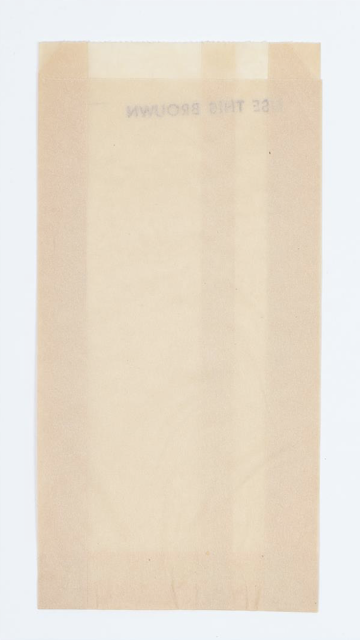
A paper bag, rubber stamped with the instruction "Use this Brouwn”. Some works were stamped with blank ink and others with dark purple. Most used lower case stamps, but some (like above, top) used upper case letters. 

The work was originally included in Wolf Vostell's Dé-coll/Age No.4, alongside Brouwn’s Phone Drawings (see earlier post, here). 

Other artists featured in the periodical include Al Hansen, Dick Higgins, Allan Kaprow, Claes Oldenburg, Tomas Schmit, and Nam June Paik. The issue includes documentation of George Brecht’s Motor Vehicle Sundown Event and Robin Page’s Guitar Piece, both significant to the history of Fluxus and performance. Copies, particularly those which include the bag, are scarce. 

Dé-coll/Age No.4 can be purchased for $789.28 US, here

The work was also distributed by the artist separately. 

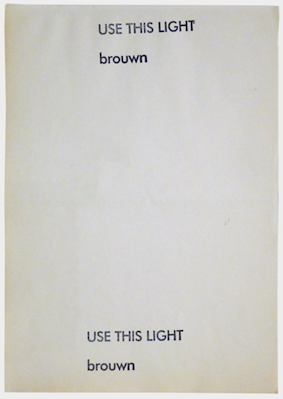
A related work from the same year, Use This Light, is below. 


Friday, September 13, 2024

Jannis Kounellis | Kounellis


Jannis Kounellis
Kounellis
Monchengladbach, Germany: Städtisches Museum, 1978.
[5] pp., 19.5 x 15 cm., loose leaves, boxed
Edition of 440 numbered copies


Accompanying his exhibition, which ran from May 11th to June 11th in 1978, this boxed catalogue consists of a printed cardboard box containing four cards and a multiple by Kounellis. Three of the cards feature a continuous text of the poem Die Skythen, a poem written in 1918 by Russian lyrical poet Aleksandr Blok. The fourth is the title or colophon page. The multiple is made of compressed board, and features a metal rod embedded in white tissue. The rod is laminated in explosive powder the the work is intended to be ignited. 

When lit, the fuse produces a “bright hissing glow that leaves a black smoke trail on the grey-white plate”. 

This was the final boxed work in the Städtisches Museum series that began with Joseph Beuys in 1967 and also included editions by Carl Andre, Hanne Darboven, George Brecht & Robert Filliou, Piero Manzoni, Stanley Brown, Daniel Buren, Jasper Johns, Marcel Broodthaers, Lawrence Weiner, Gerhard Richter, and James Lee Byars, amongst others. 

The price during the run of the exhibition was DM 6. The work can now be purchased from Printed Matter, here, for $1800.00 US. 


Wednesday, December 14, 2022

Stanley Brouwn | Send me a map of the city where you are living


Stanley Brouwn
Send me a map of the city where you are living
Copenhagen, Denmark: Self-published, 1970
7.1 x 10.1 cm.
Edition size unknown


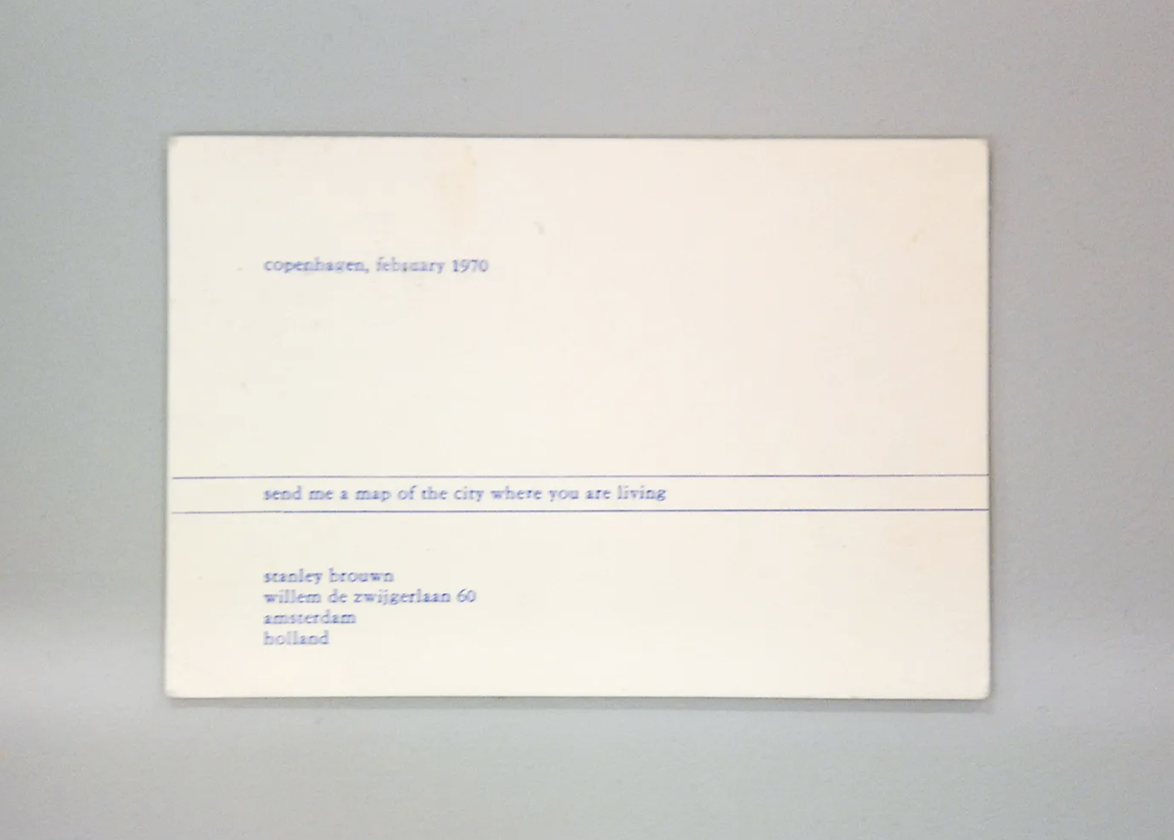
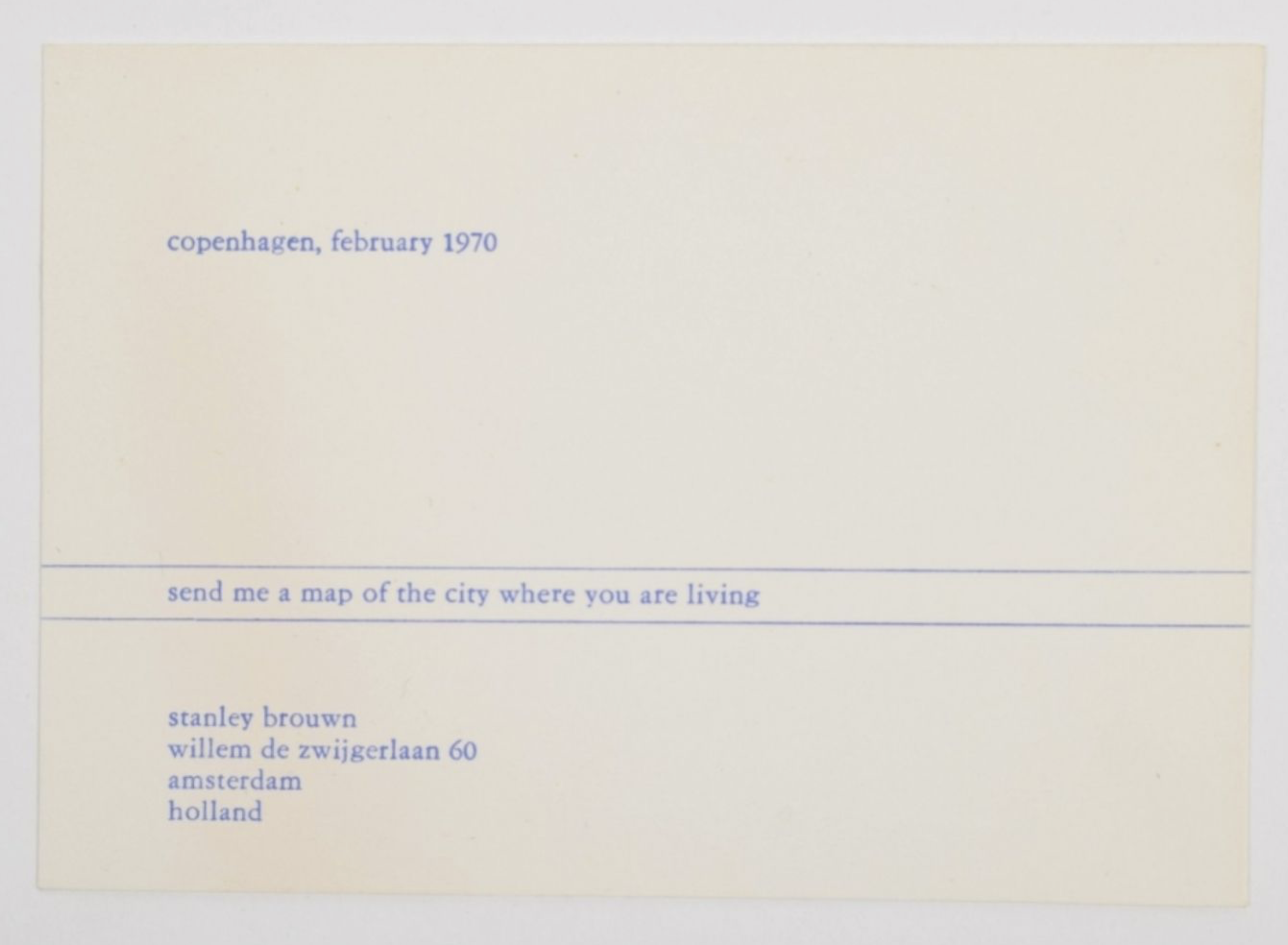
A postcard soliciting maps from around the world, not dissimilar to the artist's This Way Brouwn project in which he invited passersby to sketch out quick provisional instructional maps which he then exhibited and published as 'drawings'. 

According to Harry Ruhe's Stanley Brouwn: A Chronology, cards were "send by Brouwn from Copenhagen to people and institutes all over the world."

A scarce piece of ephemera by an important and underrated artist, valued at upwards of a thousand dollars, depending on condition and provenance. 


Friday, September 2, 2022

This Way Brouwn


[Stanley Brouwn] Igno Cuypers
This Way Brouwn
Amsterdam, The Netherlands: Harry Ruhé, 2020
34 pp., 35 x 30 x 4.5 cm., boxed
Edition of 10 signed and numbered copies


An archival box containing 25 original photos of an artist famous for not wanting to be photographed (or  documented at all) performing his most notorious work. This Way Brouwn involved the artist stopping passersby in the street and asking them for directions, which he had them scrawl on a pad of paper. The results were then rubber-stamped with the title and shown in vitrines as a kind of vernacular drawings. 

The photographs were taken by the Dutch photographer Igno Cuypers - brother to jazz pianist Leo Cuypers. The work is signed and numbered by Cuypers in an edition of ten copies. 

It is published by Harry Ruhé, who had previously produced a binder catalogue raisonne of the artists' editions. This Way Brouwn is available from Ruhé, here


Wednesday, May 18, 2022

Stanley Brouwn


Stanley Brouwn died on this day in 2017, at the age of 81.