Showing posts with label Claes Oldenburg. Show all posts

Friday, June 5, 2026

Claes Oldenburg | Typewriter Eraser


Claes Oldenburg
Typewriter Eraser
New York City, USA: Leo Castelli Gallery, 1977
81.3 x 88.9 x 58.4 cm.
Edition of 18 [+5 AP]


The typewriter eraser was a common stationery item, consisting of a pink rubber wheel used to erase typing errors, and a brush to wipe away the remnants [see below, top]. Oldenburg has been interested in the object as a subject matter since the late sixties, when he began producing drawings of typewriter erasers as proposals for soft and monumental sculptures [see below, centre].

This editioned version predates the towering five ton public sculptural works of the same name (located at the National Gallery of Art in Washington, the Seattle Art Museum and the City Centre Fine Arts Collection in Nevada - see below, bottom) by twenty-two years. It is interesting to note that even the large public outdoor versions are ultimately editioned, also. 

The 1977 version published by Leo Castelli is made of acrylic on aluminum, ferrocement and stainless steel and was produced by Oldenburg at the Lippincott foundry. 

The work has been known to sell at auction for over a million dollars. 


Tuesday, October 7, 2025

Dorothy Herzka | Pop Art One


Dorothy Herzka
Pop Art One
New York City, USA: Publishing Institute of American Art, 1965
16 pp., 15 × 19 cm., spiral bound with loose leaves
Edition size unknown


One of the earliest documents of the New York Pop Art scene, this uniquely designed publication was edited by Dorothy Herzka. Herzka moved to Manhattan at the age of 24, to work at the Bianchini Gallery, on the Upper East Side. The following year, the gallery staged the exhibition The American Supermarket [see previous post] where she met her future husband.  

“We asked Roy [Lichtenstein] and Andy [Warhol] if they’d put an image on a shopping bag. I met Roy when he came in to sign the shopping bags,” she told Gagosian Quarterly in 2018. They married in 1968 and were together until his death in 1997. Dorothy died at her home in Southampton, New York on July 4, 2024, at the age of 84.

Pop Art One is comprised of twenty-seven loose leaf plates by Lichtenstein, Jasper Johns, Claes Oldenburg, James Rosenquist, Tom Wesselmann, and Warhol. It includes brief biographical notes and small photographic portraits of the artists.

The cover and pages of text are cut lengthwise in half, with plastic-comb binding on the outer edge of each half, folding together in the centre to enclose the portfolio of loose plates. The cover was held together with a sticker designed by Lichtenstein, though few of these survived, as the had to be torn for the book to be opened. 

Copies sell for between four and five hundred dollars. 


Wednesday, April 9, 2025

American Pop Art, 106 Forms of Love and Despair


Billy Klüver and Öyvind Fahlström
American Pop Art, 106 Forms of Love and Despair
Stockholm, Sweden:  Moderna Museet, 1964
112 pp., 22 x 22 cm., staple-bound
Edition size unknown


An early Pop Art exhibition catalogue, produced to accompany the show of the same name which ran from February 29th to April 12th, 1964. Artists included Jim Dine, Roy Lichtenstein, Claes Oldenburg, James Rosenquist, George Segal, Andy Warhol and Tom Wesselman.


"This catalogue, created for an exhibition curated by Pontus Hultén (1924–2006)—director of the Moderna Museet between 1958 and 1973—was its own peculiar work of art. The show was a close read of seven then up-and-coming artists utilizing Pop imagery and populist subjects. This seemingly unfussy staple-bound book contained pictures of artworks that were printed, aside from a few tip-in plates, entirely in duotone. Imagine a world where we might know and remember Roy Lichtenstein’s or Claes Oldenburg’s or George Segal’s art in peachy pink and magenta, muddy green and gray. This volume offered up a subversive Pop idea—that these psychedelic reproductions depicting different paintings and sculptures could have (or should have) appeared this way in real life. It anticipates a world where images as we experience them are and are not what they seem.”
- Alex Da Corte


Sunday, November 24, 2024

Claes Oldenburg | Soft Alphabet


Claes Oldenburg
Soft Alphabet 
New York City, USA: Multiples, Inc., 1978
74 x 56.2 x 7.3 cm. 
Edition of 16 [+ 2 AP] signed and numbered copies


Wim Crouwel (1928 - 2019) was a designer and typographer who began working for the Stedelijk Museum in Amsterdam, in 1964.

In 1970, Crouwel designed the catalogue Claes Oldenburg for the museum, with a stark cover featuring only the artist’s name and the initials of the institution (see previous post). The embossed text was in a typeface inspired by Oldenburg’s iconic soft sculptures that came to be known as ‘padded letters’.  They are built on an elementary three-by-three unit grid, altered slightly for the ascenders, descenders, and the letter “M,” employing an inner rounded corner.1 

“When the catalogue was finished and Claes saw it,” Crouwel later said, "he asked me if I would do the whole alphabet. So I did. Then he sent me a lovely drawing, of his ice-cream alphabet, with the dripping letters.” 

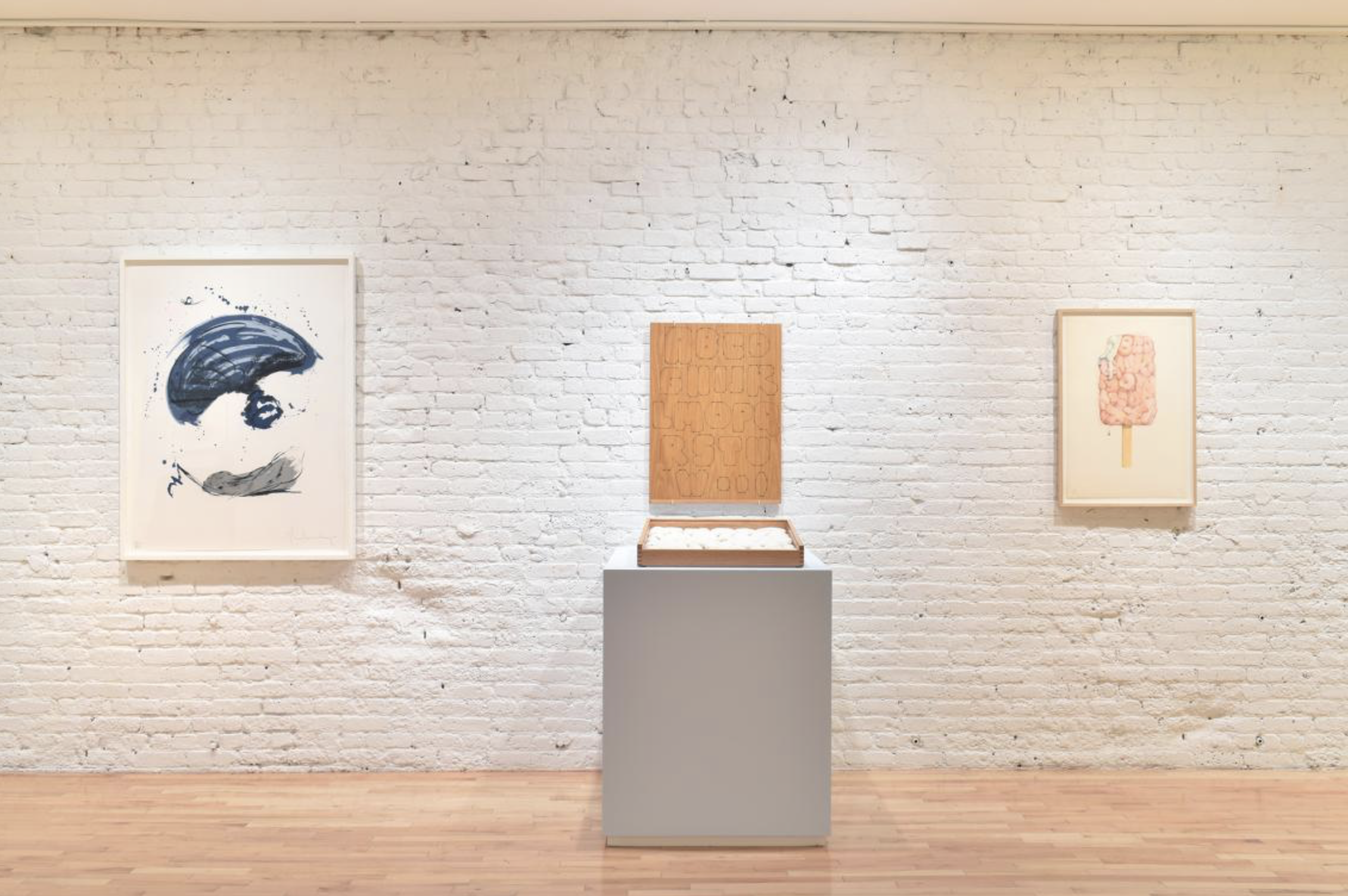
Oldenburg transformed the characters into soft objects themselves, and produced them for Marian Goodman’s Multiples Inc., in 1978. The forty-one characters are sand-filled bags made of sewn cotton, housed in a large screen-printed wooden box which is signed on the underside in black ink. 

The work has a value of about twenty-thousand dollars. The study for the work (graphite and wax crayon on paper, below) is valued at upwards of a hundred thousand dollars. 


1. Crouwel also invented the typeface New Alphabet, which was not used for anything of note for twenty-one years, when it appeared on the cover of Joy Division’s Substance LP. 


Saturday, November 23, 2024

Claes Oldenburg


Wim Crouwel
Claes Oldenburg
Amsterdam, The Netherlands: Stedelijk Museum, 1970
74 pp., 27.6 x 20.8 cm., softcover
Edition size unknown


Designed by Wim Crouwel (see next post), Claes Oldenburg is a catalogue produced to accompany an exhibition at the Stedelijk Museum, from the 16th of January to the 15th of March, in 1970. The book features five reproductions in colour and 139 in black and white. 

It includes texts (in English and Dutch) by E. de Wilde and Alicia Legg and Oldenburg’s famous 1961
I Am For… statement (my favourite of which is "I am for an art that grows up not knowing it is art at all, an art given the chance of having a starting point of zero”). 

Crouwel used the same cover font he designed for the exhibition poster, below. 

The catalogue is available here, for €80.00.


Tuesday, October 8, 2024

Kasper König’s collection


Works from the collection of Kasper König - who died in August at the age of 80 - took in around $6.5 million at auction last week. 

Among the four hundred or so works sold were pieces by artists including Richard Artschwager, Thomas Bayrle, William Copley, Nicole Eiseman, Katharina Fritsch, On Kawara, Paul McCarthy, Claes Oldenburg, Sigmar Polke, and Thomas Schütte. The top went to a work by Kawara, whose work May 7, 1967 fetched roughly $878,000. According to the auction house, Van Ham, this set a new record for On Kawara's date paintings.

Before his death, König donated around fifty works from his collection to Museum Ludwig, including pieces by Pawel Althamer, Maria Eichhorn, Isa Genzken, Dan Graham, Thomas Hirschhorn, Jenny Holzer, Richard Long and Jeremy Deller.

Above are some relevant (to this site) works from the auction.