Showing posts with label chess. Show all posts

Wednesday, October 1, 2025

Takako Saito


There are unconfirmed reports that Takako Saito has died. RIP. 


Friday, August 15, 2025

Takako Saito | Grinder Chess


Takako Saito
Grinder Chess
New York City, USA: ReFlux, nd
17 x 17 x 7.2 cm.
Edition of 19 signed and numbered copies


I can't think of another artist who has made as many great chess board variations as Takako Saito. Her disrupted sets include games in which you identify your pieces by scent, taste, weight and sound, as well as Book Chess (1980), Nut & Bolt Chess (1964) and even wearable chess sets. 

Grinder Chess isn't as conceptually strong as some of the others, but its formally great - drill bits reimagined as soldiers. The piece may be a pun on the chess term "grinder", which refers to a player with an unassuming style. 

The work is designed by George Maciunas, who predatory drawing is below. 


Saturday, November 11, 2023

Les Levine | Art In America Chess/Checkers Game


Les Levine
Art In America Chess/Checkers Game 
New York City, USA: Art in America, 1969
24.25 x 24.25"
Edition size unknown


Designed by Les Levine and produced by Georg Jensen in 1969, for the "Art for Everyday Living" series of artist's games, published by Art in America magazine. The periodical also commissioned coins, toys, ceramics, lithographs, and needlepoint projects. 

This Chess/Checkers game includes a 16 black and 16 white custom square cut board pieces. Each square reads Checkers on one side and the chess piece name on the opposite. 

The work is featured in Art in America Vol. 57, No. 6, November / December 1969, on pages 74-75. 


"Les Levine (Irish, b. 1935) Les Levine, a conceptual artist and one of the originators of media art, was born in Dublin in 1935 and now lives in New York City. Levine studied at the Central School of Arts and Crafts, London, before moving to Toronto in 1958, where he continued his studies at the New School of Art. His artistic practice has been explored through various means including painting, sculpture, installation, performance work, mail art and artists’ books. Moving to New York in the 1960s, he became a leading conceptual art figure, intersecting art and life in a variety of projects such as Levine’s Restaurant, 1969 and the conceptual museum he invented in 1970 called the Museum of Mott Art, Inc. He regards himself as a media sculptor, “mould(ing) media the way others would mould matter.” In the 1960s, Levine was one of the first artists to work with video and television. His work was to become a precursor to the new generation of experimental artists who were exploring the possibilities of the moving image including Dan Graham, Gary Hill and Bruce Nauman. Since the 1980s Levine has become particularly recognized for his billboard works in which he subverts the language of mass advertising to interrogate social and political problems."


Saturday, May 14, 2022


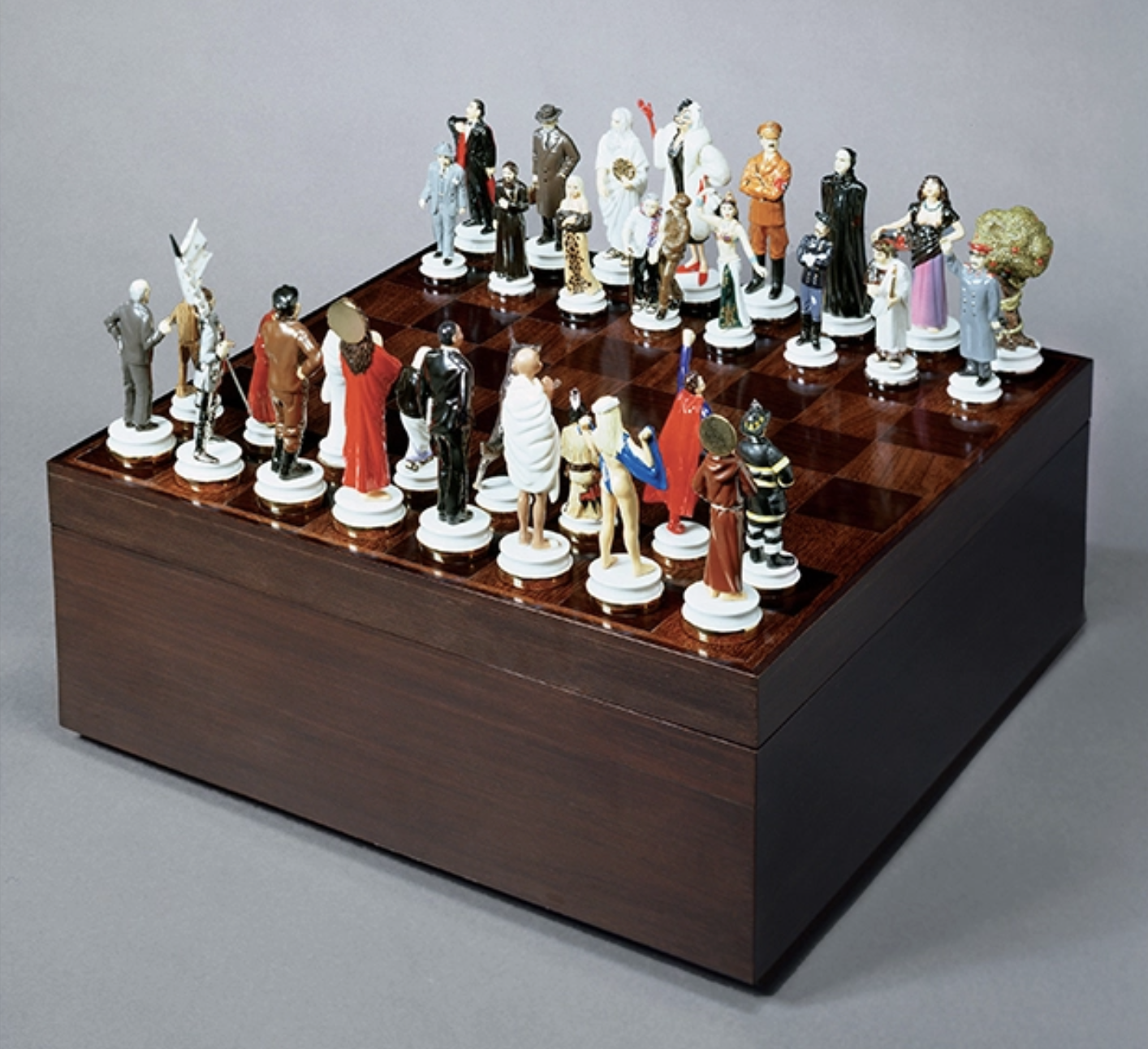
Additional Chess sets by Tracey Emin, Max Ernst, Maurizio Cattelan, The Chapman Brothers, Damian Hirst, Kelly Mark, Gavin Turk, Alastair Mackie, Tom Friedman, and Takako Saito. 

Friday, May 13, 2022

Yoko Ono's Chess Partners


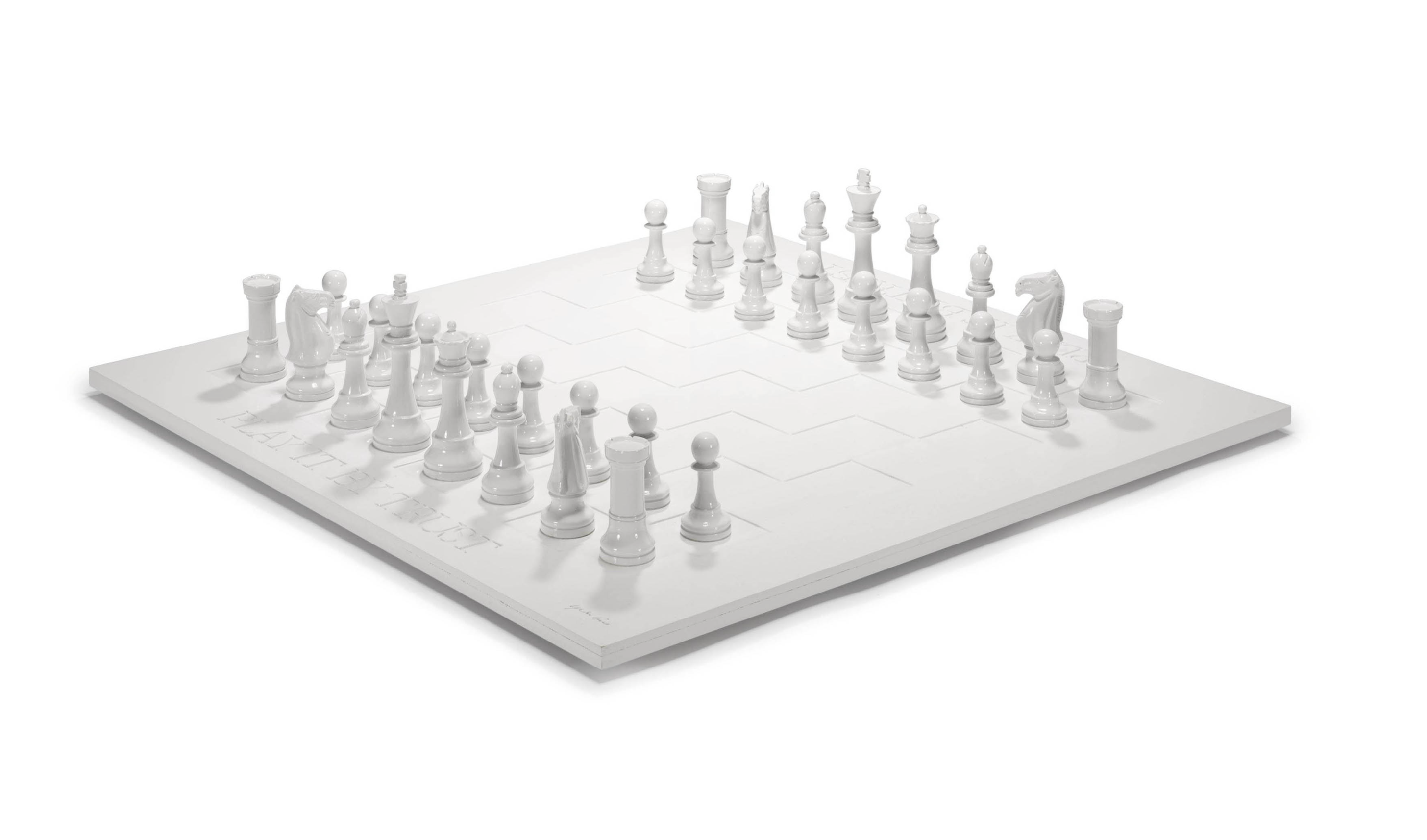
Yoko Ono playing chess on her White Chess Set [Play it by Trust] with Fluxus scholar Jon Hendricks, artist Shinya Watanabe, collector Luigi Bonotto, RZA of the Wu-Tang Clan, her second husband Tony Cox, and her third husband John Lennon.


Yoko Ono | Play it by Trust


Yoko Ono
Play it by Trust 
New York City, USA: Self-published, c1986
76.2 x 76.2 x 19 cm.
Edition of 8 signed and numbered copies


It'll come as no surprise here that my favorite artist-designed chess set is by Yoko Ono. Takako Saito's series of excellent chess sets disrupt the way that the game is played, but Yoko Ono's set achieves the same with a greater economy of means, a more elegant result, and a richer resonance. 

The work dates back to the sixties and this 1986 edition might be the first to alter the title from White Chess Set to Play It By Trust. While this may clarify an important component for the artist, it risks reducing the readings. One might think about White Chess Set as being about the the futility of war, the joy of non-competitive play, the need for high levels of concentration, the way that memory fails us, etc. etc.  In Ono's own comments below, she speaks more about persuasion than trust. 

As of 2015, two of Ono's highest auction prices ($47,000 and $116,500 USD) were both for this piece. This may have subsequently been surpassed, though it's unlikely there is another editioned work with a higher value. 

White Chess Set has been exhibited as sculpture, as participatory multi-set installations, as large scale public art, etc. etc. 


"When I created Play It By Trust I wasn’t thinking about Duchamp at all. Many artists have worked with chess, but they usually worked with the decorative aspect of the chess pieces. I wanted to create a new chess game, making a fundamental rather than decorative change. The white chess set is a sort of life situation. Life is not all black and white, you don't know what is yours and what is theirs. You have to convince people what is yours. In the chess situation it is simple if you are black then black is yours. But this is like a life situation, where you have to play it by convincing each other.
 
[...]
 
In the art world, work is shown in a museum and a lot of people or a few people will see it, then if it’s bought by someone, that’s the end of it, or it comes back every once in a while. So I like the idea that Play It By Trust is repeated in different places, because the environment makes a big difference to the piece. Again, it’s the concept that is the work."
- Yoko Ono


Thursday, May 12, 2022

Takako Saito | Play Chess With the Sun


Takako Saito 
Play Chess With the Sun
Japan: Self-published, 1993
7 x 15.5 x 3 cm.
Edition of 11 signed and numbered copies


Takako Saito | Grinder Chess


Takako Saito
Grinder Chess
New York City, USA: ReFlux, nd
17 x 17 x 7.2 cm.
Edition of 19 signed and numbered copies


I can't think of another artist who has made as many great chess board variations as Takako Saito. Her disrupted sets include games in which you identify your pieces by scent, taste, weight and sound, as well as Book Chess (1980), Nut & Bolt Chess (1964) and even wearable chess sets

Grinder Chess isn't as conceptually strong as some of the others, but its formally great - drill bits reimagined as soldiers. The piece may be a pun on the chess term "grinder", which refers to a player with an unassuming style.