Ubuweb has just made available for download the complete recordings made for Obscure Records,
here.
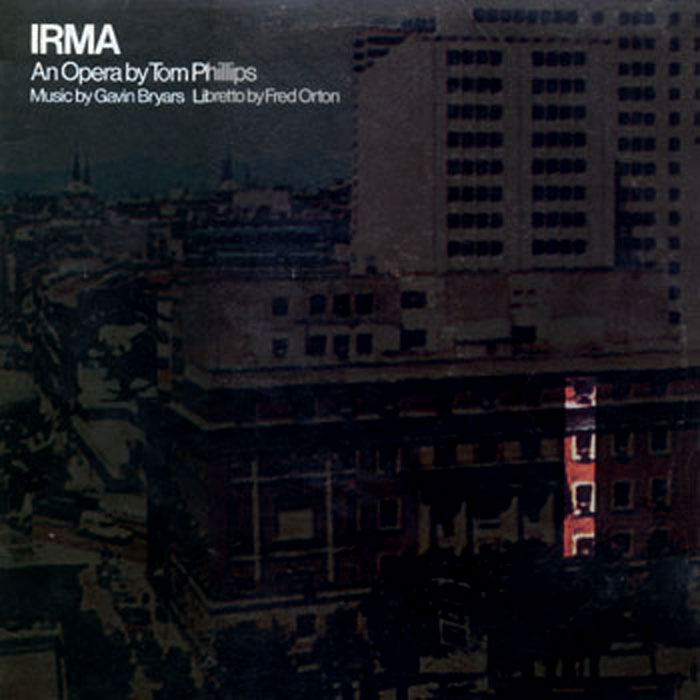
Obscure Records was a British record label created and ran by Brian Eno, and distributed by Island Records. Eno selected the composers and produced the recordings, with considerable help from Gavin Bryars. Ten albums were released between the years 1975 and 1978. All of the records in the series used variations of the same cover art, a collage by John Bonis, overprinted with black ink, with different window reveals on each.
The first in the series, Bryars'
The Sinking of the Titanic, is also one of the strongest. Not only has it been re-recorded and re-released four separate times, but the b-side,
Jesus' Blood Never Failed Me Yet, was also expanded and given it's own separate release on CD. It was reportedly Tom Waits favorite 'song' and he played it so frequently that he had worn out his vinyl copy. Bryars roped him in to accompany the looped field recording of a homeless man on the CD reissue, but other than drawing attention to the project, the addition of Waits is entirely unnecessary. I've written about the title track on more than one occasion; first when I interviewed Bryars for York University's newspaper Excalibur and, more recently, for the Power Plant's website,
here.
The third Obscure Record is Eno's own
Discreet Music, an album that predated his coining of the term 'ambient music' by a couple of years, but is actually more satisfying than the better known
Music For Airports (Ambient #1). In addition to building upon Erik Satie’s notion of “furniture music”, the piece is also notable as an example of generative composition. Rather than merely being an intellectual exercise, though, the resulting piece of music is beautiful and melodic. It is also harmonically unrooted and near static, and entirely without rhythm, or even time signature. But, as ambient music was intended, the piece fully rewards close listening, but never demands it.
The liner notes to the record (hopefully at a high enough resolution below to read, when clicked on or saved) explain the recording set up and the origins of Eno’s interest in ambience: he was in bed with a broken leg and a visiting friend put a record on and left, but the volume was set very low and one of the speakers was defective so, being bed-ridden, Eno had no choice but to experience the record at the threshold of audibility. They also include my favorite statement on conceptualism ever (sorry Sol, Larry):
Since I have always preferred making plans to executing them, I have gravitated towards situations and systems that, once set into operation, could create music with little or no intervention on my part.

The sixth disk in the series continues the systematic conceptual compositional technique, with Michael Nyman’s
Decay Music. Before he composed lush soundtracks to feature films (the long-term collaboration with Peter Greenaway, the widely celebrated score for Jane Campion's
The Piano, etc.) Nyman was heavily invested in the avant-garde music of John Cage, Karl Stockhausen, and Cornelius Cardew, as well as the sound experiments of the Fluxus group; La Monte Young and George Brecht in particular. He was also a member of The Portsmouth Sinfonia, a group known for forbidding anyone from playing an instrument they were proficient on. Two years prior to the release of
Decay Music, Nyman published the influential book
Experimental Music: Cage and Beyond. The two works on the album,
1-100, and
Bell Set No. 1 both experiment with percussive, long decay musical forms. Nyman discusses the work,
here.
The label followed this with a record with considerably more commercial potential. The Penguin Cafe Orchestra sounded like friendly 20th century 'classical' minimalist music in the vein of Philip Glass and Steve Reich, played unpretentiously on folk instruments like guitar, piano, ukulele, penny whistle, harmonium and mandolin. I can’t think of much else on the label that could comfortably be called exuberant.
Other records include an opera by Tom Phillips, collaborations between Bryars and other composers such as John Adams, Christopher Hobbs and John White, the debut recordings of David Toop and Harold Budd.
Of the ten, only Eno’s stayed continuously in print, and many are still unavailable on CD. Those that are available, tend to have alternate covers: