Showing posts with label Ulises Carrión. Show all posts

Sunday, October 5, 2025

Clemente Padín | Happy Bicentennial


Clemente Padín
Happy Bicentennial
Amsterdam, The Netherlands: Daylight Press, 1976
12 pp., 14.5 x 10.7 cm., staple bound,
Edition size unknown


"Happy Bicentennial, a small paper booklet, is unassuming at first sight. Its simplicity – both in material and in design – reflects the lack of resources accessible to artists in Uruguay during the military dictatorship. Pen and paper comprise the materials necessary for its creation. The nature of the booklet itself, its contents hidden between pages, waiting to be opened, asks for intimacy with its reader. It interacts with its audience on a one-to-one basis. This intimacy is then preyed upon as Padín makes the reader not just a receiver of information, activates them as a participant in a plot. 

Happy Bicentennial instructs its reader on how to build a bomb to send to a Wall Street office in the United States. The language is directive yet, at times, almost surreal as Padín requests that the bomb be stuffed with “beautiful flowers.” The tension between opacity and ambiguity asks the reader to draw their own conclusions on the meaning of the booklet, thus making them active participants. Holding and reading the booklet suddenly becomes an overt political action as Padín places the reader in a politicised plot against the US Government, who continued business with Uruguay despite the inhumane military dictatorship occurring. Padín can therefore be seen utilising the material mode of Mail Art, which does not adhere to borders, to challenge the global context of the Uruguayan dictatorship. Happy Bicentennial raised awareness of the military dictatorship in Uruguay whilst directly challenging the involvement of the United States. Moreover, through Happy Bicentennial Padín removed passivity as a choice for his audience, forcing them into a position of active participation as they picked up the booklet and flipped through it. The forcefulness of the booklet, which is threatening, dangerous, and potent, echoed the forcefulness of the military dictatorship under which millions were living similarly, without choice. 

Happy Bicentennial also challenged the capitalised ideologies which padded the artworld. As an item of Mail Art, Padín’s artwork did not bid on monetisation: its purpose was simply communication. The artist championed Mail Art for its accessibility in this regard, claiming that “Mail Art is an artistic school without any “isms.” As such, any student can enter this school and participate.” Radically democratising in its message; anyone could create Mail Art. Against the tide of an increasingly capitalistic global art market (which grew massively in the 1970’s due to an increasing understanding of art as investment) Padín’s artwork emphasised the importance of art as a medium for human-to-human communication and connection. One of the key features of Mail Art was its physical demise: damage caused by the postal system, creases due to folding, marks left by stamps. These visual features of mail art became a part of the artwork itself and became referred to as ‘noise.’ Noise visible on Mail Art gave each piece a visual history. The temporaneity of the art form reflects the immediacy of the message which it conveys: mail art is not created to be preserved and hung on gallery walls or bought by a collector. Its purpose is to reach the viewer, both physically and ideologically.

Therefore, naturally, much of the work of Padín and his contemporaries was lost. Yet, the values their Mail Art communicated remain relevant. Censorship and moderation continue to play huge roles in the way we receive information today. Happy Bicentennial stands as an example of artistic and political transgression which utilised art mediums to connect with people across the world. Padín’s Mail Art is a quiet yet forceful revolt. It reminds us that though navigating ever-changing political climates can feel overwhelming and at times debilitating, there are always alternative ways to connect with each other and to stand for what we believe in. All we need is a pen, and some paper. “


Clemente Padín died on Friday, at the age of 85. 


Monday, May 12, 2025

Ulises Carrión | Dear Reader. Don’t Read.


Ulises Carrión
Dear Reader. Don’t Read.
Self-published, 1973
24 × 36.8 cm.
Edition size unknown


Wednesday, November 6, 2024

Ulises Carrión | Mirror Box


Ulises Carrión
Mirror Box
Amsterdam, The Netherlands: Self-published, 1979
[18] pp., 18.5 x 18.5 cm., staple-bound
Edition of 100


An Artist Book handmade and self-published by Ulises Carrión featuring images of boxers rubber-stamped with pink and blue ink. The ink bleeds through the felt, leaving a ghostly impression on the opposing pages.

Ulises Carrión was reportedly a life-long boxing aficionado, and had just edited an issue of Commonpress a year prior, titled Box, Boxing, Boxers

The title is extremely scarce and prohibitively expensive. A copy is available at Printed Matter for $3,000.00 US, here


“Mirror Box is printed on synthetic felt with rubber stamps of two boxers facing each other in sequential sparring positions. The soft touch of the page, in contrast to the strong punch of the imagery, makes for a potent allusion ot the exchange and repression of male sexuality.” 
-Tim Guest / Germano Celant, Books by Artists


Monday, August 26, 2024

Ulises Carrión | Dear Reader. Don’t Read


[Ulises Carrión]
Dear Reader. Don’t Read
Madrid, Spain: Museo Reina Sofía, 2016
272 pp., 19 x 27 cm., softcover
Edition size unknown


Dear Reader. Don’t Read traces the activities of Ulises Carrión from his early career as a young, successful writer in Mexico, to his numerous activities in Amsterdam where he co-founded the city’s first independent artist' run space In-Out Center, and the legendary bookshop-gallery Other Books and So (1975–79). The title includes texts by longtime Carrión collaborators Guy Schraenen and Felipe Ehrenberg, among others. 

The out-of-print volume also includes an audio CD, featuring audio from Carrión’s 1977 cassette The Poet’s Tongue.


Monday, July 15, 2024

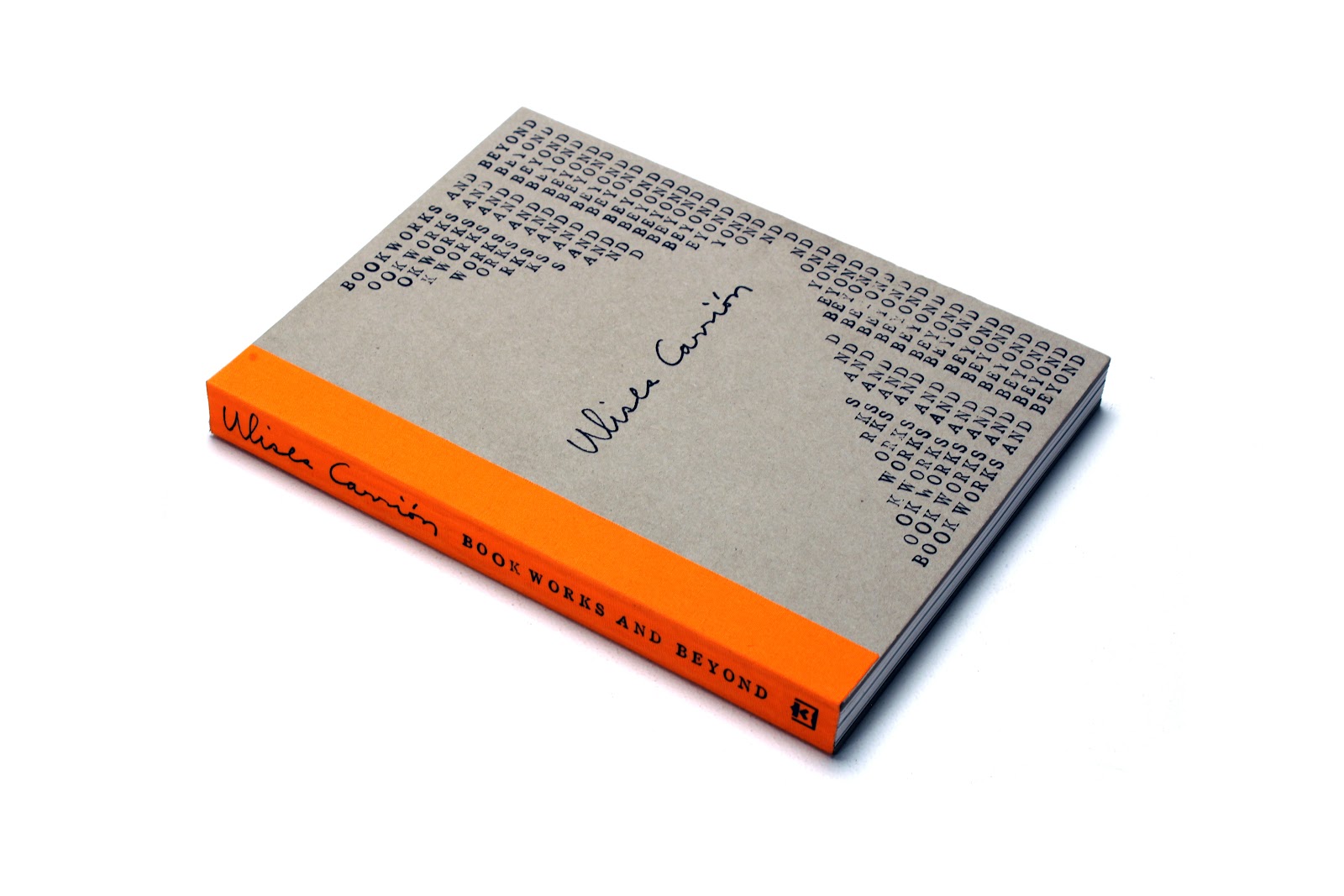
Ulises Carrión: Bookworks and Beyond


[Sal Hamerman & Javier Rivero Ramos, editors]
Ulises Carrión: Bookworks and Beyond
Princeton, USA: Princeton University Press, 2024
176 pp., 17.8 x 25.4 cm., hardcover
Edition size unknown


Published in February of this year, this impressive volume accompanies an exhibition of the same name, which is billed as the largest retrospective of Ulises Carrión's work in the US, fittingly held in a library, not a museum. Bookworks and Beyond examines Carrión's life and work through the lens of the Artist Book. 


More broadly, it makes the case that Carrión’s practice involved a series of cultural strategies and the creation of networks that were foundational to his work: the artist as editor, publisher, fabricator, distributor, gallerist, bookseller, theorist, archivist and organizer. 


Ulises Carrión was born in San Andres Tuxtla, Veracruz, Mexico in 1941. He studied philosophy and literature at the National University of Mexico, before receiving a grant to continue his studies at the Sorbonne in Paris, France. From there he went to the Goethe Institute in Achenmühle, Germany, and then to the University of Leeds, where he obtained a postgraduate degree with a dissertation on William Shakespeare titled Judas' Kiss and Shakespeare's "Henry VIII"


In 1972, he definitively settled in Amsterdam, a progressive and cosmopolitan city where he could live as an openly gay man. He co-founded (with Raúl Marroquín) the In-Out Center, the first independent artist-run centre in the city. Here he used a mimeograph machine to self-publish several artists' books under the imprint of In-Out Productions. The venue also hosted his first solo exhibition, Texts and Other Texts, in June of 1973. 


The In-Out Center closed in 1974 and the following year Carrión opened Other Books and So, possibly the first centre dedicated to Artists’ Publications in Europe (Art Metropole in Toronto opened a year prior and Printed Matter in New York City a year after, in 1976). 


In a short period of time, Other Books and So became “a key meeting point for practitioners engaged in mail art, artists’ books, and experimental writing and performance.” The basement bookstore/gallery - operated in collaboration with his lover Aart van Barneveld -  advertised its wares as “other books, non books, anti-books, pseudo books, quasi books, concrete books, conceptual books, structural books, project books, plain books.”


As a gallery, it hosted over fifty exhibitions, including solo shows by artists such as Dick Higgins, Dorothy Iannone, Maurizio Nannucci, Allan Kaprow, Takako Saito, Anna Banana, and Jiri Valoch. Like Art Metropole, Other Books and So also published a magazine. Ephemera was a 12-issue periodical edited by Carrión, Barneveld, and Salvador Flores, focusing on Mail Art. 


“By reimagining books as a sequence of spaces and temporalities, Carrión unmoored the book from its more conventional definition as a material support of texts and images” write the editors in the opening essay. They contextualize Carrión as starting out at a time when artists began employing text as an alternative to painting and sculpture, and when avant-garde writers started exploring the visual and sonic properties of poetry. 


Monica de la Torre’s text “An Essay in Nine Books (and Not)” explores Carrión's work from his 1970 acclaimed collection of short stories De Alemania to the excellent 1979 Artist Book In Alphabetical Order


This is followed by “Communities, Bureaucracy, and Office Technologies in Ulises Carrión’s Publishing Projects”, by Felipe Becerra. The text begins with Carrión’s disillusionment with Mail Art in the late seventies (which had devolved into goofy “Crackjack Kid” indulgences) and explores the typewriter, mimeograph and rubber stamp. But rather than merely celebrate these tools for their liberating DIY qualities, Becerra examines the clerical and bureaucratic connotations in works such as Sonnet[s] (1972) and Arguments (1973). 


The essay also recounts the story of Carrión discovering a Beau Geste Press title in a bookstore in 1972, and writing to the publishers to learn more about their activities, leading to a lifelong friendship and collaboration. 


“The Archive is Open” by co-editor Sal Hamerman follows, expanding the conversation from books to libraries and archives, as well as methods of distribution. Artists dedicated to the bookwork as a new form had to simultaneously consider ways to get these works into the hands of 'readers' and librarians.  


When Other Books and So folded after three years, it was converted into an archive. Toronto’s Art Metropole developed an archive alongside their distribution activities, which eventually sold to a collector in the late nineties, who donated it to the National Gallery in Ottawa, where it remains accessible to researchers. Other artist-initiated archives from the era include Maurizio Nannucci’s Zona and Martha Wilson’s Franklin Furnace. 


“Why should an artist open a gallery? Why should he keep an archive?”, Carrión wrote in 1985. “Because, I believe, art as a practice has been superseded by a more complex, more rigorous, and richer practice: culture. We’ve reached a privileged historical moment when keeping an archive can be an artwork.” Carrión felt an obligation to collect and preserve cultural artifacts, while avoiding the trappings of institutional libraries, museums and archives, which he characterized as “perfect cemeteries for books.”


Javier Rivero Ramos’ “The Most Illustrious Unknown Postmaster: The Erratic Networks of Ulises Carrión” applies Craig Saper’s notion of “intimate bureaucracies” to Carrión’s practice. Saper coined the term in 1997 to refer to systems which make "poetic use of the trappings of large bureaucratic systems and procedures to create intimate aesthetic situations, including the pleasures of sharing a special knowledge or a new language among a small network of participants.”


The final chapter in Ulises Carrión: Bookworks and Beyond is “Plural Authority as Queer Polyphony in Ulises Carrión’s Mail Art Projects” by Zanna Gilbert. Her essay investigates the artist’s interest in plagiarism and multi-authorship and also places his work in the context of other queer artists working with Mail Art, such as Dick Higgins and Ray Johnson (whose own work was not examined through the lens of his homosexuality until over twenty-five years after his death). She writes: “Carrión’s interest in plural authorship and artistic polyphony to create a community and queer the art world's systems was at the heart of this unusually trenchant engagement with mail art projects.” 


Gilbert also gets at the Marxist underpinnings of the artist’s ideas, quoting Carrión from 1981: 


“The organization of communication, and not the little thing that you send or the little thing that you make, nor the book that you make…is the next step, historically in art.” This notion perhaps best encapsulates Carrión’s wholistic approach to art production: 


“Before you were a worker, now you’re the director of the factory.” 


Ulises Carrión: Bookworks and Beyond is essential reading for anyone interested in "Mexico’s most important conceptual artist”, Artist Book theory, and artist-run bookstores. It is available from Printed Matter for $49.95 US, here


Sunday, July 14, 2024

Ulises Carrión | The I want to be in your catalogue no matter what the theme of your project is Card


Ulises Carrión
The I want to be in your catalogue no matter what the theme of your project is Card
Amsterdam, The Netherlands: Other Books and So Archive, 1982
4 x 6"
Edition size unknown


“One of Carrión’s last mail art projects, The I want to be in your catalogue no matter what the theme of your project is Card from 1982 could be interpreted as a sardonic dig at the “junk mail” and “quick-kopy crap” that dominated the mail art network in the late 1970s and early 1980s. The postcard did not invite responses, and this might be read as reflecting, Carrión’s dissatisfaction with the mailers networks model of collective authorship. It is equally possible however, the postcard was not just a humourous attempt to poke fun at the network, but an expression of earnest support for it. The very act of circulating the postcard (or any mail artwork) is what creates the network, and the gesture of participation is as important as, if not more important than, the content produced. “How can we measure the intention intensity of our knocking" Carrión and asked in 1978. His answer "by the echo reproduce, obviously.”
- Zanna Gilbert, Ulises Carrión: Bookworks and Beyond (see next post)


Wednesday, July 3, 2024

Ulises Carrión | Second Thoughts


Ulises Carrión
Second Thoughts
Amsterdam, The Netherlands: Void Distributors, 1980
72 pp., 21 x 16 cm, softcover
Edition of 500


“Where does the border lie between an artist’s work and the actual organization and distribution of the work?” asks Ulises Carrión, in this compendium of polemical essays.

The contents include:

The New Art of Making Books 
From Bookworks to Mailworks 
Rubber Stamp Theory and Praxis 
Rubber Stamp Art
Mail Art and the Big Monster
Table of Mail Art Works
Personal Worlds or Cultural Strategies? 
Bookworks Revisited


Saturday, September 30, 2023

Other Books and So Sales Catalogue #2


Ulises Carrión, Aart van Barneveld and Michael Gibbs
Other Books and So Sales Catalogue #2
32 pp., 21 x 14 cm., staple-bound
Edition size unknown


It's no surprise that most of the venues set up as non-profits to distribute Artists' Books were founded by artists. Sol Lewitt and Lucy Lippard* started Printed Matter in New York City, in 1976. General Idea started Art Metropole in Toronto two years prior. And Ulises Carrion founded Other Books (later Other Books and So) in the year in between, in 1975. 

This is the second issued inventory catalogue for the Amsterdam bookstore (the first can be viewed at archive.org in its entirety, here). Sections include Language Art, Objects/Multiples, Records, Cassettes, Posters, Music, and Postcards. 

The scarce title is available from Jonathan Hill, here, who are positioning themselves as experts in ephemera from artist-initiated bookstores. 


"For an artist’s book to be a bookwork it’s essential that it looks and functions like an ordinary book. That means no unusual size, no extravagant materials, no eccentric content.”
- Other Books 


*Along with Carol Androcchio, Amy Baker, Edit DeAk, Mike Glier, Nancy Linn, Walter Robinson, Ingrid Sischy, Pat Steir, Mimi Wheeler, Robin White and Irena von Zahn. 

Tuesday, June 7, 2022

Ulises Carrión | Arguments


Ulises Carrión
Arguments
Geneva, Switzerland: Editions Héros-Limite, 2005
[96] pp., 21 x 15 cm., softcover
Edition of 750


The rare second edition of Ulises Carrión’s bookwork Arguments, which was originally published in 1973 by the Beau Geste Press). 

Available from Jonathan Hill Bookseller, here, for $150.00 US. 


"The book Arguments was made with the help of Beau Geste Press. The founders of BGP were Mexican artists Felipe Ehrenberg and Martha Hellion. They ran a printing community of artists’ publications with their children and like-minded people in the countryside of Devon. Ulises, Felipe and Marta knew each other from a circle of pioneering artists, writers and actors – regular visitors of a cultural center in Mexico City in which Ulises steered the library for some time. While studying in England for his Master’s degree, Carrión contacted the Mexicans after he saw some of their publications. The proposal for Arguments, however, was conceived in Amsterdam. Ehrenberg responded by saying that Ulises had to come over and create the book in collaboration with them. Money was scarce at first, but Felipe’s idea of a luxury edition on coloured paper, meant to be a flirtation with collectors, was thought to solve the financial issues. It soon appeared in an edition of 400 (200 in colour and 200 in white) – a great book among Carrión’s impressive list of books, released in 1973." 
- Tineke Reijnders, 2017

“Carrión humorously interrogates the structure and content of books and the literary devices used by authors and playwrights. The titular exchanges in Arguments are indicated only by the names of the participants, with no reference to the actual content of their disagreements. The distinctly Anglophone names are arranged in various configurations on each page of the book, leaving the reader to wonder about the substance of the disputes.”
- Zanna Gilbert, Artists and Their Books, Books and Their Artists (2018)