Showing posts with label John Baldessari. Show all posts

Thursday, August 20, 2026

Baldessari Afters


Five works that reference Baldessari’s signature work: Banksy, Thérèse Mastroiacovo, Jonathan Monk, Emily Reimer, Yann Sérandour. Interestingly, all but one of them call back to the premise of students writing lines: Banksy draws a parallel with Bart’s weekly punishment in the opening credits of The Simpsons; Jonathan Monk defies the dictum; and Emily Reimer (then a student of mine) defaced the undersides of the classroom tables.  


Tuesday, November 4, 2025

John Baldessari | Brutus Killed Caesar


John Baldessari
Brutus Killed Caesar
Akron, USA: The Emily H. Davis Art Gallery, 1976
[35] pp., 10.2 × 27.3 cm.,  spiral bound
Edition size unknown


Brutus Killed Caesar is a narrow, oblong spiral-bound book which continues Baldessari's study of found photography and appropriated imagery. Each layout features the juxtaposition of three images: portraits of two men facing each other with a “murder weapon” in between them. The portraits remain the same but the weapon changes with each spread: a kitchen knife, a gun, a magnifying glass, a book of matches, pushpins, string, a dart, a pipe, etc. These gradually shift away from the dangerous to the humorous: a withering spider plant, a clothespin, a banana peel. 


"Baldessari’s book Brutus Killed Caesar is a narrative on a reduced scale which uses the sequence of pages as a means of comparison. On each page there are the same two facing pictures — blurry newswire photos of facing men who ambiguously signify politicians or gangsters or some kind of sinister patriarchs. Between these two faces is set a possible murder weapon, a different object on each page, ranging from guns and knives to flowerpots and bathroom scales. Altogether this sequence of juxtapositions is like a simple story repeated over and over, in a different way each time. It also demonstrates a range of narrative possibilities: for example the murder weapons are mainly common household objects which, in the context of the book, are ironically manipulated to appear on one hand as clues to a mystery brimming over with dramatic potential, and on the other hand as the worst cliches of banal evil.”
- Tim Guest, Toronto, 1981 (Books By Artists, Art Metropole)


The title is available for $1500 US, from Printed Matter, here


Monday, September 8, 2025

International Literacy Day


Today is International Literacy Day, celebrated on September 8th since 1967, organized by UNESCO. Works above by Lawrence Weiner, Jeremy Deller and John Baldessari. 


Monday, August 12, 2024

John Baldessari | Repository


John Baldessari 
Repository 
Los Angeles, USA: Brain Multiples, 2002
36 × 32 × 10 cm.
Edition of 48 signed and dated copies


Marcel Duchamp’s Fountain has inspired countless responses from others, often little more than sculptural memes. This glazed ceramic work was produced for Brian Butler’s Brian Multiples imprint, which has also produced works by Meg Cransont, Rachel Khedoori, Paul McCarthy, Jorge Pardo, Philippe Parreno, Jason Rhoades, Katy Schimert, Diana Thater, Rirkrit Tiravanija, and many others.


Thursday, March 21, 2024

John Baldessari pillow cases


John Baldessari
The Thing Quarterly, Issue 22
San Francisco, USA: The Thing Quarterly, 2014
33 x 25 cm.
Edition size unknown


Issue 22 of The Thing Quarterly consists of two 100% cotton sateen pillowcases featuring an image of a woman clutching a pillow. The black and white image is taken from a Hollywood film still in Baldessari's collection and has been silkscreened on each pillowcase with environmentally-friendly, water-based ink.  The pillowcases are standard-sized and envelope-style, with a thread count of 320. 

The work was intended as an open edition, but The Thing Quarterly folded in 2017, after operating for just under a decade. The edition is unsigned, though the artist signed a few copies which were sent out at random to purchasers. 

For other Thing Quarterly editions see the hashtag below. 

See also: pillows by Michael DuMontier and Neil Farber, Marina Abramovic, Miranda July, Christian Marclay, Bless and Lucas Grogan, here


Thursday, November 5, 2020

John Baldessari | New Order September 12-13


John Baldessari
New Order September 12-13
Los Angeles, USA: , 1987
34 ¼ x 23"
Edition size unknown


Offset lithograph with images by John Baldessari and typography by Laura Stein. Produced for New Order's 1987 performances in California at Irvine Meadows on September 12 and The Forum on September 13.


Saturday, October 31, 2020

Factory Records & Visual Artists


Michael H. Shamberg (1952-2014) was an artist, filmmaker, video producer, and the head of Factory Records US, which he ran out of an office above White Columns gallery at 325 Spring Street. 

From 1975 to 1977, he worked at The Kitchen in New York, as a video assistant. Here he organized screenings and video installations by artists such as Vito Acconci, Dan Graham, Nancy Holt, Lawrence Weiner and Robert Wilson. He was the Director of Photography on two of Lawrence Weiner's 1976 videos: Do you Believe in Water? and A Bit of Matter and a Little Bit More. 

When he began making videos with Factory Records bands such as New Order and A Certain Ratio he invited filmmakers from the art world to direct them. Robert Longo shot New Order’s “Bizarre Love Triangle” in 1986 and Robert Frank filmed "Run 2" in 1989. William Wegman shot one of several music videos for the song "Blue Monday" and Chris Marker shot "Getting Away With It" by New Order side-project Electronic. 

Shamberg asked Kathryn Bigelow to film New Order's 1987 video for "Touched by the Hand of God", a few years before her breakthrough feature films (Blue Steel, Point Break, and Strange Days) and over twenty years before her Oscar winning film The Hurt Locker

He invited John Baldessari, Barbara Kruger and Lawrence Weiner to create the posters for New Order events. 

For the rest of the week I'll post examples of album covers, posters and promotional materials designed by Lawrence Weiner, John Baldessari, Barbara Kruger, Robert Breer and others. 
 

Wednesday, October 14, 2020

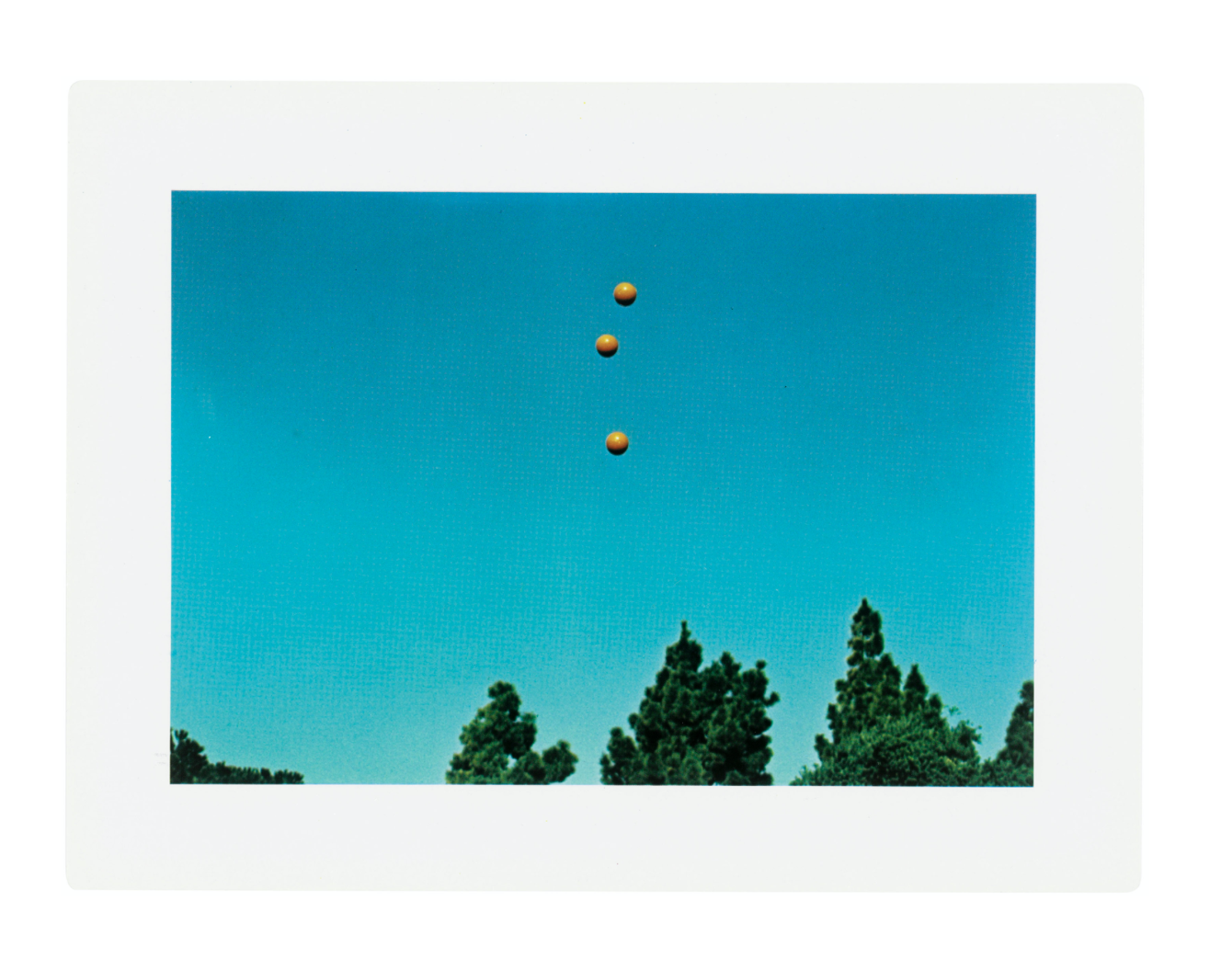
John Baldessari | Throwing Three Balls in the Air to Get a Straight Line (Best of Thirty-Six Attempts)


John Baldessari
Throwing Three Balls in the Air to Get a Straight Line (Best of Thirty-Six Attempts)
Milan, Italy: Edizioni Giampaolo Prearo and Galleria Toselli, 1973
[12 pp]., 25 x 32.5 cm., loose leaves
Edition of 2000 [+500 publisher's copies]

12 coloured photographic plates in an embossed box, produced on the occasion of Baldessari’s first solo exhibition in Italy in 1973. 


"Ever since the onset of photography, the roles of the hand and the arm in making art have been subject to doubt. Once the definitive means of bringing an idea into form, these human appendages could seem feeble or quaint in an age of science and industry. Allowing gravity to participate in marking became a vital way to give art a deeper or more objective structure. Marcel Duchamp dropped threads to make the lines of his pivotal 1913–14 work 3 Standard Stoppages, and Jackson Pollock later dripped paint to push the limits of his control over line. These tactics called attention to art making as a performative grappling with chance and indifference.

In his 1973 series Throwing Three Balls in the Air to Get a Straight Line (Best of Thirty-Six Attempts), John Baldessari brought his impish wit to this modernist turn. He threw three balls in the air in hopes that a snapshot might catch them aloft and aligned. Through the magic of photography, gravity was defeated, and the balls never had to come down. Although he playfully inserted his arm or his finger in other works, in Throwing Three Balls he kept himself out of the frame. Well, not quite: his balls were in the frame, and the playful reference they make both to his surname and to masculine anatomy is crucial. Throwing Three Balls spoofs the swagger of the Pollock myth of a man laying himself bare through his struggle with the elements. Whereas Pollock orbited his canvases on the floor with all the gravitas of a seminal creator, Baldessari sent his tiny planets skyward with a playful toss.

We should remember, however, that Throwing Three Balls was a game for two players. While Baldessari threw, his then-wife Carol Wixom operated the camera. Chance became the intersection of their performances, where the scattershot and the snapshot met. Each resulting image depicted a hanging sculpture made from dime-store materials that invoked, in the deadpan innocence of pop, both the lofty aspirations of the moon-shot era and the absurd randomness of the atomic age. As the catalyst of such images, Baldessari’s arm became one of the most disarming of his generation.

- Robin Kelsey, Aperture Magazine


Last night on Jimmy Kimmel Live, the host interviewed his wife Molly McNearney, from their shared bedroom - which houses Throwing Three Balls..., framed above the bed: