Showing posts with label Allan Kaprow. Show all posts

Sunday, March 29, 2026

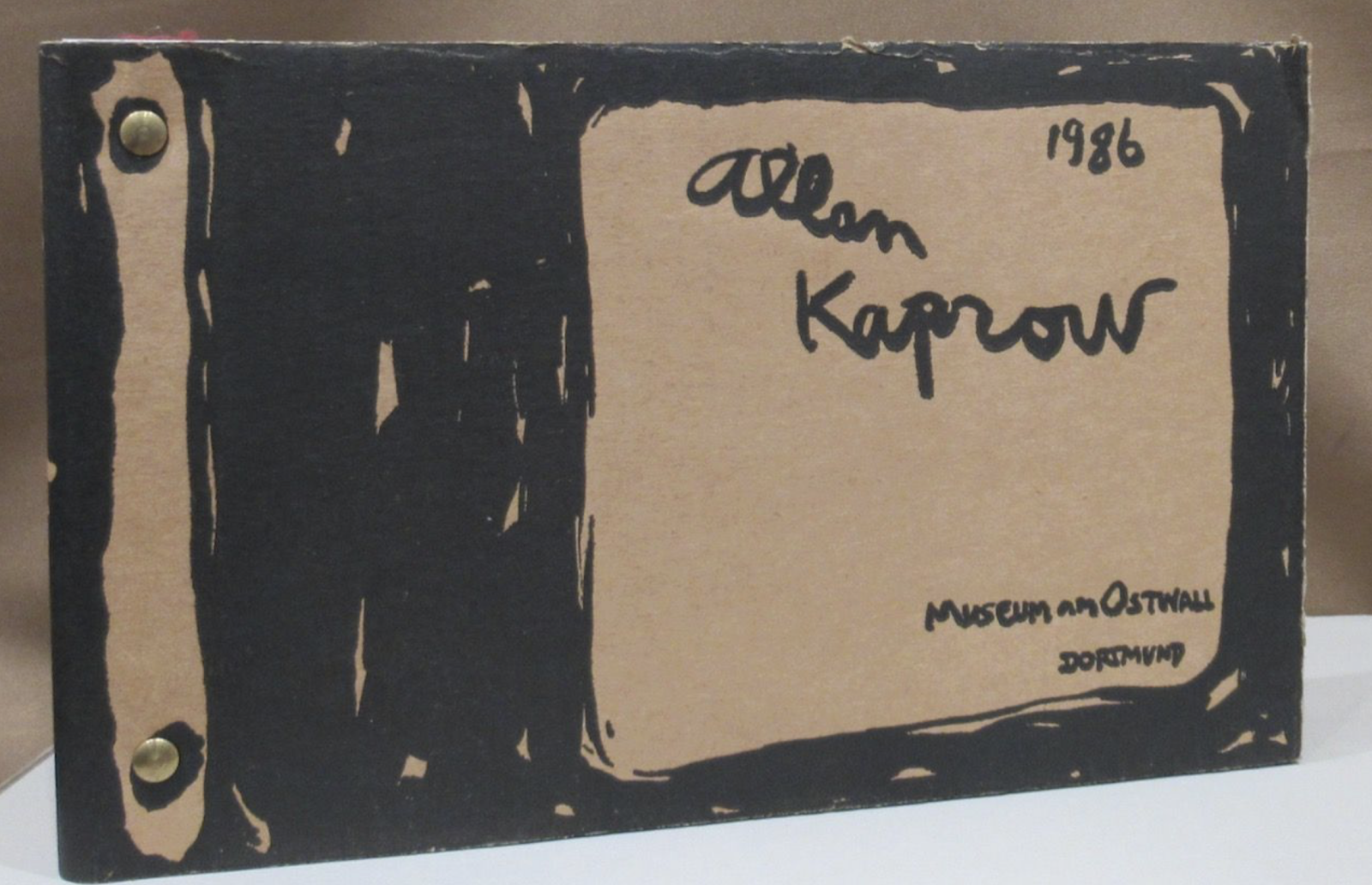
Allan Kaprow | Collagen, Environments, Videos, Broschüren, Geschichten, Happening und Activity-Dokumente 1956-1986.


Allan Kaprow
Collagen, Environments, Videos, Broschüren, Geschichten, Happening 
und Activity-Dokumente 1956-1986. 
Dortmund, Germany: Museum am Ostwall, 1986
150 pp., 27.5 x 17 cm., hardcover
Edition size unknown


An exhibition catalogue published in conjunction with a career retrospective show held August 24th to October 5th, 1986 in Germany. 

Kaprow invited friends and colleagues (Wolfgang Feelisch, Inge Baecker, Robert C. Morgan, Milan Knizák, Barbara Smith, Joachim Diederichs) to write about him and his work, from both personal and critical positions. The title also includes a discussion between the artist and Wolf Vostell, as well as a bibliography and artist's exhibition history. Text in English and German, with photography by Eric Andersen, Dick Higgins, and Peter Moore.

Designed by Kaprow, the book features a corrugated cardboard cover, held together with two brass screws. The title additionally includes a bibliography and artist's exhibition history.


Tuesday, June 24, 2025

Allan Kaprow | Photoalbum : Moving, A Happening


Allan Kaprow
Photo Album: Moving, A Happening
Chicago, USA: Museum of Contemporary Art, 1967
16 pp.,  21.5 x 14 cm., staple-bound
Edition size unknown


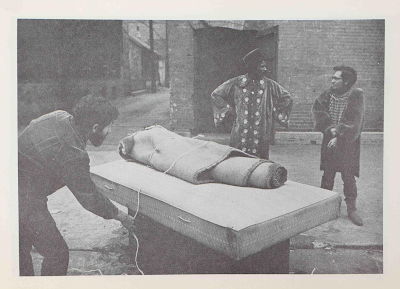
A slim Artists' Book documenting a happening which took place over four days, at six different sites. Designed by Kaprow, the booklet features seventeen black&white photographs by (Fluxus photographer) Peter Moore. 

 
"Some unused houses in different parts of the city. On each of four days, old furniture is obtained, and is pushed through the streets to the houses. The furniture is installed. On the first day, bedrooms are furnished, and slept in that night. On the second day, dining rooms are furnished, and a meal is eaten. On the third day, living rooms are furnished, and guests are invited to cocktails. On the fourth day, attics are filled and their doors are locked.” 
- Allan Kaprow


"In December 1967 Kapfow did an event in Chicago called Moving (sponsored by the Museum of Contemporary Art), in which participants were asked to furnish apartments with secondhand furniture that had been purchased for the event. The participants would briefly occupy one apartment—perhaps eating a meal together— before packing up their belongings and moving on to the next, rolling stacks of chairs, boxes, lamps, even a piano through the streets like bands of urban nomads. Moving was familial and friendly and required less labor than Fluids had, but it was just as fluid in its wanderings from
place to place.”    
- Jeff Kelley


Saturday, July 27, 2024

Allan Kaprow | Collagen, Environments, Videos, Broschüren, Geschichten, Happening und Activity-Dokumente 1956-1986.


Allan Kaprow
Collagen, Environments, Videos, Broschüren, Geschichten, Happening und Activity-Dokumente 1956-1986. 
Dortmund, Germany: Museum am Ostwall, 1986
150 pp., 27.5 x 17 cm., hardcover
Edition size unknown


An exhibition catalogue published in conjunction with a career retrospective show held August 24th to October 5th, 1986. Kaprow invited friends and colleagues (Wolfgang Feelisch, Inge Baecker, Robert C. Morgan, Milan Knizák, Barbara Smith, Joachim Diederichs) to write about him and his work, from both personal and critical positions. The title also includes a discussion between the artist and Wolf Vostell, as well as a bibliography and artist's exhibition history. Text in English and German. 

Designed by Kaprow, the book features a corrugated cardboard cover, held together with two brass screws. 


Wednesday, January 24, 2024

Allan Kaprow | Courtesy


Allan Kaprow
Courtesy
's-Hertogenbosch, The Netherlands: Slowscan, 2000
12" vinyl LP
Edition of 150 


Slowscan Volume 11 is a single-sided orange vinyl record with a sixteen minute performance by Kapprow. It was recorded on June 22nd, 1977, at KPFK Radio Los Angeles, hosted by John Duncan. 


Tuesday, April 18, 2023

Pictures to be Read / Poetry to be Seen


[Various Artists]
Pictures to be Read / Poetry to be Seen
Chicago, USA: Museum of Contemporary Art, 1967
36 pp., 23 x 21.5 cm., softcover
Edition size unknown


An exhibition catalogue for a group show held at the Chicago Museum of Contemporary Art from October 24th to December 3rd, 1967. Curated by Jan van der Marck, the exhibition featured works by Shusaku Arakawa, Gianfranco Baruchello, Mary Bauermeister, George Brecht, Öyvind Fahlström, Ray Johnson, Allan Kaprow, R. B. Kitaj, Alison Knowles, James Nutt, Gianni-Emilio Simonetti, and Wolf Vostell. 

The title suggests the show might feature concrete poetry and works that blurred boundaries between genres, but it was appears to be primarily works by Fluxus artists and associates. The exhibition features Alison Knowles now-classic The Big Book, a bookwork large enough to climb into, with the pages on casters (see below). 

A PDF of the catalogue can be downloaded from monoskop, here.


A second 'catalogue' of objects was also released. See next post. 


Sunday, November 3, 2019

Prepared Box For John Cage


[Allan Kaprow, ed]
Prepared Box For John Cage
Cincinnati, USA: Carl Solway Gallery, 1987
[83] pp., 21.5 x 20.5 cm., loose-leaves in box
Edition size unknown

Produced as a deluxe catalogue for the exhibition "Tribute to John Cage", organized by the Carl Solway Gallery at the 1987 Chicago International Art Exposition, this boxed portfolio served as a way to honour Cage on the occasion of his seventy-fifth birthday.

The participants are associates and admirers of Cage, primarily comprised of artists affiliated with Fluxus (Joseph Beuys, George Brecht, Giuseppe Chiari, Henry Flynt, Peter Frank, Geoffrey Hendricks, Alice Hutchins, Joe Jones, Shigeko Kubota, Milan Knizak, Alison Knowles, Fredric Lieberman, Larry Miller, Yoko Ono, Nam June Paik, Benjamin Patterson, Takako Saito, Paul Sharits, Mieko Shiomi, and Peter and Barbara Moore), Pop Art (Jasper Johns, Richard Hamilton, Claes Oldenburg, Robert Rauschenberg and George Segal) or both (Robert Watts, Ray Johnson). 

There are also contributions by artists associated with Happenings and Performance Art (Laurie Anderson, Allan Kaprow, Per Kirkeby, Carolee Schneemann) and the Nouveau Réalists (Jean Tinguely). Cage's lover Merce Cunningham contributed, as did curator Anne d'Harnoncourt, composer Christian Wolff and writers Dore Ashton and Allen Ginsberg. Other artists included Dorothea Rockburne, Christo, Richard Long, Tom Marioni, Robert Morris, and Louise Nevelson. 

Kaprow served as the editor, initiating the project with a letter sent to 100 friends and colleagues: 


"The Carl Solway Gallery is organizing an exhibition in honor of John Cage for the Chicago International Art Exposition in Nay, 1987. Many of John's friends and colleagues are assisting in the preparation of this exhibition by making new works, lending existing works, contributing statements or critical pieces for reproduction in the catalogue.

A number of us who are contributing have always had a keen interest theoretical and historical discourses among the arts of our time; and John has obviously played a key role in them. It would be of great value on this occasion to examine with care the radical shift he made possible in all the arts of the late 20th century. His influence is regularly acknowledged everywhere, but rarely in detailed or evaluatively. (For example, precisely how he has affected Fluxus, the Happenings, Sound Poetry, the New Dance, experimental film, and within what theoretical frameworks?). I'm writing to you, therefore, hoping that you'll find it intriguing to prepare for the catalogue a serious critical or speculative piece on the intellectual dimensions of John's teachings, essays and music, seen as a whole.

In my own case, I would like to look at the idea of chance, not just as a method, of chance operations, but at its philosophical implications, that of relinquishing the traditional control and ordering we normally associate with art making. I'd also like to account for the effect of John's early use of radios and other non-musical instruments, as a "permission" to go all the way toward integrating everyday life and art, to the extent that no art be apparent or necessary."


Paul Sharits' contribution is a 35 mm photographic slide of one of his filmstrip projects (pictured above). Ginsberg contributed a series of photographs from his kitchen window. Claes Oldenburg’s sketch “Colossal Monument with Mushroom and Screw” alludes to Cage’s use of nuts and bolts in his prepared piano works, as well as his interest in mycology. Other contributions include personal anecdotes ("he curved a dome of music into infinity" -Milan Knížák), images, games, poems, essays, and compositional scores.

The works are housed in a cardboard box held together with red, yellow and blue rubber bands, over an image of a street map of Chicago. This graphic relates to the felt-tip pen work by Cage from 1978, titled A Dip in the Lake: Ten Quicksteps, Sixty-One Waltzes and Fifty-Six Marches for Chicago and Vicinity (see below). To create the work, Cage assembled (through 'chance operations', naturally) a list 427 addresses and arranged them into ten groups of two, sixty-one groups of three, and fifty-six groups of four. Performers are instructed to visit the locations, listen, perform sounds or make recordings.

The reader must remove the bands to access the contents, but can also rearrange them to alter the street grid, or possibly place them on the open end of the box and pluck them like a home-made guitar.


Friday, May 23, 2014

Allan Kaprow | 3 Crime Stories


Allan Kaprow
3 Crime Stories
Verona, Italy: Edizioni Archivio F. Conz, 1995
11.2 x 9.5 x 3 cm.
Edition of 1500, 300 of which are signed

A cardboard box containing a transparent plastic box containing three scrolls held closed with brass rings. Each scroll contains a printed crime story.

Available for € 390.00, here.