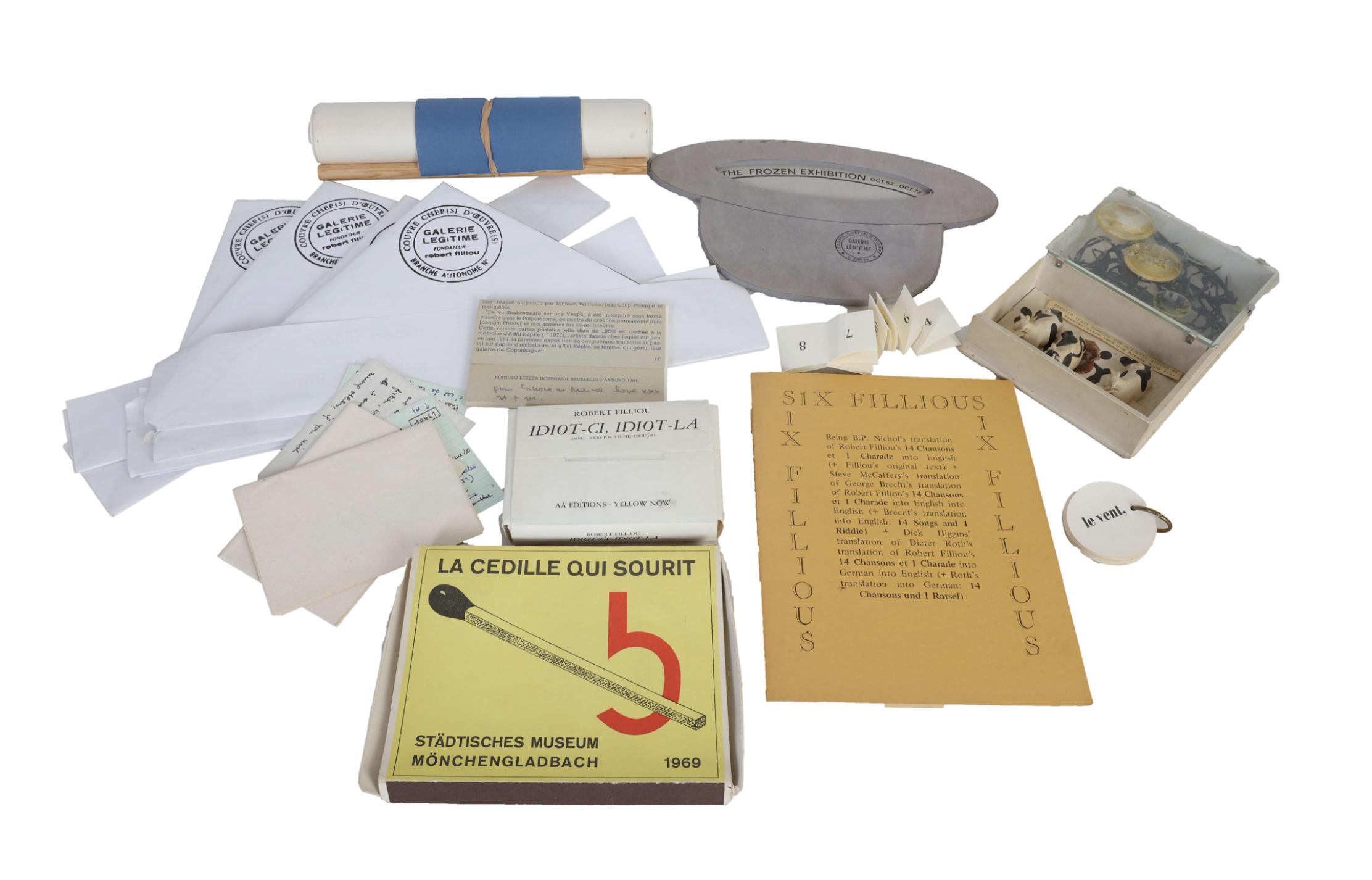
Showing posts with label Robert Filliou. Show all posts

Wednesday, July 22, 2026

Robert Filliou | Fluxdust


Robert Filliou
Fluxdust
New York City, USA: Fluxus, [circa] 1967
12 × 10 × 1.7 cm.
Edition size unknown


A plastic box with a label designed by George Maciunas [see above, bottom] containing collected dust. In 1984, the artist stated to Jon Hendricks that mentioned having a collection of hair and dust to Maciunas over a beer in London during the Festival of Misfits.  “By the time it was published, I had totally forgotten the idea.”

The works were later realized by Maciunas as a stand alone multiple for $3.00, and as part of the collective Fluxkit [see below]. 

A companion piece, Fluxhair, was produced at the same time with a near identical label. Despite Filliou's importance to Fluxus (and his interest in boxed editions), these two barely indistinguishable works appear to be the only multiples by him published by Fluxus. Some others reached the prototype stage - and there is a label design for something called The Obvious Deck - but none of them were produced or distributed via Fluxus. 

A later, better dust work (though without Maciunas’ design savvy) was published in 1977, under the title  Poussière de Poussière [see next post]. 


Saturday, July 4, 2026

Robert Filliou | Eins, Un, One


Robert Filliou
Eins, Un, One
Cologne, Germany: Edition Hundertmark, c1984
3 x 3 x 3 cm.
Edition of 100 [+ 50 AP] signed copies


An over-sized wooden die in which all sides display 'one'. Filliou's initials appear on a small sticker on one of the sides.

The work was originally issued as part of the Armin Hundertmark Karton 100 [above, centre], a boxed work contained forty-four works by different artists, including Monika Bartholomé, Claus Böhmler, Günther Brüs, Henri Chopin, Philip Corner, Robert Filliou, Jochen Gerz, Ludwig Gosewitz, Al Hansen, Anatol Herzfeld, Bernard Heidsieck, Joe Jones, Milan Knizak, Alison Knowles, Arthur Köpcke, Te Tsumi Kudo, Maria Lassnig, George Maciunas, Mario Merz, Otto Mühl, Hermann Nitsch, Paul Sharits, Takako Saito, Tomas Schmit, Endre Tot, Jiri Valoch, Ben Vautier, Stefan Wewerka, Emmett Williams and others. Most of the contributions are flat graphics, with the exception of five works, including Eric Andersen’s lighter [here]. 

Filliou would later exhibit installations involving thousands of similar dice, in a variety of colours and sizes. 

See also Dan Graham’s 1991 work One, below. 


"This work first appeared in 1984 and has been displayed in several 21st-century exhibitions, including Robert Filliou’s first solo exhibition at the Henry Moore Institute in Leeds in 2013. The constellation of 16,000 multicolored dice, each with all six sides bearing a single dot, delivers one of the more humorous works of homage to Stéphane Mallarmé’s Un Coup de Dés Jamais N’Abolira le Hasard. With the guarantee of a single dot, it might be thought that chance has been abolished, whichever and however many dice are rolled. The multiple sizes and colors of the dice and the varied constellations into which they might fall per installation suggest otherwise.

Just a thought.

As Mallarmé’s last line — Toute Pensé émet un Coup de Dés — implies, even this thought emits a throw of the dice.”


Friday, May 22, 2026

George Brecht | Cedille Uhr


George Brecht
Cedille Uhr
Mönchengladbach, Germany: Kunstverein Mönchengladbach, 1973
4 x 4.5 x 0.75 cm. [men's], 3 x 3 x 1 cm. [women's]
Edition of 90 [+5 A.P.] signed and numbered copies


A wrist watch containing a variety of tiny objects. Produced in an edition of 90 copies: 45 men's size and 45 women's.


In 1969, George Brecht and Robert Filliou organized an exhibition titled "La Cédille qui Sourit" at the Municipal Museum in Mönchengladbach. The exhibition referred to their three year stay in France, in a house called "La Cédille qui Sourit" in Villefranche.

In the summer of 1965, Brecht and Filliou placed a yellow awning and chalkboard sign in the window of the house that had previously housed a television repair store and candy shop. They called it La Cédille qui Sourit, or "The cedilla that smiles”, after the diacritical mark added under certain letters to modify their pronunciation (suggesting an S sound rather than a K, under the letter C, for example). The proprietors claimed the store would offer for sale "anything that contained a cedilla, and anything that did not".

The store carried materials from a number of artist affiliated with Fluxus, including titled published by the Something Else Press, Fluxus, and MAT Editions, though it was difficult to discern which items were completed and which were "in-progress”, as the space mostly served as the pair’s studio. 

Filliou later recounted “[It was] a sort of workshop and of shop, of nonshop would we say now, for we were never commercially registered, and the Cédille was always shut, opening only upon request of visitors to our homes.” They viewed it as a "Center of Permanent Creation”, using it to conduct research, write letters, jokes, songs, poems, scores and recipes,  and produce puzzles, games, drawings, and events.

Even as a studio space, its use was questionable, with the artists reportedly more likely to be working in nearby cafes.

In the third year of the store's operation, the Something Else Press published Games at the Cedilla [see below] as their 14th title (it was immediately followed by Store Days, by Claes Oldenburg, whose similar venture operated in New York City a few years prior). The charming book is a compendium of ideas, notations, journal records, correspondence, games, "One Minute Scenarios" and other writings made while Brecht and Filliou tended store.

This watch was produced at La Cédille qui Sourit, and - like most objects created in the three-year span  - bears its name. 


Wednesday, January 14, 2026

Robert Filliou | There Was A Drawing In the Centre of this Page


Robert Filliou
There Was A Drawing In the Centre of this Page
Köln, Germany: Galerie and Edition Hundertmark, 1993
[24] pp., 21 x 14.5 cm., staple-bound
Edition of 500


One of my favorites in the Hundertmark Booklet series is not an artists' book, but this posthumous catalogue listing many of Filliou's editions and multiples (for Hundertmark, but also other publishers, such as Vice-Versand, Zona, Edition Block and other contemporaries of Armin Hundertmark). Black and white images of A Most Curious Invention of Gaga Yogi, the LEEDS card game, Information Box, the Sans Object brick,  the Optimistic Boxes, Monsters Are Inoffensive, and many other works are accompanied by brief descriptions. 

Filliou died in December of 1987, five or six years before this publication, though it's possible that it could have been arranged many years prior to publication. Dorothy Iannone contributes a two page remembrance about Filliou, his partner Marianne and their child Marcelline. She calls him warm and wise and notes that she never - in twenty years - heard him say anything trivial: 

"When he spoke it was usually of the things we care most about. He dealt with them seriously, humorously, sometimes even sadly or bitterly, at times joyously, but he always seemed to abide by the heart of the matter."

The best part of the publication is the reproduction of a drawing Filliou gifted Armin Hundertmark nearly twenty years earlier, which is where the booklet takes its title, also. 

Last month Micah Lexier posted an image of the book to his Instagram account, alongside the promotional announcement, see below. 


Monday, February 3, 2025

Robert Filliou | The Obvious Deck


Robert Filliou
The Obvious Deck
New York City, USA: Fluxus, 1967
12 x 9.5 x 2 cm.
Edition never realized


The Obvious Deck is a deck of cards in which the front or back of each playing card is printed the same, allowing your opponents to see your hand. 

The work was intended as a project for Implosions, Inc., the publishing venture of George Maciunas, Herman Fine and Robert Watts. Multiple prototypes exist, or at least label and label designs, but the work never made it into production. This is presumably due to the cost of printing, as many other Fluxus card games involved the alteration of existing commercial decks. 

The above examples of the George Maciunas label design are from he Lila & Gilbert Silverman collection (now at MoMA), and Fondazione Bonotto.  

Jon Hendrick’s comprehensive Fluxus Codex lists the work advertised in no fewer than five Fluxus Newsletters, spanning just over two years: March 8, 1967, Spring 1967, January 31, 1968, December 2, 1968, March 15, 1969. The price listed is $6, which was on the higher side for Fluxus boxed works. 

The Obvious Deck shares much in common with Fluxus chess sets by Yoko Ono and Takako Saito and with Adam David Brown's transparent deck Play By Trust, which borrows its name from Ono's all white chess set. 


Friday, September 13, 2024

Jannis Kounellis | Kounellis


Jannis Kounellis
Kounellis
Monchengladbach, Germany: Städtisches Museum, 1978.
[5] pp., 19.5 x 15 cm., loose leaves, boxed
Edition of 440 numbered copies


Accompanying his exhibition, which ran from May 11th to June 11th in 1978, this boxed catalogue consists of a printed cardboard box containing four cards and a multiple by Kounellis. Three of the cards feature a continuous text of the poem Die Skythen, a poem written in 1918 by Russian lyrical poet Aleksandr Blok. The fourth is the title or colophon page. The multiple is made of compressed board, and features a metal rod embedded in white tissue. The rod is laminated in explosive powder the the work is intended to be ignited. 

When lit, the fuse produces a “bright hissing glow that leaves a black smoke trail on the grey-white plate”. 

This was the final boxed work in the Städtisches Museum series that began with Joseph Beuys in 1967 and also included editions by Carl Andre, Hanne Darboven, George Brecht & Robert Filliou, Piero Manzoni, Stanley Brown, Daniel Buren, Jasper Johns, Marcel Broodthaers, Lawrence Weiner, Gerhard Richter, and James Lee Byars, amongst others. 

The price during the run of the exhibition was DM 6. The work can now be purchased from Printed Matter, here, for $1800.00 US. 


Wednesday, January 17, 2024

Robert Filliou


Robert Filliou was born on this day in 1926.


Tuesday, December 5, 2023

George Brecht


Boxed works by George Brecht, who died on this day in 2008, at the age of 82.