Showing posts with label Joseph Beuys. Show all posts

Tuesday, August 4, 2026

24 Stunden


[Various Artists]
24 Stunden
Itzehoe-Vosskate, Germany: Hansen & Hansen, 1965
[592] pp., 10.5 x 7.5 cm., softcover
Edition size unknown


An exhibition catalogue as Artist Book as Artist Multiple, this short but thick volume documents a twenty-four hour performance event which took place at the Galerie Parnass, Wuppertal, Germany, on June 5, 1965 [see below]. 

In auction listings the work is generally attributed to Joseph Beuys, but I’ll assume that’s because he’s the most bankable of the group, rather than it being a project of his that they contributed to (the information tends to be in German). 

In addition to Beuys, the participating artists include Wolf Vostell, Bazon Brock, Rolf Jährling, Ute Klophaus, Charlotte Moorman, Nam June Paik, Eckart Rahn, and Tomas Schmit. 

The ambitiously produced book features bound leporellos as well as square punching in the middle, in order to house a plastic bag filled with flour, intended as the final element of the work. 


Tuesday, May 12, 2026

Joseph Beuys


Joseph Beuys was born on this day a hundred and five years ago. 


Sunday, June 8, 2025

Lightbulbs


Lightbulb works by Joseph Beuys, Joan Brossa, Maurizio Cattelan, Eduard Escoffet, William Pope L., Katie Patterson, Sigmar Polke and Miyo Takeda. 


Saturday, February 15, 2025

Joseph Beuys | Evervess II 1


Joseph Beuys
Evervess II 1
Berlin, Germany: Galerie René Block,1968
27 x 16.5 x 9.5 cm.
Edition of 40


Evervess II 1 consists of two carbonated water bottles, housed in an unsigned, unnumbered wooden box. The labels of one of the bottles has been obscured by Beuy’s trademark grey felt. The text on the cover instructs: 

The sender starts giving information when ‘II’ has been drunk completely and the bottle cap has been thrown away as far as possible.’1 The work thus requires the collaboration of its user in order for it to take full effect as the ‘sender.’


"I search for a suitable quality in an object, which permits multiplication of that object, for instance the quality implying a series, found in this bottle of tonic-water.  Just by being an article of commerce, this bottle can communicate much through repetition.

But actually, it's more important to speak of distribution, of reaching a larger number of people... You can look at it from a number of different aspects. Why is anyone interested in distributing a thing as widely as possible? 

The whole thing is a game, one which, with the help of this kind of information, counts on anchoring a vehicle somewhere close by, so that people can later think back on it. It's a sort of prop for the memory, yes, a sort of prop in case something different happens in the future.

For me, each edition has the character of a kernel of condensation upon which many things may accumulate.

You see, all those people who have such an object will continue to be interested in how the point of departure from which the vehicles started is developing. They'll be watching to see what the person who produced these things is doing now. That way I stay in touch with people; just as you have come to me because of what I've made and we can talk about it, I can talk to just about anybody who owns such an object. There's a real affinity to people who own such things, such vehicles. It's like an antenna which is standing somewhere and with which one stays in touch. There are also cross­connections between people, or ricochets. One person says: Yes, I've got such a bottle. Another one has such a wooden box and a third one says: I've heard something about political activities, and so all sorts of different concepts converge, and that's what I'm interested in, that a whole lot of concepts come together.

I'm interested in the distribution of physical vehicles in the form of editions because I'm interested in spreading ideas.

The objects are only understandable in relations to my ideas. The work I do politically has a different effect on people because such a product exists than it would have if the means of expression were only the written word.

Although these products may not seem suitable for bringing about political change, I think more emanates from them than if the ideas behind them were revealed directly.

To me the vehicle quality of the editions is important...”
- Joseph Beuys


Tuesday, December 17, 2024

Germano Celant | Record As Artwork


Germano Celant
Record As Artwork
London, UK: Royal College of Art Gallery, 1973
[28] pp., 17.2 x17.7 cm., staplebound
Edition size unknown


An exhibition catalogue published on the occasion of Royal College of Art Gallery in London show in November 1973, which is often considered the first survey of artworks made for the format of the vinyl LP. 

Edited by Roselee Goldberg (who went on to become a leading authority on Performance Art), the book features records by Marina Abramovic, Richard Artschwager, Joseph Beuys, Jean Dubuffet, Marcel Duchamp, Yves Klein, Arthur Koepcke, Bruce Nauman, Jean Tinguely, Bernar Venet, Andy Warhol, Lawrence Weiner, and others. 

The title is scarce and valued at around $500 US. 


Wednesday, December 11, 2024

Nam June Paik: Art in Process


[Nam June Paik]
Nam June Paik: Art in Process
Los Angeles, USA: Gagosian, 2022
180 pp., 23.5 × 30.2 cm., hardcover
Edition size unknown


Published on the occasion of the two-part exhibition of the same name, curated by John G. Hanhardt, this volume surveys Paik’s work and reflects on the artist’s working method and the ideas and materials that inspired his art practice.

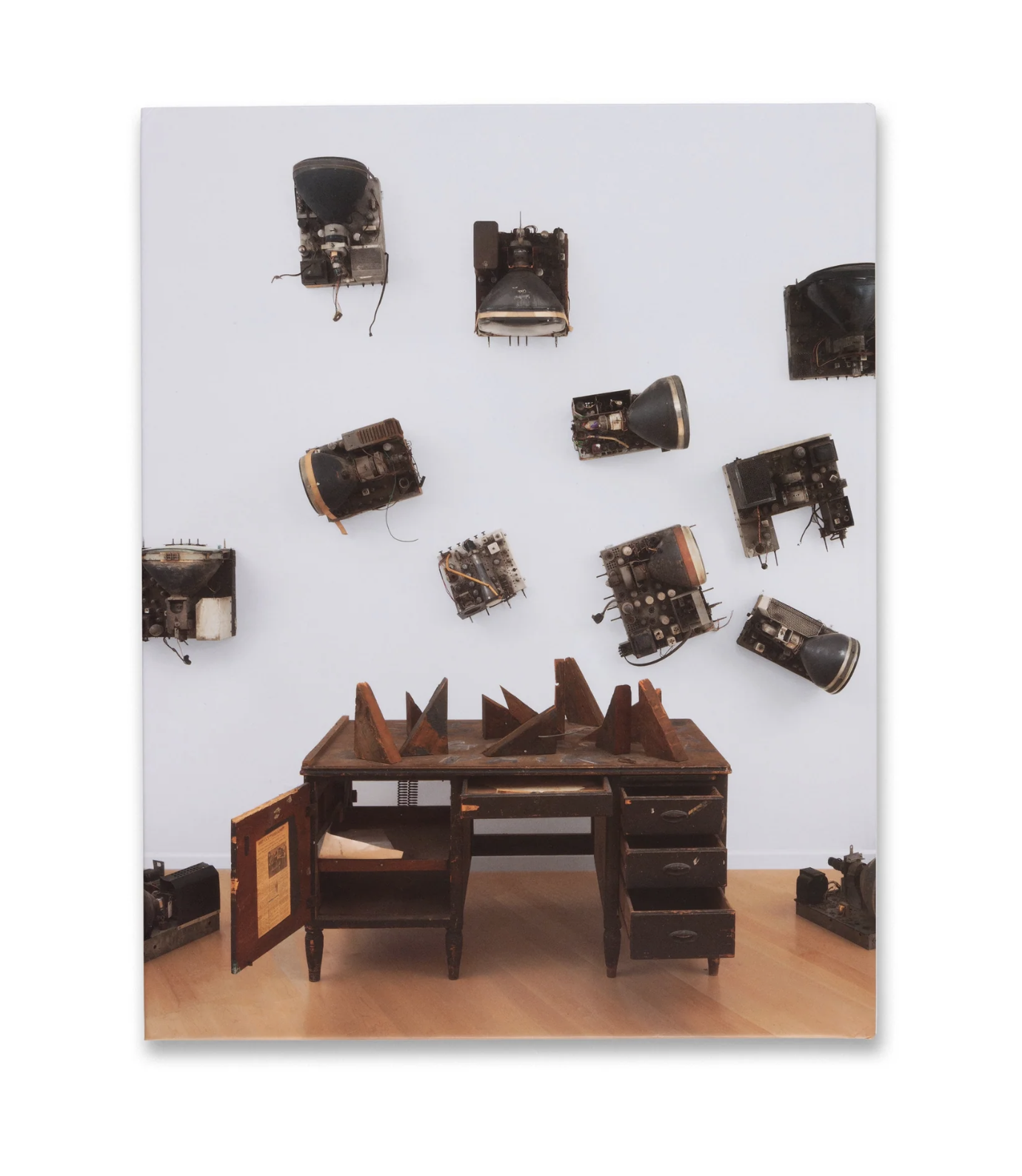
As the title suggests, the book highlights the centrality of process across Paik’s career—from the manipulation of television sets in the early 1960s to live global satellite telecasts and large-scale video sculptures. It includes collaborations with Joseph Beuys and Charlotte Moorman. 

Nam June Paik: Art in Process features essays by Hanhardt and Gregory Zinman, and extensive illustrations including numerous full-page plates and details, a foldout of the score for Paik’s Symphony for 20 Rooms (1961), as well as rarely seen archival photographs documenting Paik’s early performances by Peter Moore (1932–1993), dating from 1964 through 1977.


Wednesday, May 15, 2024

Joseph Beuys | Rose for Direct Democracy


Joseph Beuys
Rose für direkte Demokratie 
Heidelberg, Germany: Edition Staeck, 1973
2 x 2 x 13.25"
glass graduated cylinder with inscription, rose
Edition of 440 signed and numbered copies


"At the documenta 5 exhibition in Kassel, West Germany in 1972, Beuys established a ‘political bureau’ for the Organisation for Direct Democracy Through Free Collective Referendum, a group he had recently co-founded. Throughout the hundred days of the exhibition, he spoke and debated with exhibition visitors, putting forward his ideas for reshaping society through creative activity. Though his proposals were often radical, Beuys worked hard to distance himself from groups like the Red Army Faction (R.A.F.) in West Germany and the Red Brigades (B.R.) in Italy, who at this time were advocating violence as a means of achieving social revolution. In contrast to this position, Beuys emphasised his wish for a more peaceful, evolutionary route to societal development.

On his desk at documenta 5 stood a slender glass vase, in which a fresh-cut red rose was placed each day. The multiple Rose for Direct Democracy derives from this vase, but consists of a graduated cylinder, on which the work’s title is inscribed. Spiraling upward from the cylinder’s base, the inscription follows the direction of the rose’s growth, evoking the smooth trajectory along which Beuys hoped to see society progress. The petals of the rose, which differ radically in appearance from the rest of the plant, became a signifier of this process in Beuys’s eyes, since they emerge by means of a gradual transformation of its leaves. As he noted in this connection several years after the exhibition, ‘Bud and bloom are in fact green leaves transformed. So in relation to the leaves and the stem the bloom is a revolution, although it grows through organic transformation and evolution.’”


Tuesday, January 23, 2024

Joseph Beuys


Joseph Beuys died on this day in 1986, at the age of 64.