Showing posts with label Tony Conrad. Show all posts

Sunday, January 28, 2024

Gavin Bryars | The Sinking of the Titanic


Gavin Bryars
The Sinking of the Titanic
San Francisco, USA: Superior Viaduct, 2022
Audio CD
Edition size unknown


Once impossible to find, now seemingly everywhere, in a variety of different versions, Bryar’s The Sinking of the Titanic is available on CD from Superior Viaduct. 

The label, founded in 2011, has produced a series of reissues of excellent and rare works by Glenn Branca, William Burroughs, Tony Conrad, Jean DeBuffet, David Cunningham, Henry Flynt, Terry Fox, Joe Jones, Takehisa Kosugi, Chris Marker, Phil Niblock, Steve Reich, The Residents, Yoshi Wada, La Monte Young, Marian Zazeela and many other artists whose work will have appeared here. 

They are also issuing vinyl by musicians, such as Ornette Coleman, Pascal Comelade, The Fall, Brigitte Fontaine, Laraaji, Charles Mingus, Sun Ran, Suicide, Tuxedomoon and the Upsetters. 

Visit their site, here


Friday, March 4, 2022

Henry Flynt | Down With Art!


Henry Flynt
Down With Art!
New York City, USA: Fluxpress, 1968. 
12 pp., 10 x 27 cm., staple-bound
Edition size unknown


Henry Flynt began his Anti-Art campaign in earnest in 1962. A year later he demonstrated against cultural institutions in New York City, including MOMA and Lincoln Center, with artist and musician Tony Conrad and filmmaker Jack Smith. In 1964, he picketed performances by Karlheinz Stockhausen. 

On February 28th, 1963, Flynt read from his text From Culture to Veramusment at Walter De Maria's loft in front of a portrait of Vladimir Mayakovsky, the Futurist poet, playwright, artist, and actor. Diane Wakoski's photograph of the event became the cover graphic for the pamphlet Down With Art! (and perhaps the most iconic image of Flynt ever). 

The 12-page George Maciunas-designed leaflet is Flynt's first solo publication. His Concept Art essay appeared in An Anthology in 1963, and he contributed to Wolf Vostell's décollage the year prior. From Culture to Veramusment was included in the third Fluxus newspaper (see below). The work features Flynt's Art or Brend essay (below), as well as artists' statements by Terry Riley, Robert Morris, Walter De Maria, Diane Wakoski and Ben Vautier.


"Art Or Brend

1. Perhaps the most diseased justification the artist can give of his profession is to say that it is somehow scientific.

It is the creative personality him- or herself who has the most reason to object to the "scientific" justification of art. Again and again, the decisive step in artistic development has come when an artist produces a work that shatters all existing "scientific" laws of art, and yet is more important to the audience than all the works that "obey" the laws.

2. The artist or entertainer cannot exist without urging his or her product on other people. In fact, after developing his or her product, the artist goes out and tries to win public acceptance for it, to advertise and promote it, to sell it, to force it on people. If the public doesn't accept it as first, he or she is disappointed. He or she doesn't drop it, but repeatedly urges the project on them.

People have every reason, then, to ask the artist: Is your product good for me even if I don't like or enjoy it? This question really lays art open. One of the distinguishing features of art has always been that it is very difficult to defend art without referring to people's liking or enjoying it. (Functions of art such as making money or glorifying the social order are real enough, but they are rarely cited in defense of art. Let us put them aside.) When one artist shows his latest production to another, all he can usually ask is "Do you like it?" Once the "scientific" justification of art is discredited, the artist usually has to admit: If you don't like or enjoy my product, there's no reason why you should "consume" it.

There are exceptions. Art sometimes becomes the sole channel for political dissent, the sole arena in which oppressive social relations can be transcended. Even so, subjectivity of value remains a feature which distinguishes art and entertainment from other activities. Thus art is historically a leisure activity.

3. But there is a fundamental contradiction here. Consider the object which one person produces for the liking, the enjoyment of another. The value of the object is supposed to be that you just like it. It supposedly has a value which is entirely subjective and entirely within you, is a part of you. Yet--the object can exist without you, is completely outside you, is not your or your valuing, and has no inherent connection with you or your valuing. The product is not personal to you.

Such is the contradiction in much art and entertainment. It is unfortunate that is has to be stated so abstractly, but the discussion is about something so personal that there can be no interpersonal examples of it. Perhaps it will help to say that in appreciating or consuming art, you are always aware that it is not you, your valuing--yet your liking it, your valuing it is usually the only thing that can justify it.

In art and entertainment, objects are produced having no inherent connection with people's liking, yet the artist expects the objects to find their value in people's liking them. To be totally successful, the object would have to give you an experience in which the object is as personal to you as your valuing of it. Yet you remain aware that the object is another's product, separable from your liking of it. The artist tries to "be oneself" for other people, to "express oneself" for them.

4. There are experiences for each person which accomplish what art and entertainment fail to. The purpose of this essay is to make you aware of these experiences, by comparing and contrasting them with art. I have coined the term `brend' for these experiences.

Consider all of your doings, what you already do. Exclude the gratifying of physiological needs, physically harmful activities, and competitive activities. Concentrate on spontaneous self-amusement or play. That, is concentrate on everything you do because you like it, because you just like it as you do it.

Actually, these doings should be referred to as your just-likings. In saying that somebody likes an art exhibit, it is appropriate to distinguish the art exhibit from his or her liking of it. But in the case of your just-likings, it is not appropriate to distinguish the objects valued from your valuings, and the single term that covers both should be used.

When you write with a pencil, you are rarely attentive to the fact that the pencil was produced by somebody other than yourself. You can use something produced by somebody else without thinking about it. In your just-likings, you never notice that things are not produced by you. The essence of a just-liking is that in it, you are not aware that the object you value is less personal to you than your very valuing.

These just-likings are your "brend." Some of your dreams are brend; and some children's play is brend (but formal children's games aren't). In a sense, though, the attempt to give interpersonal examples of brend is futile, because the end result is neutral things or actions, cut off from the valuing which gives them their only significance; and because the end result suggests that brend is a deliberate activity like carrying out orders. The only examples for you are your just-likings, and you have to guess them by directly applying the abstract definition.

Even though brend is defined exclusively in terms of what you like, it is not necessarily solitary. The definition simply recognizes that valuing is an act of individuals; that to counterpose the likes of the community to the likes of the individuals who make it up is an ideological deception.

5. It is now possible to say that much art and entertainment are pseudo-brend; that your brend is the total originality beyond art; that your brend is the absolute self-expression and the absolute enjoyment beyond art. Can brend, then, replace art, can it expand to fill the space now occupied by art and entertainment? To ask this question is to ask when utopia will arrive, when the barrier between work and leisure will be broken down, when work will be abolished. Rather than holding out utopian promises, it is better to give whoever can grasp it the realization that the experience beyond art already occurs in his or her life--but is totally suppressed by the general repressiveness of society.

Note: the avant-garde artist may raise a final question. Can't art or entertainment compensate for its impersonality by having sheer newness as a value? Can't the very foreignness of the impersonal object be entertaining? Doesn't this happen with my "Mock Risk Games," for example?

The answer is that entertainmental newness is also subjective. What is entertainingly strange to one person is incomprehensible, annoying or irrelevant to another. The only difference between foreignness and other entertainment values is that brend does not have more foreignness than conventional entertainment does.

As for objective newness, or the objective value of "Mock Risk Games," these issues are so difficult that I have been unable to reach final conclusions about them."


Monday, February 8, 2021

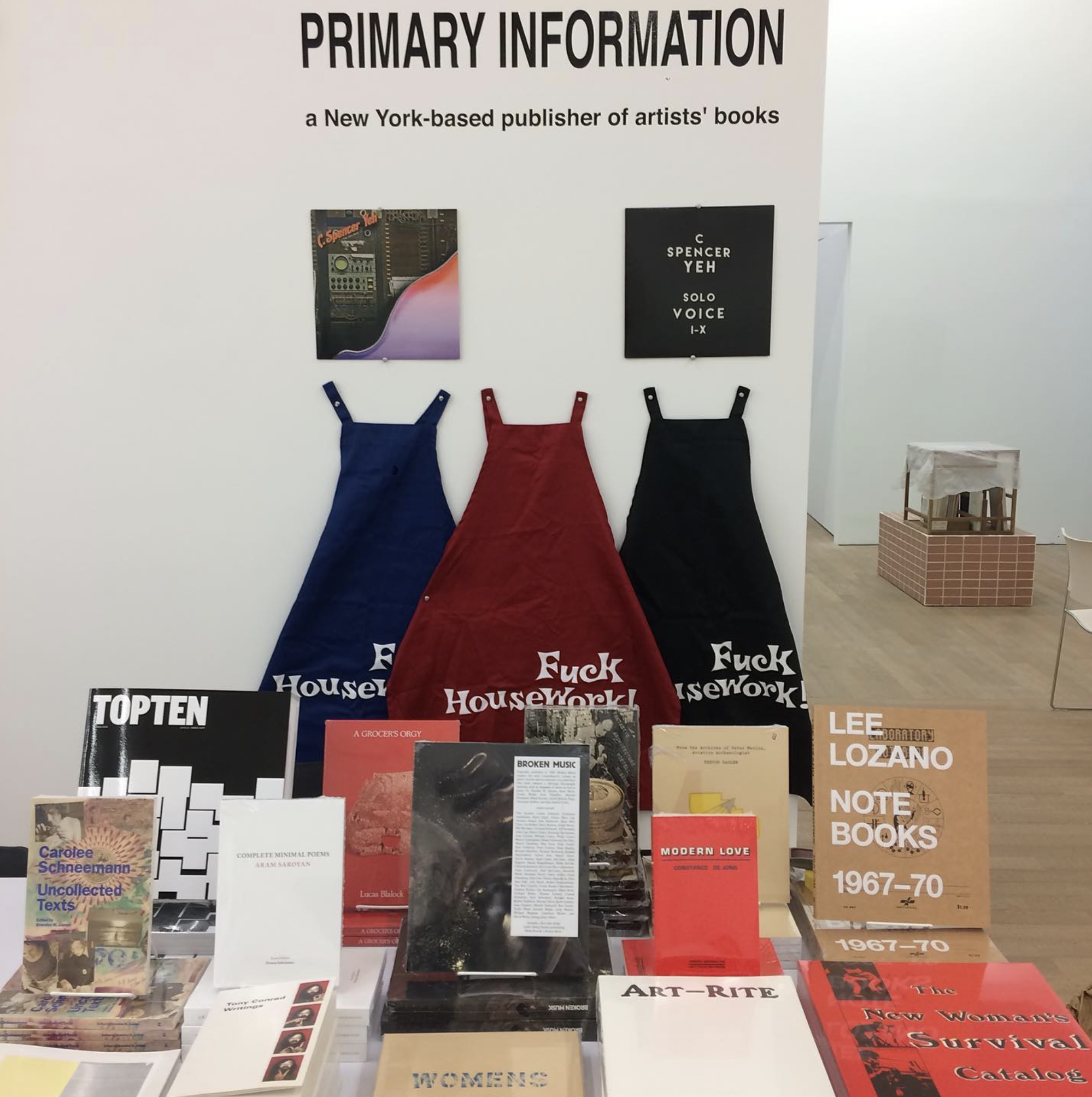
Primary Information


The previous post concludes a week of Primary Information titles. Fourteen posts are, of course, not enough to do justice to the publisher, and there are several glaring omissions: 

Fantastic Architecture and An Anthology of Concrete Poetry, which I never bought as I have the original Something Else Press titles. Both are essential. 

James Hoff’s TopTen, which I was also lucky enough to get the original, pre-PI version. 

The box set of Great Bear Pamphlets, which deserve a full week themselves. I’ll try to get to them next month. 

Women in Concrete Poetry, which deserves a deeper dive than I can accommodate right now. 

Tony Conrad’s Writings, which I need to finish reading. 

Avalanche, which I missed out on and which is now sold-out. 

Visit Primary Information here


Tuesday, January 28, 2020

Primary Information Sale


Primary Information have just announced a sale lasting 48 hours, during which all of their available titles are being offered for 50% off the list price.

Founded in 2006, the Brooklyn-based nonprofit quickly established themselves as an essential publishers of artist's books and editions. In addition to new titles by both emerging and established artists (Sarah Crowner, James Hoff, Fia Backström, Cory Arcangel, etc.) their mandate was to make long out-of-print titles available again to new audiences. These include facsimile reprints of classic bookworks from the Something Else Press (Fantastic Architecture, An Anthology of Concrete Poetry, the Great Bear Pamphlets), essential titles from Lee Lozano, Carolee Schneemann, Tony Conrad, Constance DeJong, etc., as well as collections of influential artist periodicals (Art Rite, Real Life, Just Another Asshole, Avalanche, Yeah, Destroy All Monsters) and vinyl LPs (the UJerks, Allan Kaprow's How to Make a Happening, The Guerrilla Art Action Group).

The sale ends on January 30 at 10:00am EDT.

Visit www.primaryinformation.org for more information.

Friday, April 14, 2017

Aryen Hoekstra | On The Flicker


Aryen Hoekstra
On The Flicker
Toronto, Canada, Self-published, 2017
42 x 590 cm.
Edition of 240

Tony Conrad died a year and a week ago, of prostate cancer, at age 76. One of his best known works, The Flicker, celebrated it's fiftieth anniversary that year. Produced with the help of Jonas Mekas, the 30-minute film took months to design and a few days to shoot. Apart from three title cards, The Flicker consists of only two frames. The first title is a warning that the producer, distributor, and exhibitors waive all liability for physical or mental injury:

"Since this film may induce epileptic seizures or produce mild symptoms of shock treatment in certain persons, you are cautioned to remain in the theatre only at your own risk. A physician should be in attendance."

Then "Tony Conrad Presents," and "The Flicker". At this point the screen goes white and flickers with a black frame, producing a stroboscopic effect that induced headaches and vomiting from some viewers. It is widely celebrated as a masterpiece of early structuralist filmmaking.


On The Flicker is Aryen Hoekstra's fictional account of attending a screening of the film. It exists as a free takeaway poster which forms the basis of his exhibition The Flicker, which opens tonight at YYZ Artist’s Outlet in Toronto. The text, written as part of a Banff writers residency, is at the centre of the exhibition, which also includes a suite of 24 paintings produced in collaboration with his partner Jennifer Carvalho, and a series of "objects and gestures" within the gallery intended as speculative sites against which the text might be considered.

"I’d arrived in Banff with the intention of writing a longer essay on Tony Conrad’s The Flicker (1965-66), anticipating that I’d use that film as a prompt from which to enter an extended discussion on light and dark, image and interval, and projection and speculation; a way to tease out themes already bubbling under and at the surface of my practice. The text had other ideas about what it should be and instead transformed itself into a short fiction set at a screening of Conrad’s film."

The exhibition opened Wednesday, with a reception tonight from 5 to 8 pm. Hoekstra will present a reading before a 16mm screening of Conrad's The Flicker at CineCycle (129 Spadina Ave) at 5:00pm tomorrow, Saturday April 15th.

For more information, visit the YYZ site here and the artist's website, here.


Saturday, April 9, 2016

Tony Conrad, RIP


Tony Conrad died today, at age 76.

Monday, July 28, 2014

Mieko Shiomi | Disappearing Music for Face


Mieko Shiomi
Fluxfilm No. 4 : “Disappearing Music for Face”
New York City, USA: ReFlux, 2002
[40] pp., 4 x 6.2 cm., staple-bound
Edition of 79

A work by Mieko (Chieko) Shiomi, performed by Yoko Ono, designed by George Maciunas, published by Fluxus, photographed by Peter Moore and re-published by his wife Barbara Moore (who ran Reflux Editions, and Bound and Unbound, among other things). The date and edition size of the original Fluxus work is unknown, but when Moore acquired the Maciunas estate she discovered enough vintage printed sheets to re-collate 79 copies as the Reflux edition.

In 1966, Maciunas got his hands on an expensive high-speed 'scientific analysis camera', which recorded film at a rate of 2000 frames a second.  When the resulting films are projecting at the standard speed of 24 frames a second, it produced an extreme sensual slow motion effect. Having access to the camera for only a single day, he set up in photographer Peter Moore’s East 36th Street apartment and invited a number of Fluxus artists to submit projects that could be filmed in the short production session.

Shiomi's contribution was a work that she had originally presented as a performance piece in 1964 (see below).  The original score for the performance simply reads: "Performers begin the piece with a smile and during the duration of the piece, change the smell very gradually to no smile". The eight seconds of footage shot that day of Ono moving from smile to no smile, became an 11 minute, 15 second film (though the duration of the piece changes and in Fluxus newsletters Maciunas advertises it as fifteen minutes in length in 1966 and ten minutes long in 1969).

Maciunas had hoped to turn many of the Fluxfilms into flip books, but only this title and Dick Higgins Invocation of Canyons and Boulders were ever produced.


“What happened was that Chieko Shiomi [...] had just left to go to Japan.  Then this high-speed camera idea came up, and when George was saying, ‘Quick, quick, ideas,’ I said, ‘Well, how about smile’; and he said, ‘No, you can’t do that one.’ Finally, he said, ‘Well, OK, actually I wanted to save that for Chieko Shiomi because she had the same idea.  But I will let you perform.’  So that’s me smiling. Later I found out that hers was a disappearing piece; the concept is totally different from what I wanted to do.  Chieko Shiomi’s idea is beautiful; she catches the disappearance of a smile.  At the time I didn’t know what her title was.”
- Yoko Ono


"I remember the Fluxfilms very clearly because I was friends with George at the time when that project came together. One day he told me with a broad laugh that he was going to rent a high-speed camera and that all the Fluxus artists were going to make films in one day, and that it would cost hardly anything. I think George loved being able to trample traditions and expectations; here
was a way for the Fluxus group to become star filmmakers with virtually no effort or expenditure.

John Cale had shot a little film, and he gave that to George, and other people made conceptual pieces that they executed using that high-speed camera. Yoko Ono did several, and Chieko Shiomi did the beautiful Disappearing Music for Face, a wonderful film."

- Tony Conrad

The flip-book is available at Printed Matter, here, for $150 US, and the original film can be viewed at Vimeo, here.


Thursday, May 10, 2012

Tony Conrad | Pickled Films


From an interview my friend Jay Sanders conducted with the artist, for Bomb magazine, a few years back:

JS: It’s amazing to see how far things are pushed with your work from that period—in the Yellow Movies from ’73, which are films that can basically go on forever but utilize no projectors and no film, and also the film objects that you made around that time, where film itself is treated and transformed chemically, and is often fully unprojectable. I know you gave a recent talk at the Guggenheim and you called some of that work “pathological.” Citing this work specifically, could you elaborate on some of those projects?

TC: Well, if you take a roll of film and instead of making pictures on it, you process it by pickling it in vinegar and putting it in a jar and presenting it for people to look at that way, projected through the lens of the fluid around it, this is so distorted and such a monstrous disfigurement of the normal way in which you are “supposed to use” film, that it is a kind of pathology; it’s a sickness in the sense of a virus being inserted in the system. I think wellness and change are measured by comparison to potential for extremes of illness or death. I was trying to kill film. I wanted to let it lay over and die.