Showing posts with label Lapp Princess Press. Show all posts

Wednesday, July 5, 2017

Jackie Ferrara | Drawings June and July 1977


Jackie Ferrara
Drawings June and July 1977
New York City, USA: Lapp Princess Press, 1977
[10] pp., 16 x 16 cm., saddle-stitched
Edition of 2000

An examination of the pyramid structure using birds-eye-views and profile views, and a curious scale key, wherein 1/8" equals 1/4".

Available from Printer Matter, here, for $20.00 US.

Sunday, April 2, 2017

James Rosenquist | Drawings while waiting for an idea


James Rosenquist
Drawings while waiting for an idea
New York City, USA: Lapp Princess Press, 1979
[24] pp., 16 x 16 cm., saddle-stitched
Edition of 2000

Rosenquist died after a long illness, at his home in New York City on Friday, at the age of 83.

Fred Sandback | Ten Isometric Drawings for Ten Vertical Constructions


Fred Sandback
Ten Isometric Drawings for Ten Vertical Constructions
New York City, USA: Lapp Princess, 1977.
[24] pp., 15.3 x 15.3 cm, staple-bound
Edition of 2000

A six-inch squared booklet featuring ten diagrams and no text, the title is the first in a series of uniform-sized publications produced by the Lapp Princess Press. The Press was founded by writer and art critic Amy Baker, who later would marry Sandback, and become the executive publisher of Artforum. Lapp Princess’s goal was to create artists’ books that could be purchased by the widest possible audience, insisting on large edition sizes and affordable prices. Under Baker’s directorship twelve titles were issued and the press continued on without her, producing other booklets in the six-inch squared format, as well as other dimensions.

Sandback's title was followed by Victor Burgin’s Family, Lines and Non-Lines by Edda Renouf, Drawings June and July 1977 by Jackie Ferrara,  Unwritten by David Shapiro/Lucio Pozzi, Project Entitled 'The Beginnings of a Complex...' by Alice Aycock, Studies by Ralph Humphrey, Inches and Field by Sylvia Plimack Mangold, Parete by Marco Gastini, Drawings While Waiting for an Idea by James Rosenquist, Six Arcs by Robert Mangold, and Keith/Six Drawings/1979 by Chuck Close.

A 2003 reprint is available for $12.00 from Diabooks, here. The original can be found at Amazon, here, for $85.00.


Friday, August 19, 2016

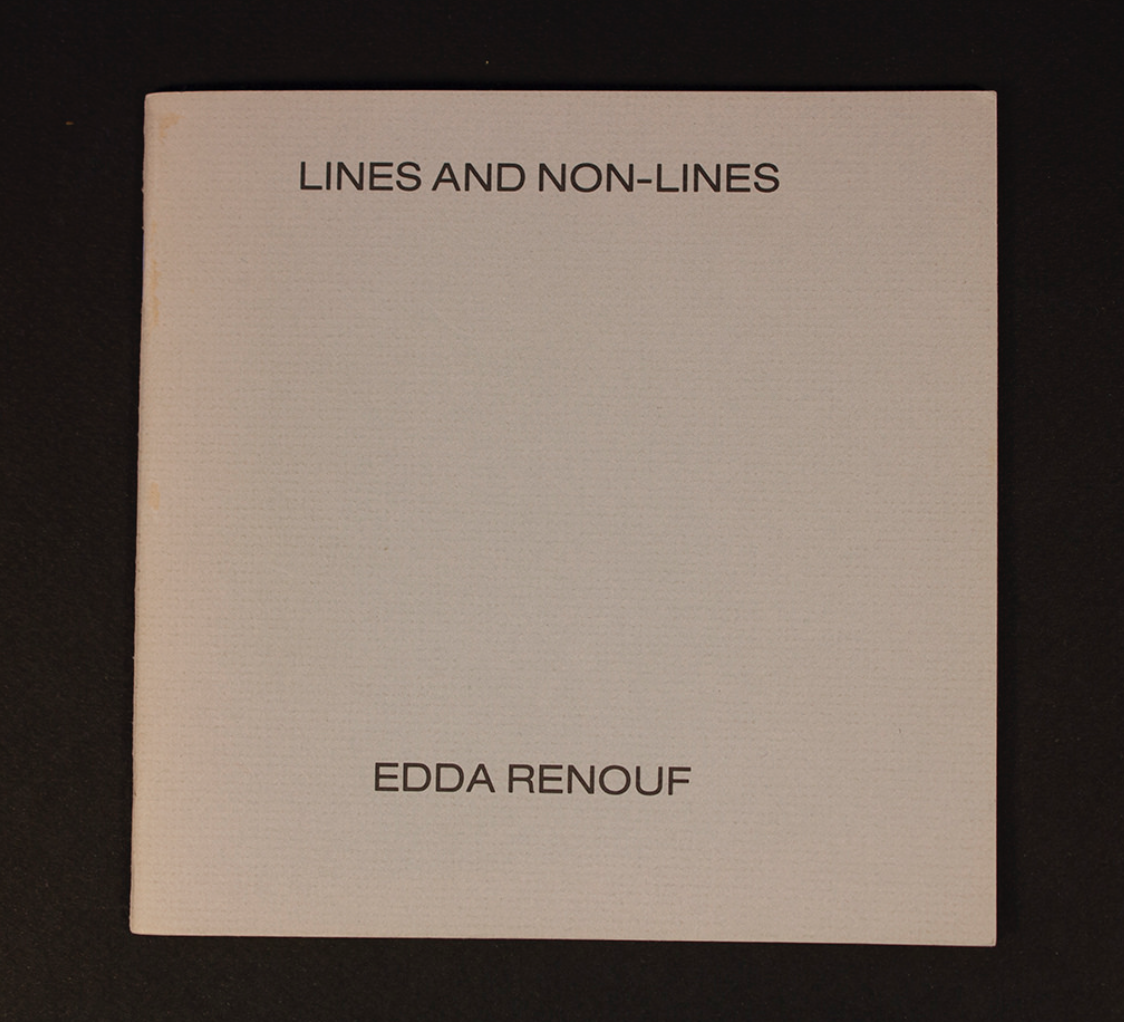
Edda Renouf | Lines and Non-Lines


Edda Renouf
Lines and Non-Lines
Lapp Princess Press, 1977
24 pp., 6 x 6", staple-bound
Edition of 2000

Renouf describes the images in this book with three simple lines on the title page: From One To Many, From Short To Long and Vice Versa.

Thursday, August 18, 2016

James Rosenquist | Drawings while waiting for an idea


James Rosenquist
Drawings while waiting for an idea
New York City, USA: Lapp Princess Press, 1979
[24] pp., 16 x 16 cm., saddle-stitched
Edition of 2000

Wednesday, August 17, 2016

Robert Mangold | Six arcs


Robert Mangold
Six Arcs
New York City, USA: Lapp Princess Press, 1978
[25] pp., 16 x 16 cm., side-stitching
Edition of 2000

The eleventh booklet in the Lapp Princess Press series is an artists' book consisting of six line drawings that originate and terminate in various locations on the page as described on the front cover:

1) Corner to Corner
2) Corner to Square
3) Middle to Corner
4) Corner to Middle
5) Square to Corner
6)  Corner to Corner


Thursday, August 4, 2016

Chuck Close | Keith : Six Drawings 1979


Chuck Close
Keith : Six Drawings 1979
New York City, USA: Lapp Princess Press, 1979
[12] pp., 16 x 16 cm., softcover
Edition of 2000

Six drawings of sculptor Keith Hollingworth, who Close had first painted almost a decade prior. The two had become friends while they were both teaching at the University of Massachusetts, Amherst. The drawings are made using six different mark making and thumb printing techniques: fingerprints, water colours, white conte, black gouache, ink sticks, and Spring Street Swizzle Sticks 


"Chuck and I had been friends for some time when he approached me and asked if I would be one of his "mug shots," as he then called them. A series of shots was taken by my brother Wayne, who worked as a professional photographer at the time. Chuck was amazed about the images being so consistent. The explanation is simple: as I have a facial paralysis, I preferred to just hold my face and avoid the risk of showing an asymmetrical expression. That was the sitting. Then, a grid system was applied to a 16 x 18 inch photograph to blow the image up. It was hard for me to look at the finished work. But this was mainly because of my facial paralysis, as I hadn't come to terms with it. In the long run, it was also difficult to understand that "Keith" and I had become two completely separate entities.

When the painting was finished, Chuck had a show at the Bykert Gallery and asked if I would help him hang it. It felt odd to have the art handlers speak of moving "Keith" around as they worked to organize the show. Henry Geldzahler, the legendary curator of contemporary art at the Metropolitan Museum, came by. Although I attempted to stand a little taller so that he would make a connection between me and the painting, neither he nor anyone else noticed the relationship.

In 1998, I took my family to see the [Chuck Close] retrospective at MoMA. My sons quickly stepped out of the first room where my portrait was. I think they couldn't bear to see me so oversized. They also had to go through another room with even more versions of the portrait, all of them of respectable sizes, too: a Mezzotint and a series of drawings. One of my sons remarked that I looked so angry. Actually, he was right: I was quite angry at that time in my life.

In the beginning, the painting, and later the mezzotint and other images, made me uncomfortable because of my poor self-image. As the years have passed, however, I am able to talk about the portrait without feeling at odds with myself. I have to continually remind people that the painting is famous, and I am simply the subject."

- Keith Hollingworth, interviewed by Matthias Waschek in 2006


Wednesday, July 27, 2016

Victor Burgin | Family


Victor Burgin
Family
New York City, USA: Lapp Princess Press, 1977
14 pp., 15,2 cm x 8 cm., softcover
Edition of 2000

Co-published by Printed Matter, the second Lapp Princess Press booklet borrows the format of a child’s primer to comment on contemporary family life.


"Burgin makes photographic work like no other artist, but his themes and motifs are drawn from experiences common to us all – the modern city, the structures of family, language as something that forms and reforms us, the power of images, principles of government, memory and history.  And yet, encouraged by the media to look to art for quick messages, some audiences and critics have found his work ‘inaccessible’. Actually Burgin’s work is among the most accessible I know, if by that we mean ‘easy to get into’. It’s the getting out that’s tricky. To be truly challenged and changed is to find yourself unsure, slightly lost, forgetting where you came in but pleased you did. As Roland Barthes once put it, ‘To get out, go in deeper.'"
- David Campany, Aperture Magazine no. 210, 2012.

Sunday, February 9, 2014

Edda Renouf | Lines and Non-Lines


Edda Renouf
Lines and Non-Lines
Lapp Princess Press, 1977
24 pp., 6 x 6", staple-bound
Edition of 2000

Like all Lapp Princess Press publications (which published bookworks by Fred Sandback, Alice Aycock, Victor Burgin, Chuck Close and others), Lines and Non-Lines is 6 inch square, produced in an edition of 2000 and originally sold for $3.00.

Renouf describes the images in this book with three simple lines: From One To Many, From Short To Long and Vice Versa.


Available from 246 Books here, for $42.00 US.

Thursday, July 11, 2013

Fred Sandback | Ten Isometric Drawings for Ten Vertical Constructions


Fred Sandback
Ten Isometric Drawings for Ten Vertical Constructions
New York City, USA: Lapp Princess, 1977.
[24] pp., 15.3 x 15.3 cm, staple-bound
Edition of 2000

Writer and art critic Amy Baker founded Lapp Princess Press in 1977 with the goal to create artists' books that could be purchased by the widest possible audience. Works were published in editions of 2,000 and sold for $3 each. Other than the uniform format (6 inches square), artists were given complete freedom in terms of the content. Sandback, who would later marry Baker, was the first artist invited. Eleven others followed between the years of 1977 and 1979, until Baker left to become executive publisher of Artforum. Other artists include David Shapiro, Chuck Close, Victor Burgin and Alice Aycock.