Tuesday, October 10, 2023

Wim Delvoye | Cloaca Mug


Wim Delvoye
Cloaca Mug
New York City, USA: New Museum, 2002
11 oz mug
Edition size unknown


Perhaps the artist's signature work, Cloaca is a large installation of beakers and machinery that mimics the human digestive system: you feed it in the morning, and in the the afternoon it shits. 

These commemorative ceramic gift shop mugs were produced for Delvoye's first solo show in USA, at the New Museum in New York City, in 2002. The show later travelled to the Power Plant in Toronto, where I fed it its final meal with my friend Alex (coincidentally, on an Easter Sunday).  

The Cloaca logo takes the Procter & Gamble brand name and mascot (also known as Mr. Proper) and presents him with his intestines exposed, adorned with a title card that resembles the Ford logo. 


"This exhibition of Wim Delvoye’s large-scale installation Cloaca represents the first-ever solo presentation by a U.S. museum of the acclaimed young Belgian artist’s work. Built from chemical beakers, electric pumps, and plastic tubing arrayed on a series of seven stainless steel tables, Cloaca is the result of a three-year collaboration between the artist and scientists at the University of Antwerp, whose shared mission was to duplicate the functions of the human digestive system as closely as possible. Cloaca is fed twice a day from a large funnel reached by climbing a stepladder.  At the work’s inauguration, Delvoye himself ascended the ladder carrying a tray laden with a tasty and substantial Belgian meal of mushroom soup, filet of fish, and a rich pudding, which he dropped in the funnel a dollop at a time. The food is chewed by a garbage disposal device before traveling on a 27-hour-long digestive trajectory, through six glass vats connected by tubes and pipes, pumps and various electronic components that are Cloaca's stomach, pancreas, and small and large intestines. The “digesting” food is constantly kept at a precise 37.2 degrees centigrade and each of Cloaca’s “organs” is full of computer-monitored enzymes, bacteria, acids and bases such as pepsin, pancreatin, and hydrochloric acid. The product finally goes through a separator and the remaining solids are extruded onto a conveyer belt."
 - Dan Cameron, Senior Curator at the New Museum

Monday, October 9, 2023

Sophie Calle


Sophie Calle turns 70 today. 


Friday, October 6, 2023

Peter Fischli & David Weiss | Record


Peter Fischli & David Weiss 
Record
Zurich, Switzerland: Parkett Publishers, 1988
30 cm. diameter
Edition of 120 [+ 26 AP] signed and numbered copies


"The record made by Peter Fischli and David Weiss for the deluxe edition of Parkett no. 17 was not produced in a sound studio. Instead it is an object entitled Record but an object that can be played. Those who are not afraid of ruining their record player or rather the needle will hear something like a cross section of average disco music. Average in this case also means decreased quality of sound reproduction - the hi-fi fetish choking on itself.   

Records rank among the most popular and common objects in ordinary use. They are stock items in every household along with potted plants, furniture, frying pans, cars, magazins and jam. Yet rarely have we ever come across a homemade, home- pressed species of record. Only Fischli/Weiss associate this likable mass-produced article with a homemade dress, a self-made bookcase, or a self-constructed house. They draw our attention to the state of suspension between the ridiculous and the sublime inherent in such objects. This record is an imitation.   

One is reminded of the ancient legend in which a bird tries to eat a painted cherry because the imitation of nature in the picture is so flawless. Fischli/Weiss offer us an object in which the cherry has been turned into a record and the bird’s beak, into a needle. The same issue was involved in one of the small sculptures in the series “Suddenly This Overview” in which Fischli/Weiss molded the trademark of “His Master’s Voice.” Not only do we ask ourselves whether the dog is listening to his master’s real or fake, right or wrong voice but also whether the duplicated trademark can still claim to be a trademark. The Fischli/Weiss record is made of Beracryl (acrylic) and is similar to the material used by the artists for their socalled “rubber” sculptures. Thus “rubber” can sometimes imitate rubber but in the present case, acrylic is “imitating” vinyl."
- publisher's blurb 


Thursday, October 5, 2023

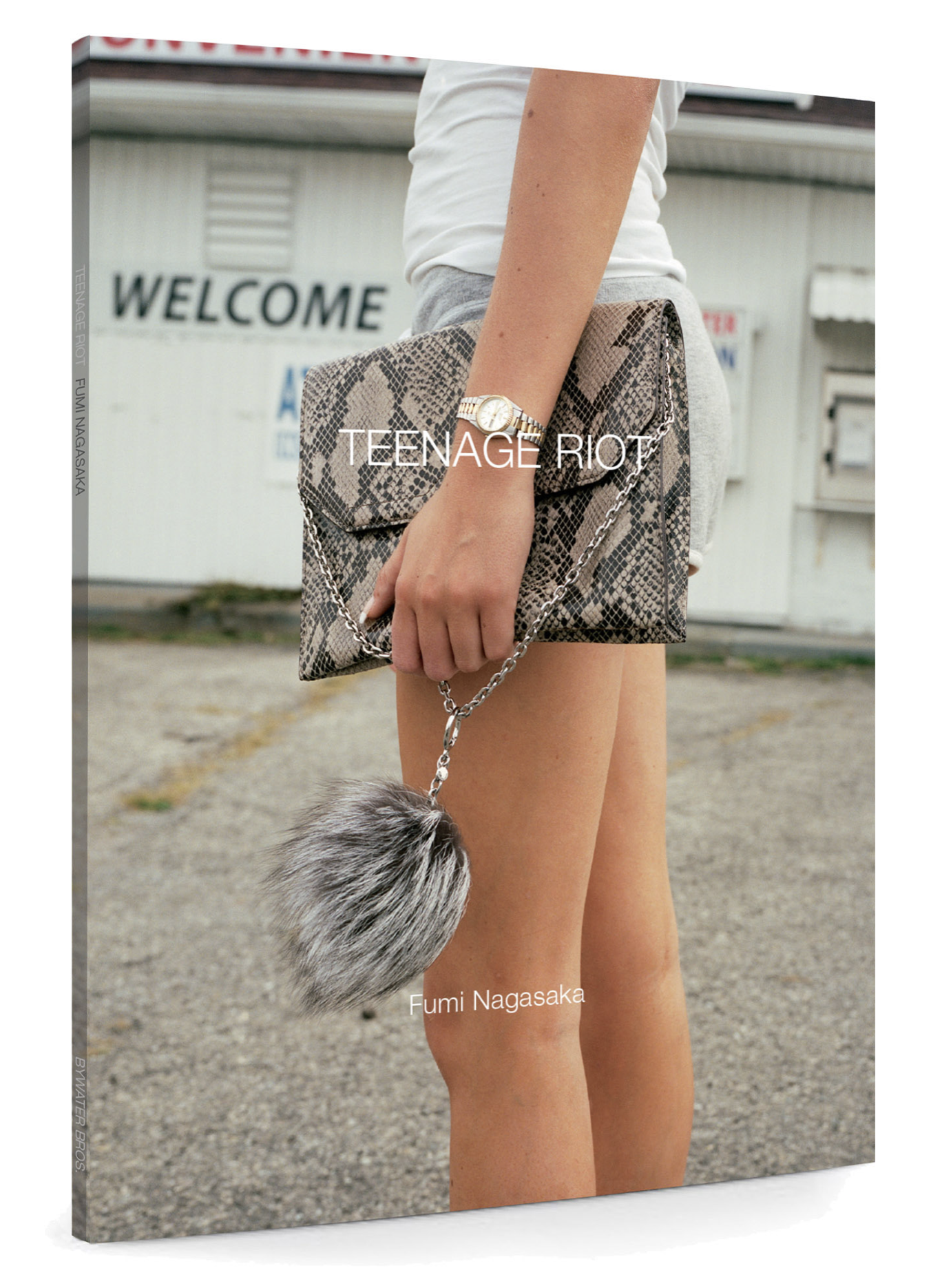
Fumi Nagasaka | Teenage Riot


Fumi Nagasaka
Teenage Riot
Port Colborne, Canada: Bywater Bros. Editions, 2018
80 pp., 22.7 x 16.7 cm., softcover
Edition size unknown


Taking it's title from a 1988 Sonic Youth song, Teenage Riot is Japanese photographer Fumi Nagasaka's second book, after the 2016 Kohl Editions title Untitled Youth

The book presents a series of portraits taken over the course of several years, of four teenage girls from varying backgrounds: Maxine from the small Ontario town of Port Colborne; sisters Isabella and Alana from Brooklyn; and Fubuki, a young student from Tokyo. 

Nagasaka was specifically interested in how their different upbringings were reflected in each girl’s personality and interests.

"The place they grew up in really affects who they become," she told Paige Silveria at Office Magazine. "For the girl in Canada, she’s my book publisher’s daughter. I met her at the New York book fair three years or so ago. I was surprised how different she was from her parents, who are very cultural. She really likes Kim Kardashian and had really crazy eyelashes. I thought it was so interesting that she grew up in an art environment and had such dissimilar interests from her parents. That made me want to photograph her. So, I spent some time up with them at their home in Canada. Because the town is very small, all of the information she gets is from social media and the internet. She would wear Juicy Couture pink velour tracksuits and was really into Victoria’s Secret. Every year I went back and she would change her style—it was always very different from the year before. And when she turned 16, she got her driver’s license. So I would drive around with her in the white BMW her parents gave her."

Collaborating with a subject over many years helped Nagasaka create intimate and candid images of the young women that wouldn't be possible with single-sitting portraiture. 

"Photographing youth is very exciting for me as it underlines that youth is something fleeting and that we can’t keep forever. Listening to their dreams, looking at their pure expressions motivates me to capture and record moments in their lives. Youth in fact, has been the singular focus of my published works," she told NPR in 2021. 


Teenage Riot is available from the publisher, for $25 CDN, here


Tuesday, October 3, 2023

Peter Fischli & David Weiss | Haus


Peter Fischli & David Weiss
Haus (Special Edition)
Zurich, Switzerland: Luma Foundation, 2019
276 pp., 20.5 x 20.5 cm., hardcover
Edition of 36 [+6 AP] signed and numbered copies


Haus began as a work by Fischli & Weiss for the Munster Sculpture Project in 1987. Their 1:15 scale representation of a four-storey commercial building was presented in an unpretentious area - far from tourist attractions -  near a railway station, in between a cinema and sausage stand. 

The work was subsequently shown in exhibitions at the Guggenheim Museum, New York and Museo Jumex, Mexico City. 

This publication was produced on the occasion of the donation of the work to the city of Zurich, by the Luma Foundation. An aluminum version was permanently installed in the city, in front of the cycle-racing track Offenen Rennbahn in Zurich-Oerlikon. 

In addition to this deluxe signed and numbered edition, housed with a folder in a folded box, a trade edition is also available. 


Katie Paterson | Lightbulb to Simulate Moonlight


Katie Paterson
Lightbulb to Simulate Moonlight
London, UK: Bookworks, 2008
25 x 16 x 11 cm.
Edition of 10


Katie Paterson’s research-based projects often see her collaborating with specialists from the fields of astronomy, astrophysics, genetics, and nanotechnology. For the installation work Lightbulb to Simulate Moon Light, Paterson worked with engineers to determine the spectral measurements of moonlight. They took light-meter readings, analyzed wavelengths, and found an appropriate surface coating in order to produce a bulb that emits rays approximating the light of a full moon.

Paterson commissioned OSRAM Licht AG, a multi-national lighting manufacturer based in Munich, to manufacture the 28 W bulbs with a lifespan of 2,000 hours. The work is exhibited and sold as a wooden crate containing 289 bulbs, which corresponds to the average human life expectancy of 66 years (based on 2008 estimates). Each time the work (produced in an edition of nine copies) is exhibited - with a single bulb burning in the gallery - the lifespan of the artwork is shortened.

The work also demonstrates her wider interests, which include a preoccupation with space and geological time, and the earth’s relationship with the cosmos.

This version from Bookworks contains two of the bulbs in a cloth-covered, letter-pressed box.


Monday, October 2, 2023