Sunday, May 8, 2016
Visual Language: Michael Snow/Vera Frenkel
As part of the Pages Unbound Festival, Vera Frenkel and Michael Snow will be interviewed - first alone and then together - by Robert Enright, today at 2pm at the Art Gallery of Ontario.
The event will also serve as a launch for Frenkel's new book, Points of Departure: Words & Works. The title is edited by Jonathan Shaughnessy, the National Gallery's Associate Curator of Contemporary Art, who curated Frenkel's exhibition Ways of Telling at the Museum of Contemporary Canadian Art in 2014, which serves as the basis for the volume.
Sunday, May 8th at 2:00 pm
Jackman Hall, Art Gallery of Ontario
317 Dundas Street West, Toronto
Marcel Broodthaers | My Ogre Book, Shadow Theater, Midnight
Marcel Broodthaers
My Ogre Book, Shadow Theater, Midnight
Los Angeles, USA: Siglio Press, 2016
160 pp., 6 x 7.75", clothbound
Edition of 1000 copies
For many, Broodthaer's Pense-Bête sculpture (with copies of his poetry volume encased in plaster, see below posts) served as a kind of object-manifesto, a declaration that he was now an artist and no longer a poet. This new Siglio Press volume, and the retrospective wrapping up at MoMA next week, serves to dispel that notion by placing his poetry in the context of his broader visual output.
"For us, what also really mattered in this exhibition was to bring the poetry back,” said curator Christophe Cherix at the recent press viewing of the Belgian's first New York retrospective, "and to counter the idea that in ’64 he stopped being a poet.”
The Pense-Bête sculpture was considered Broodthaers' first artwork at a time when filmmaking and photography were less likely to be considered tools of the visual artist. Broodthaers had experimented with both - simultaneous to his writings - and the MoMA retrospective presents these works alongside each other, tracing the chronological evolution of Broodthaers' practice.
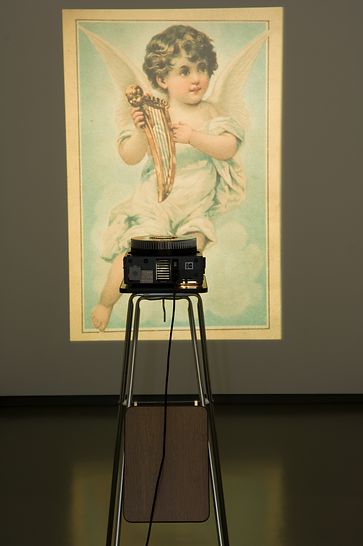
My Ogre Book, Shadow Theater, Midnight was released in late February of this year, a week after the opening of Marcel Broodthaers: A Retrospective. The title presents the first available English translations of the artist's earliest two books of poetry (Mon livre d'ogre and Minuit) paired with Ombres chinoises, or Shadow Theater (see below). Shadow Theater is an 80-slide projection work with a running time of approximately nine and a half minutes. Produced much later than the writings in this book (1973-1974), the images are published here, in full, for the first time.
The volume serves to reposition poetry as an important aspect of Broodthaers' output, better read - not in isolation - but in concert with the visual. This comes into focus when one begins to recognize the numerous titles and phrases from his later output that originated in these early texts.
The title is available from the publisher, here, for $39.95, though the availability may be brief as it is listed as "very low stock".
Saturday, May 7, 2016
Marcel Broodthaers | La Conquête de l'espace, Atlas à l'usage des artistes et des militaires [reprint]
Marcel Broodthaers
La Conquête de l'espace, Atlas à l'usage des artistes et des militaires
New York City, USA: Museum of Modern Art, 2016
38 pp., 6 x 6 x 1", boxed
Edition of 500
Available for the first time since it was published in 1975, this facsimile reprint of Broodthaers' last bookwork is available here for $175 US. A deluxe edition is also available, in an edition of 50 (the same as Broodthaers' original). It includes an uncut press sheet, as the artist himself originally included with a limited edition of his Atlas. It is priced at $500 US, here.
This week on Tumblr
This week on Tumblr: (mostly recent) reprints and reissues: facsimile reprints of artists' books and artists' periodicals.
Friday, May 6, 2016
Marcel Broodthaers | Pense-Bete [reprint]
Marcel Broodthaers
Pense-Bete
New York City, USA: Granary Books, 2016
32 pp., 8 5/8 x 11 5/8", softcover
Edition of 100 numbered copies
Broodthaers' best known bookwork is presumably his least read.
This deluxe Granary Books reprint aims to change that, allowing libraries (and high-end private collections) access to a title most know only as a sculpture (see previous post).
Pense-Bête is Broodthaers's fourth book of poetry, which he financed himself. The French title translates roughly to 'visual reminder' or 'memory aid' (such as a mnemonic device, a knot in a handkerchief, or a string tied around one's finger). The poems were written as early as 1962, and published in January of '64.
In a short introductory text titled "Ars Poetica", Broodthaers recalls his early reading as a child: "A dangerous passion, an obsession, whose meagre results you have here, a few poems deflected from their natural state, from people and from things." The introduction also almost anticipates the eventual sculpture: "a taste for secrecy, hermetic practices, for me they're all one, and a favourite game."
But even before encasing the book in plaster, Broodthaers had began experimenting with obstructing the text. After distributing a few copies, he began altering the books with rectangles and squares of children's coloured paper. Some were glued down completely, and others only along the top, allowing the reader to lift the paper and read the poem below. (A few years later Broodthaers similarly altered a copy of Stéphane Mallarmé's Un Coup de Dés given to him by Réné Magritte, by replacing all of the text with black stripes, and published it as an artist's book).
The Granary Books publication of Pense-Bête is a faithful facsimile, modelled on several examples of the collaged version. Brooklyn poet and translator Elizabeth Zuba worked with Broodthaers' widow Maria Gilissen to translate the originals into English. The edition was produced by Steve Clay and Diane Bertolo and printed by Philip Gallo at The Hermetic Press, and bound by Judith Ivry.
The edition comprises one hundred copies, of which seventy-five are for sale. The "hors commerce" (or "outside of trade") copies were distributed to the estate, and to Zuba.
The title is available from the publisher for $2000.00 US. For more information, visit Granary Books, here.
Marcel Broodthaers | La Conquête de l'espace, Atlas à l'usage des artistes et des militaires
Marcel Broodthaers
La Conquête de l'espace, Atlas à l'usage des artistes et des militaires
Brussels, Belgium/Hamburg, Germany: Lebeer Hossmann Éditeurs, 1975
38 pp., 4.2 x 2.9 x 1 cm., slipcase
Edition of 50 [+ 5 AP] unsigned copies, stamped and numbered by the publisher
The artist's last book, published shortly before his death in early 1976, The conquest of space, Atlas for the use of artists and the military, plays on language, scale and function. The paradoxical nature of a pocket Atlas for the military is clear - it is transportable but useless. The title consists of silhouettes of 32 countries, each printed on a separate page, causing them to appear as islands. They are arranged alphabetically, not geographically.
Marcel Broodthaers | Pense-Bête
Marcel Broodthaers
Pense-Bête
Brussels, Belgium: Self-published, 1963-1964.
32 pp., 27.5 x 21.5 cm., softcover
Edition size unknown
In 1964 Marcel Broodthaers was middle-aged and broke. His fourth (and final) book of poetry was self-financed and he was supporting himself as a bookseller and photojournalist.
“I, too, wondered whether I could not sell something and succeed in life,” he wrote that year, in the promotional brochure for his first ever art exhibition, at galerie Saint-Laurent in Brussels. “For some time I had been no good at anything. I am forty years old…Finally the idea of inventing something insincere finally crossed my mind and I set to work straightaway.”
One of the most celebrated works in the exhibition (and which many cite as his first artwork ever) shares it's name with Pense-Bête, and indeed it's content. Fifty copies of the book ("the last two parcels") were encased in plaster as a sculpture, marking his move from poet to artist.
“You cannot read the book without destroying its sculptural aspect,” he later remarked, “…no one had any curiosity about the text; ignorant of whether it was the burial of prose or of a poetry, of sadness or pleasure.”
The original book is one of the artist's least available titles. The copy in the collection of the Museum of Modern Art (here) does not indicate the edition size, nor does the bibliography in the D.A.P. monograph Marcel Broodthaers (2013). However, I believe there were 100 copies produced. With fifty of those buried in plaster and many more lost to time, the title is exceedingly rare.
Subscribe to:
Posts (Atom)