Monday, October 19, 2020

Enzo Mari


 Enzo Mari died today, at the age of 88.


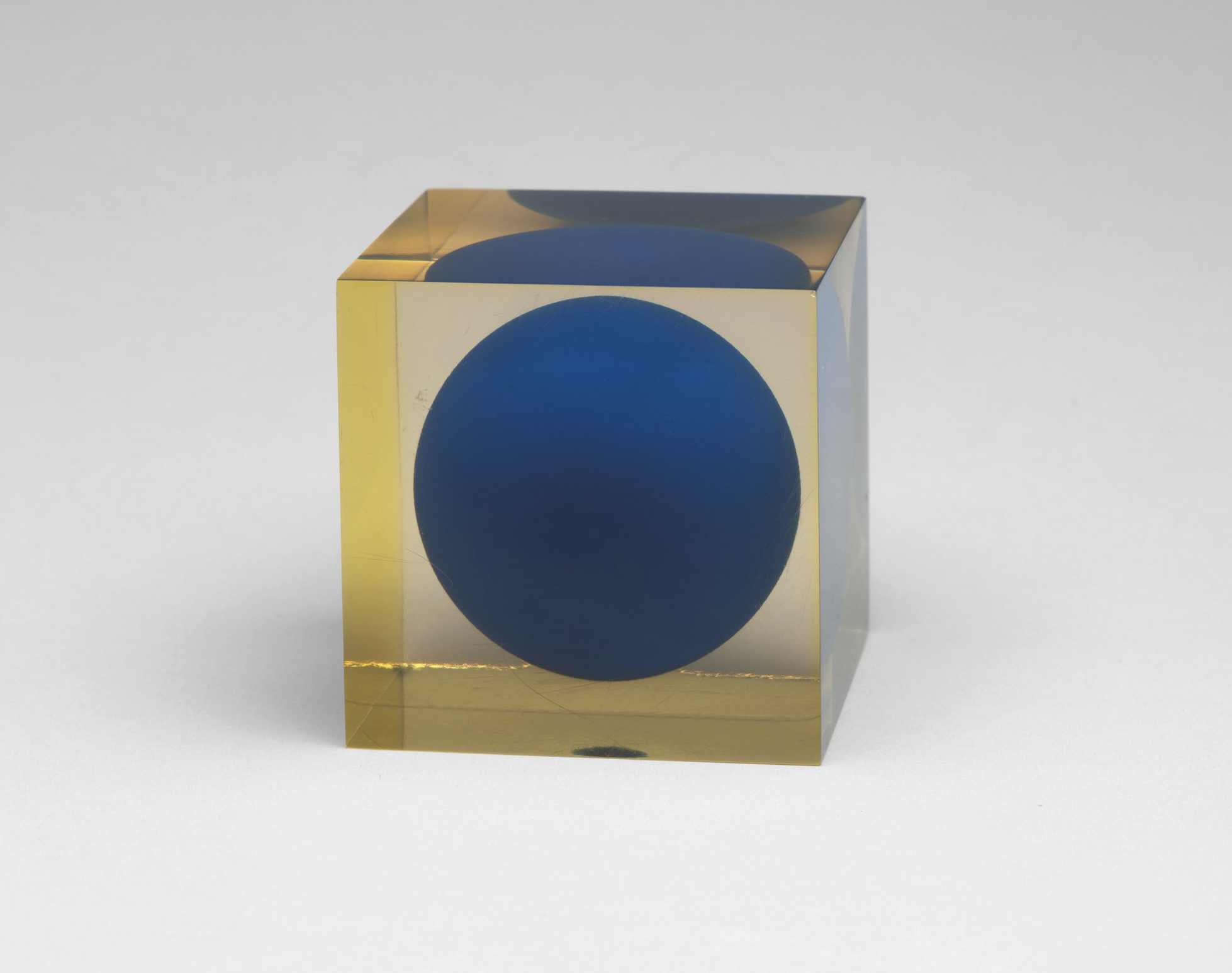
Enzo Mari | Cubo, 1959-1963


Enzo Mari
Cubo, 1959-1963
Milan, Italy: Danese Milano, 
10 x 10 x 10 cm
Edition of 50 signed and numbered copies

An acrylic glass sculpture on square plastic base, which is signed and numbered on the bottom. The glass cube contains another cube inside it, which features 16 black dots per side. 

Mari died today at the San Raffale hospital in Milan. He was 88 years old. 


Sunday, October 18, 2020

Ian Hamilton Finlay | Two Horizons


Ian Hamilton Finlay
Two Horizons
Edinburgh, Scotland: Wild Hawthorn Press, 1998
3.5 x 11 x 3.5 cm.
Edition size unknown


One of my all-time favourite Ian Hamilton Finlay works takes an everyday household item and re-contextualizes it with the title. 

Sent by the artist as a Christmas gift to friends in 1998, the work consists of a small printed box (which also functions as the mailing container) housing two spools of thread: aircraft grey and adonis blue. Simple and elegant. 


Marianne Wex | Let’s Take Back Our Space


Marianne Wex
Let’s Take Back Our Space
Berlin, Germany: Frauenliteratur Verlag, 1979
366 pp., 24 x 19 cm., softcover
Edition size unknown 


Subtitled Female and Male Body Language as a Result of Patriarchal Structures, this title features 2037 photographs of men and women and asserts that body language is a result of sex-based, patriarchal socialization, affecting all of our other "feminine" and "masculine" role behaviour. 

Anticipating the phrase "manspreading" thirty-five years ago, the volume illustrates how a woman will sit “legs held close together, feet either straight or turned slightly inward, arms held close to the body. In short, the woman makes herself small and narrow, and takes up little space." Men, on the other hand, sit "legs far apart, feet turned outwards, the arms held at a distance from the body. In short, the man takes up space and generally takes up significantly more space than the woman.”

Originally published in German, in 1979, an English translation appeared five years later in 1984, Let’s Take Back Our Space is considered to be the artist's lone surviving work. Shortly after its creation she became seriously ill and later embarked on a successful career in medicine. 

In 2009, Let’s Take Back Our Space was exhibited for the first time since its unveiling. It has shown a few times subsequently, and is now in the permanent collection of the Museum of Modern Art in New York (above, bottom). 

Wex died last week, at the age of eighty-three. 


"The German artist Marianne Wex started out as a painter before producing her photographic project Let’s Take Back Our Space, one of the great unsung works of 1970s feminist history and cultural analysis. Born in Hamburg in 1937, Wex studied at the city’s University of Fine Arts, where she later taught for seventeen years. In 1979, she published Let’s Take Back Our Space as a book, with the subtitle “Female” and “Male” Body Language as a Result of Patriarchal Structures. It is a visual survey comprised of hundreds of photographs assembled into dozens of thematic grids: Seated persons—leg and feet; arm and hand positions; standing persons—leg and feet; arm and hand positions; people sitting and laying on the ground; arm and leg positions; Egyptian, Greek, and Roman statuary; how the men of Christianity took over an old goddess gesture; the stultifying effect of the patriarchal socialization of men. And so on. The images were culled from a huge range of sources—advertisements, reportage, fashion magazines, studio portraits, the history of art—and many were taken on the streets of Hamburg by Wex, who proposes that our smallest, most unconscious gestures speak volumes about the power relations of gender in daily life."

Saturday, October 17, 2020

Last day to purchase prints and support States of Change


With the realization that five states will most likely decide the election (Arizona, Florida, Michigan, Pennsylvania and Wisconsin), the organization States of Change have released a series of fundraising prints, each selling for $150 US. The proceeds (minus $15.50 to cover production costs) will support forty-two different local groups fighting voter suppression in these battleground states.  

The sale ends tomorrow at 11:59 pm PST. 

Participating artists include Alfredo Jaar, Catherine Opie, Cindy Sherman, Ed Ruscha, Danny Lyon, Sara Cwynar, Robert Frank, Sally Mann, Hank Willis Thomas (above), Sharon Lockhart, James Welling, Hannah Price, Jack Pierson, Nan Goldin, Jason Fulford, and Kim Gordon of Sonic Youth (who recently told Pitchfork "We can’t do anything progressively until we get rid of Trump. Then we can work on Biden."). 

The works are sold as unlimited editions, unsigned and unnumbered, with the following conditions: 

(1) You must not display the artwork in a museum, gallery, exhibition, or otherwise public nature, without the express written consent of the artist.

(2) You must not resell the artwork without the express consent of the artist.

(3) You are a human making an individual purchase, and not a bot designed to make rapid purchases.

(4) You agree to not make any further copies of the image after its purchase.

(5) All sales are final. Because all net proceeds are being donated to Movement Voter Project, refunds will not be possible.

Visit the States of Change website, here, to purchase. 


La Monte Young & Marian Zazeela | Selected Writings


La Monte Young & Marian Zazeela
Selected Writings
Munich, Germany: Heiner Friedrich, 1969
104 pp., 21 x 14.5 cm., softcover
Edition of 2100, 98 of which are signed and numbered

A collection of writings by and about composer La Monte Young, and featuring drawings by his partner and collaborator Marian Zazeela.

The thin volume includes "Notes On The Continuous Periodic Composite Sound Waveform Environment Realizations Of "Map Of 49's Dream The Two Systems Of Eleven Sets Of Galactic Intervals Ornamental Lightyears Tracery," (which was also published in the Dan Graham edited issue of Aspen Magazine), "Dream House,"Conversation With La Monte Young By Richard Kostelanetz," The Soul Of The Word," "Lecture 1960," and "Poem To Diane." 


"RICHARD KOSTELANETZ - What were your purposes in the pieces of your second year at Berkeley, the compositions of 1960, written after your encounter with Cage?

LA MONTE YOUNG - I was on my way to Mount Tamalpais, the biggest mountain in the Marin County area, and I started thinking about the butterfly. Alone, it made a very beautiful piece. Being very young, I could still take something so highly poetic and use it without the fear I would have now - that it would be trampled on. Now, I would offer something quite a bit more substantial than a butterfly or a fire - something that can’t be so easily walked on. After all, a butterfly is only a butterfly. No matter how much I write about the fact that a butterfly does make a sound - that it is potentially a composition - anyone that wants to can say, “Well, it’s only a butterfly.”

KOSTELANETZ - Your point, then, in bringing into the concert situation a jar of butterflies and then releasing them, was that a butterfly makes a sound.

YOUNG - True. Another important point was that a person should listen to what he ordinarily just looks at, or look at things he would ordinarily just hear."


Valued at between $800 and $1200 US, a PDF is available at Ubuweb, here

Friday, October 16, 2020

Jean-Paul Vroom | He


Jean-Paul Vroom
He
Amsterdam, Holland: Scientific Publishing Corp., 1969
54 pp., 16 x 24 x 1 cm., softcover
Edition size unknown


Subtitled “Visual Information About a Human Being”, this title features 46 black and white images of Van der Gulik. 


"The human body is a universe, wherein all dramatic, comic, vulgar, aesthetic, ethical emotions, visual as well as sensed, can be experienced.This book makes claim to being the most optimistic book of our time" 
- Jean-Paul Vroom