Thursday, October 15, 2020

Joseph Beuys | Iphigenia / Titus Andronicus


Joseph Beuys
Iphigenia / Titus Andronicus
Munich, Germany/New York City, USA: Edition Schellmann, 1985
78 x 55.3 x 12.8 cm.
Edition of 45 [+ 5 AP] 

Joseph Beuys performed the 'action' Iphigenia / Titus Andronicus at Experimenta 3 in Frankfurt on 29th and 30th of May, 1969. The performance consisted of the artist reciting the text of Goethe’s play Iphigenia, while a loudspeaker relayed the pre-recorded sound of two actors reading Iphigenia and Shakespeare’s play Titus Andronicus. Both plays deal with the subject of vengeance, with the violent ending of Titus Andronicus contrasting with the happy ending of Iphigenia. 

Beuys appeared dressed in a fur coat, which he quickly removed before beginning to imitate the flight of birds, striking a pair of bronze cymbals and emitting guttural sounds, regurgitating fat and feeding sugar a white horse. The horse stood atop a sheet of metal, which was rigged with microphones, so that every time the horse scraped or stamped its hooves, the sound was magnified. 

Now valued at approximately $7000 US, the edition that documents the work consists of a photo-positive and negative on film, signed with the artist's brown paint stamp. 

Wednesday, October 14, 2020

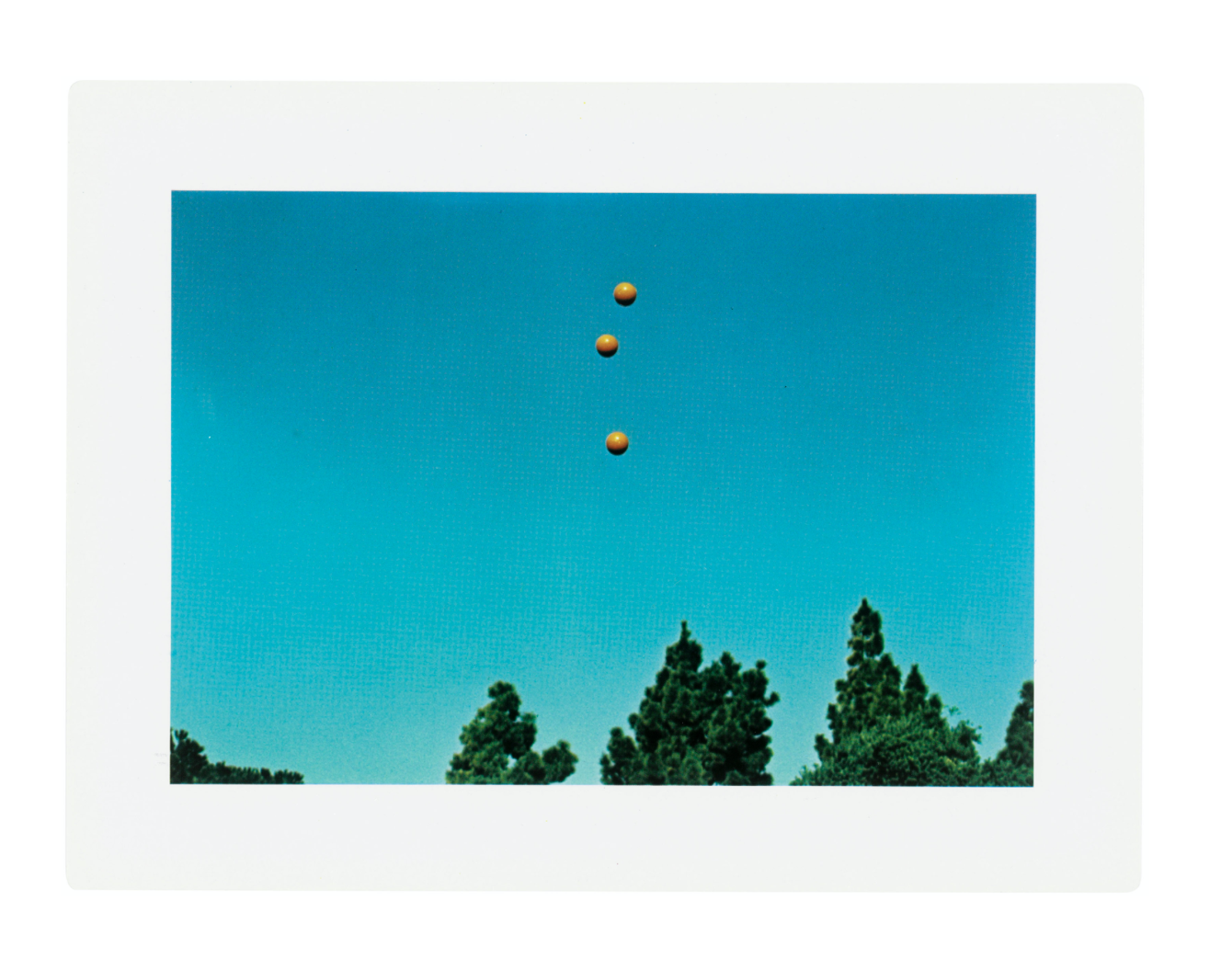
John Baldessari | Throwing Three Balls in the Air to Get a Straight Line (Best of Thirty-Six Attempts)


John Baldessari
Throwing Three Balls in the Air to Get a Straight Line (Best of Thirty-Six Attempts)
Milan, Italy: Edizioni Giampaolo Prearo and Galleria Toselli, 1973
[12 pp]., 25 x 32.5 cm., loose leaves
Edition of 2000 [+500 publisher's copies]

12 coloured photographic plates in an embossed box, produced on the occasion of Baldessari’s first solo exhibition in Italy in 1973. 


"Ever since the onset of photography, the roles of the hand and the arm in making art have been subject to doubt. Once the definitive means of bringing an idea into form, these human appendages could seem feeble or quaint in an age of science and industry. Allowing gravity to participate in marking became a vital way to give art a deeper or more objective structure. Marcel Duchamp dropped threads to make the lines of his pivotal 1913–14 work 3 Standard Stoppages, and Jackson Pollock later dripped paint to push the limits of his control over line. These tactics called attention to art making as a performative grappling with chance and indifference.

In his 1973 series Throwing Three Balls in the Air to Get a Straight Line (Best of Thirty-Six Attempts), John Baldessari brought his impish wit to this modernist turn. He threw three balls in the air in hopes that a snapshot might catch them aloft and aligned. Through the magic of photography, gravity was defeated, and the balls never had to come down. Although he playfully inserted his arm or his finger in other works, in Throwing Three Balls he kept himself out of the frame. Well, not quite: his balls were in the frame, and the playful reference they make both to his surname and to masculine anatomy is crucial. Throwing Three Balls spoofs the swagger of the Pollock myth of a man laying himself bare through his struggle with the elements. Whereas Pollock orbited his canvases on the floor with all the gravitas of a seminal creator, Baldessari sent his tiny planets skyward with a playful toss.

We should remember, however, that Throwing Three Balls was a game for two players. While Baldessari threw, his then-wife Carol Wixom operated the camera. Chance became the intersection of their performances, where the scattershot and the snapshot met. Each resulting image depicted a hanging sculpture made from dime-store materials that invoked, in the deadpan innocence of pop, both the lofty aspirations of the moon-shot era and the absurd randomness of the atomic age. As the catalyst of such images, Baldessari’s arm became one of the most disarming of his generation.

- Robin Kelsey, Aperture Magazine


Last night on Jimmy Kimmel Live, the host interviewed his wife Molly McNearney, from their shared bedroom - which houses Throwing Three Balls..., framed above the bed:


Thursday, October 1, 2020

Marcel Duchamp


Marcel Duchamp died on this day in 1968, at the age of 81.

Tuesday, September 29, 2020

Adrian Piper Permanent Collection Canvas Patch


Visitor
Permanent Collection Canvas Patch
New York City, USA: Visitor, 2019
17.5 x 9.5 cm
Edition of 5


Available from Printed Matter, here, for $75 US.

Monday, September 28, 2020

Enrico Baj | Personaggio decorato


Enrico Baj
Personaggio decorato
Cologne, Germany: Edition Mat Mot, 1965
46 x 55 x 4.5 cm.
Edition of 100 signed and numbered copies


Enrico Baj made his New York debut in 1960, when Marcel Duchamp and André Breton included him in a group exhibition at D’Arcy Galleries titled “Surrealist Intrusion in the Enchanter’s Domain.” He was one of the last artists who Breton aligned with Surrealism. 

In a 1963 essay, Breton described Baj's series Generals (pictured below), which would remain the artists' best known work: 

"A quite recent period in Baj's work has singled out from this brutish regiment several incarnations of the 'general in full dress uniform', a category summed up unforgettably by Benjamin Péret as being 'the grossly glided, perfectly poverty-stricken' [....] Had it not been for Baj, I would have been less attuned to the sight of the goldbeaters'-skins bulging out from behind all this paraphernalia."

These absurdist military characters adorned with medals and military regalia, which the artist found in flea markets, first appeared in his work in 1959, and in the next two years he produced around forty of the 'generals'. He would periodically return to them throughout his career, until his death in 2003. 

They were also the basis for his contribution to the Editon Mat Mot Collection 65. Personaggio decorato (or "Decorated Figure", in English) became the subject of a debate about authorship and value within the Mat Mot series. 

Baj's gallerist, Arturo Schwarz, wished to handle sales of the work, and objected to their low cost, fearing it would undermine his gallery prices. The work, he argued, was too similar to Baj's larger practice and would undercut sales and impact market value. 

Presumably at his urging, Baj initially refused to sign the multiples. Daniel Spoerri (founder and co-editor of Edition Mat Mot) eventually capitulated and agreed to indicate that the works were fabricated by Spoerri, distinct from an 'original' (see above pink poster). This ran counter to Spoerri's goal with the series, which was to de-emphasize the hand of the artist. 


Sunday, September 27, 2020

Herman de Vries | Infinity In Finity


Herman de Vries
Infinity In Finity
Dijon, France: Les Presses du Réel, 2013
24 pp., 17 x 21 cm., softcover
Edition of 1,000


Friday, September 25, 2020

Jenny Holzer | Selection from Survival: Men don't protect…


Jenny Holzer 
Selection from Survival: Men don't protect…
New York City, USA: Self-published, 2006
43.2 x 58.4 x 40 cm.
Edition of 10 [+2 AP] signed and numbered copies


Valued at approximately $70,000 US, the work is a Danby Imperial white marble footstool engraved with a Truism from the Survival Series. The underside is incised with the artist's studio inventory number edition number.