Showing posts with label Peter Moore. Show all posts

Tuesday, June 24, 2025

Allan Kaprow | Photoalbum : Moving, A Happening


Allan Kaprow
Photo Album: Moving, A Happening
Chicago, USA: Museum of Contemporary Art, 1967
16 pp.,  21.5 x 14 cm., staple-bound
Edition size unknown


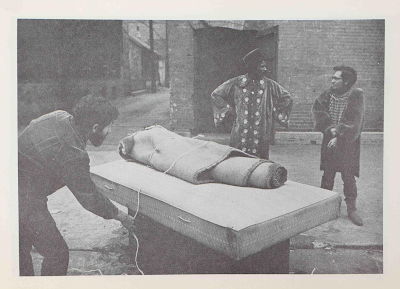
A slim Artists' Book documenting a happening which took place over four days, at six different sites. Designed by Kaprow, the booklet features seventeen black&white photographs by (Fluxus photographer) Peter Moore. 

 
"Some unused houses in different parts of the city. On each of four days, old furniture is obtained, and is pushed through the streets to the houses. The furniture is installed. On the first day, bedrooms are furnished, and slept in that night. On the second day, dining rooms are furnished, and a meal is eaten. On the third day, living rooms are furnished, and guests are invited to cocktails. On the fourth day, attics are filled and their doors are locked.” 
- Allan Kaprow


"In December 1967 Kapfow did an event in Chicago called Moving (sponsored by the Museum of Contemporary Art), in which participants were asked to furnish apartments with secondhand furniture that had been purchased for the event. The participants would briefly occupy one apartment—perhaps eating a meal together— before packing up their belongings and moving on to the next, rolling stacks of chairs, boxes, lamps, even a piano through the streets like bands of urban nomads. Moving was familial and friendly and required less labor than Fluids had, but it was just as fluid in its wanderings from
place to place.”    
- Jeff Kelley


Saturday, January 20, 2024

Mieko Shiomi | Fluxfilm No. 4 : “Disappearing Music for Face”


Mieko Shiomi
Fluxfilm No. 4 : “Disappearing Music for Face”
New York City, USA: ReFlux, 2002
[40] pp., 4 x 6.2 cm., staple-bound
Edition of 79


A work by Mieko (Chieko) Shiomi, performed by Yoko Ono, designed by George Maciunas, published by Fluxus, photographed by Peter Moore and re-published by his wife Barbara Moore (who ran Reflux Editions, and Bound and Unbound, among other things). The date and edition size of the original Fluxus work is unknown, but when Moore acquired the Maciunas estate she discovered enough vintage printed sheets to re-collate 79 copies as the Reflux edition.

In 1966, Maciunas acquired an expensive high-speed 'scientific analysis camera', which recorded film at a rate of 2000 frames a second.  When the resulting films are projecting at the standard speed of 24 frames a second, it produced an extreme sensual slow motion effect. Having access to the camera for only a single day, he set up in photographer Peter Moore’s East 36th Street apartment and invited a number of Fluxus artists to submit projects that could be filmed in the short production session.

Shiomi's contribution was a work that she had originally presented as a performance piece in 1964 (see below).  The original score for the performance simply reads: "Performers begin the piece with a smile and during the duration of the piece, change the smell very gradually to no smile". The eight seconds of footage shot that day of Ono moving from smile to no smile, became an 11 minute, 15 second film (though the duration of the piece changes and in Fluxus newsletters Maciunas advertises it as fifteen minutes in length in 1966 and ten minutes long in 1969).

Maciunas had hoped to turn many of the Fluxfilms into flip books, but only this title and Dick Higgins' Invocation of Canyons and Boulders were ever produced.

Shiomi’s flipbook was typically (but not exclusively) presented in a printed brown envelope. Later, a few copies were sold signed in a plastic case ("I prepared this plastic case to maintain the condition of the work”). 


"The premier was done with Fluxus friends and the audience at Washington Square Gallery in New York in 1964. This was the first day of the Perpetual Flux Fest that George Maciunas organized. To my right is Alison Knowles. As my English was poor at the time (it is still poor even now), she volunteered to conduct the performance instead of me. The photo [below] is from forty-eight years ago. We were both young.

Soon, Maciunas made an 8mm film out of this Disappearing Music for Face, with Yoko Ono as the performer and Peter Moore as cameraman. Along with others’ works, this became part of Fluxfilms. In Japan, it is in the collection of the National Museum of Art in Osaka. Later, Maciunas extracted a few frames from the film, printed them, and turned them into a flip-book. When you see it on the screen now it looks large, but the book’s actual size is four by six centimeters [approx. 1 9/16 x 2 3/8 in.]. It fits into the palm of your hand. There are thirty-nine photographs, and the smile gradually disappears when you flip the pages. It is very clear. Flip-books are fun even now, aren’t they? Your fingers’ actions cause an illusion of moving image. I feel as if I could imagine the pleasure of the person who invented it and made it first. On the last page, there is a history of this flip-book. According to this, it was produced by ReFlux in 2002, in an edition of seventy-nine, from the printed matter left by Maciunas. Five copies were sent to me.

[...]

The original Event piece became an eight-millimeter film, then turned into a flip-book, and then into choral music. Even now, the evolution might not be finished, and there may be a possibility of making a new work in a different medium.”
- Mieko Shiomi, 2013


Thursday, January 16, 2020

Peter Moore | Mask of George Maciunas


Peter Moore
Mask of George Maciunas 
New York City, USA: ReFlux Editions for Ubu Gallery, 1996
25 x 19.5 cm.
Edition size unknown

Die-cut mask of the late founder of Fluxus, with eyeholes, a fold-out nose and an elastic strap. By Fluxus photographer Peter Moore (and husband of Barbara Moore, who operated the publishing venture, ReFlux editions).

Monday, May 21, 2018

Geoffrey Hendricks | Flux Divorce Album


Geoffrey Hendricks
Flux Divorce Album
New York City, USA: Fluxus, 1973
39.7 x 50.6 x 10.5 cm.
Edition size unknown

A boxed work documenting the artist's divorce from Nye Ffarrabas (formerly Beatrice Cobb Forbes, Bici Forbes, and then Bici Forbes Hendricks), in which all of their belongings were sliced in two. Items from their ten years of marriage - including documents, clothing, a love seat, and their marital bed - were cut in half with scissors, a paper cutter, an ax and a power saw.

Housed in a box crafted by woodworking graduate student, the work includes "Our Flux Divorce" which resembles a wedding album, and is also bisected, horizontally. Fragments of coats, barbed wire, plastic, correspondence cut in half, and half of a wedding announcement are also included. The documentation of the performative event is by Fluxus photographer Peter Moore. George Maciunas assisted with the design, and distributed the work through Fluxus.

When Maciunas married in 1978, Hendricks officiated (in a clerical robe) and the event can almost be viewed as the inversion of his divorce.


From an Oral history interview with Geoffrey Hendricks, 2016 August 17-18:

GEOFFREY HENDRICKS: With our 10th wedding anniversary coming along, it was like, How do we celebrate it? Because we were both, you know, queer and involved with others, and I just sort of tossed out the idea, what about a Flux-divorce? And it sort of resonated, and I said, "Let me talk to George Maciunas." And so I talked to George. He was absolutely thrilled and so he did a lot of the orchestrating of it, and figuring out how to divide up the house with a wall of cardboard boxes to separate one half of the room. For another, barbed wire between the living room and the kitchen island in the middle of the—before the dining room.

[...]

And then upstairs in the bedroom, we had a division of property and with a paper cutter, we cut our wedding document in half, the wedding invitation, some correspondence that was sort of symbolic. And then with, I guess, a utility knife, cut the mattress in half with scissors and ripped the sheets in half. And then I had this circular saw and cut the wooden platform of the bed in half. And there was a wicker loveseat that I chopped in half. So this was the division of property and we tore our wedding garments in half.

LINDA YABLONSKY: Was this documented?

GEOFFREY HENDRICKS: There's some documentation of it.

LINDA YABLONSKY: Photographs or video?

GEOFFREY HENDRICKS: Yeah, Peter Moore took photographs. And there are maybe some others. I don't know that there's video, but then I made a Flux–Divorce Box so that I have this as an object. And there are copies of it in, I guess, in MoMA and the Getty and the Sohm [Archive] collection in Stuttgart, and sort of, you know, there maybe half a dozen key Fluxus collection series.

LINDA YABLONSKY: It sounds like it sets quite a precedent for Gordon Matta-Clark.

GEOFFREY HENDRICKS: [Laughs.] Yeah, right, well—

LINDA YABLONSKY: Remember he split the house—

GEOFFREY HENDRICKS: Oh, yeah, no, I know.


From a casual interview I did with Hendricks in the early nineties:

DD: How many of these were produced?

GH: Not a lot. They were all hand done. There's one in the Silverman collection, there's one in the Jean Brown collection that's now in the Getty. Francesco Conz has one, Barbara Moore. Not many more than that.


From an interview with Lars Movin:

GH: Early in 1978 while George Maciunas was battling terminal cancer, he said to me "Geoff, we had your "Flux Divorce", we should also have a "Flux Wedding". Ht wanted to have a Flux Wedding with Billie Hutching, who he was with, and he wanted me to be 'minister'.