Showing posts with label Vice-Versand. Show all posts

Saturday, September 26, 2026

C.O. Paeffgen | Rost Nest


C.O. Paeffgen
Rost Nest
Reimsheid, Germany: Vice-Versand, [1968]
6 x 15 x 15 cm.
Unlimited Edition, signed


The title of Claus Otto Paeffgen’s 1968 Vice-Versand multiple translates to Grill Nest, or Grate Nest. It appears to be a wire-mesh fence sculpted into a bird’s nest. 

The work is produced in a signed but unlimited edition, each unique. The piece is accompanied by a label bearing the artist’s signature. 


Saturday, August 29, 2026

Milan Knížák | Zeremonien


Milan Knížák
Zeremonien
Remscheid, Germany: Vice-Versand, 1971
[unpaginated], 20 x 16.8 x 2.6 cm., spiral-bound
Edition of 500 numbered copies


Zeremonien is a hard-cover, spiral-bound artist book published by Wolfgang Feelisch, in 1971. The following May, the work was seized from German collector Hans Sohm by Czechoslovak border guards, leading to arrest of Milan Knížák. 

Sohm was interrogated for hours while trying to return to Stuttgart, and the book (and other materials) were impounded on the pretext that they were “intended to discredit the image of Czechoslovakia abroad” and that their content was “pornographic.”

Knížák wrote to Feelisch asking him to organize people to write about the arrest, as well as asking lawyers and the “society for human rights” to supervise his next trial. He reasoned: “If I will go to jail, all Czech art will with me, all artfreedom will be jailed, tooooo.”

A later letter asked that Feelisch contact Wolf Vostell, Allan Kaprow, George Maciunas, Ay-o, Ben Vautier, Ken Friedman, and others, on his behalf. 

“It might seem very stupid to do all these things,” he wrote, "but they can KEEP me OUT of a jail. Best would be to send a protest of most avant-garde famous world artist and art magazine etc. to Czechoslovakian government. But this is probably too phantastic and too overblown.”

Deemed an Enemy of the State, Knížák was found guilty and sentenced to two years in prison. 

Wolfgang and Sohm co-edited an issue of Reflection Press Magazine (No. 31) in 1973, in order to draw attention to Knížák’s imprisonment. It featured an introduction by Albrecht D., letters of support from artist Allan Kaprow, curator Harald Szeemann, and others, as well as texts by the artist himself.

The international campaign indeed helped precipitate an early release. 

Later in life, Knížák became the director of the Czech National Gallery in Prague between 1999 and 2011 and was awarded the Medal of Merit by the Czech Republic.

Milan Knížák died last month at the age of 86. 


Saturday, September 14, 2024

Gábor Altorjay | Object for Short Circuit


Gábor Altorjay 
Object for Short Circuit 
Remscheid, Germany: Vice-Versand, 1969
boxed: 10.3 x 10.3 x 10.3 cm.
Unlimited edition


German publisher Wolfgang Feelisch’s Vice-Versand was founded in 1966, intended to operate as a mail-order catalogue for contemporary art. Typically small in size and with low production costs, the works were presented as open editions and generally priced at DM 8, or approximately US $2. Vice-Versand published works by Joseph Beuys, George Brecht, Robert Filliou, Dieter Roth, Daniel Spoerri, Günther Uecker, Ben Vautier and others. 

Gábor Altorjay’s Object for Short Circuit (or Kurzschlussobjekt) was a simple male electrical outlet attached to a small plastic cube (yellow, red, or blue) which would short circuit and possibly blow a fuse when plugged into an electrical grid. 

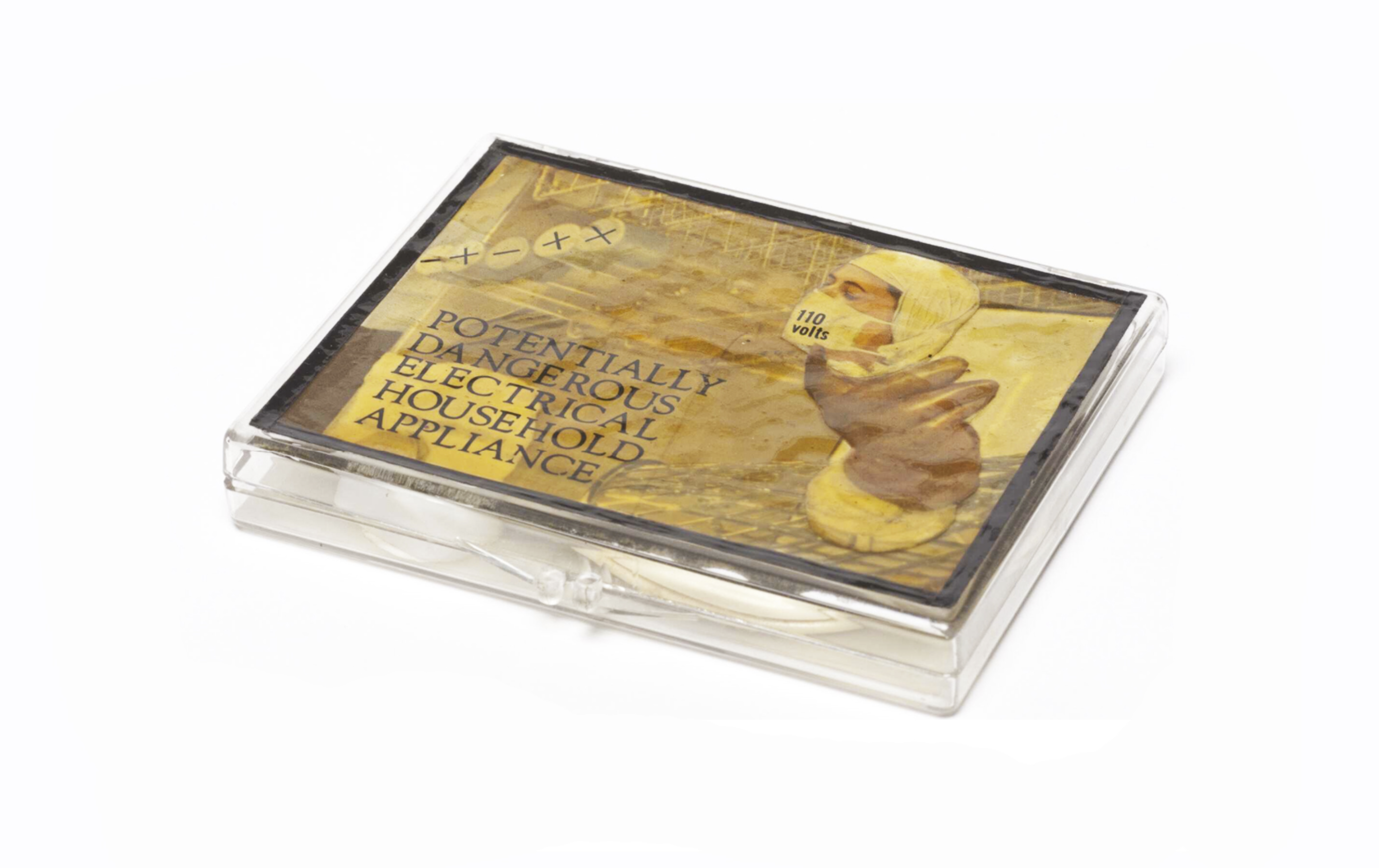
Jock Reynolds' Fluxus kit from the same year, Potentially Dangerous Electrical Household Appliance, was a very similar work, involving a short extension cord with two male ends. 

Below is a schematic for the work, and a similar piece by the artist, called Short Circuit Purse. 


Tuesday, March 12, 2024

Jock Reynolds | Potentially Dangerous Electrical Household Appliance


Jock Reynolds
Potentially Dangerous Electrical Household Appliance
New York City, USA: Fluxus, 1969
9 x 12 x 1.6 cm.
Edition size unknown


Jock Reynolds joined the inaugural class at the University of California Santa Cruz in the mid-1960s, planning to study marine biology. Artist Gurdon Woods left his position at the San Francisco Art Institute to develop the school’s arts curriculum, and encouraged Reynolds to pursue visual studies. There he encountered artists such as Willem De Kooning, Mark Rothko, and Robert Watts. Soon after, Woods applied to the Carnegie Foundation and received a large grant, allowing him to bring in visiting artists such as John Cage, Merce Cunningham, George Segal, Allan Kaprow, Dan Flavin, James Lee Byars and George Maciunas. 

"Some of these visiting artists would come for a few days to do a performance or to show films by the likes of Andy Warhol,” Reynolds recounted many years later. "Other artists stayed longer to conduct mini-seminars in which they shared their work and provided critiques to the work we students were making both individually and as a creative collective. We staged a number of Fluxus-like performances, including a hilarious Fluxus parade on the campus of U.C. San Diego in the last semester of our work with Watts." 

"I remember Maciunas brought one of his Flux briefcases out west with him and showed us what was inside: 17 boxed objects from 17 Fluxus artists, including Yoko Ono’s infamous film “Bottoms (No. 4)” and a Stan Van Der Beek film loop, among other visual oddities that fascinated us. He invited us to join him and make similar things, so I started to make a series of objects I felt were in the spirit of Fluxus and sent them off to George over the next few years, having no idea that he was actually going to produce and distribute them!”

Maciunas sketched out these ideas (see above) and produced a couple of different cover graphics for Potentially Dangerous Electrical Household Appliance. The work consists of a red hinged plastic box, containing an electrical cord with two plug ends. It shares much in common with Gábor Altorjay’s Object for Short Circuit, published the same year in Germany, by Vice-Versand (below). 


Thursday, September 21, 2023

Milan Knížák | Necklace


Milan Knížák
Necklace
Remscheid, Germany: Edition VICE-Versand, 1968
41.3 x 30.2 cm.
Edition of 2,000


Necklace (or Halsschmuck) is presumably designed to cut the clothes of the wearer, given the 'destruction' that features in much of the artists' other work (Broken Music, etc).  

The work originally sold for twelve German Marks (or under eight dollars American), which would be the equivalent of around sixty-five dollars, accounting for inflation.

It is unlikely that the full edition of two thousand copies were produced, given the scarcity of the work now.