Showing posts with label Peter Schmidt. Show all posts

Tuesday, September 20, 2016


"These cards evolved from our separate working procedures. It was one of the many cases during the friendship that [Peter Schmidt] and I where we arrived at a working position at almost exactly the same time and almost in exactly the same words. There were times when we hadn't seen each other for a few months at a time sometimes, and upon remeeting or exchanging letters, we would find that we were in the same intellectual position - which was quite different from the one we'd been in prior to that. The Oblique Strategies evolved from me being in a number of working situations when the panic of the situation - particularly in studios - tended to make me quickly forget that there were others ways of working and that there were tangential ways of attacking problems that were in many senses more interesting than the direct head-on approach. If you're in a panic, you tend to take the head-on approach because it seems to be the one that's going to yield the best results Of course, that often isn't the case - it's just the most obvious and - apparently - reliable method. The function of the Oblique Strategies was, initially, to serve as a series of prompts which said, "Don't forget that you could adopt *this* attitude," or "Don't forget you could adopt *that* attitude." The first Oblique Strategy said "Honour thy error as a hidden intention." And, in fact, Peter's first Oblique Strategy - done quite independently and before either of us had become conscious that the other was doing that - was ...I think it was "Was it really a mistake?" which was, of course, much the same kind of message. Well, I collected about fifteen or twenty of these and then I put them onto cards. At the same time, Peter had been keeping a little book of messages to himself as regards painting, and he'd kept those in a notebook. We were both very surprised to find the other not only using a similar system but also many of the messages being absolutely overlapping, you know...there was a complete correspondence between the messages. So subsequently we decided to try to work out a way of making that available to other people, which we did; we published them as a pack of cards, and they're now used by quite a lot of different people, I think."

- Brian Eno, interview with Charles Amirkhanian, KPFA-FM Berkeley, 2/1/80

"Unlike the Fluxus scores that Eno had used years earlier, which were essentially directives for performance, the Oblique Strategies cards were idea-generating tools and tactics designed to break routine thinking patterns. While born of a studio context, Oblique Strategies translated equally well to the music studio. For Eno, the instructions provided an antidote in high-pressure situations in which impulse might lead one to default quickly to a proven solution rather than continue to explore untested possibilities: “Oblique Strategies evolved from me being in a number of working situations when the panic of the situation—particularly in studios—tended to make me quickly forget that there were other ways of working and that there were tangential ways of attacking problems that were in many senses more interesting than the direct head-on approach.”

- Christopher Scoates, in Brian Eno: Visual Music

Monday, January 11, 2016

David Bowie tribute from Brian Eno, his long-time collaborator

[Bowie's worn copy of Eno's Oblique Strategies]


"David's death came as a complete surprise, as did nearly everything else about him. I feel a huge gap now.

We knew each other for over 40 years, in a friendship that was always tinged by echoes of Pete and Dud. Over the last few years - with him living in New York and me in London - our connection was by email. We signed off with invented names: some of his were mr showbiz, milton keynes, rhoda borrocks and the duke of ear.

About a year ago we started talking about Outside - the last album we worked on together. We both liked that album a lot and felt that it had fallen through the cracks. We talked about revisiting it, taking it somewhere new. I was looking forward to that.

I received an email from him seven days ago. It was as funny as always, and as surreal, looping through word games and allusions and all the usual stuff we did. It ended with this sentence: 'Thank you for our good times, brian. they will never rot'. And it was signed 'Dawn'.

I realise now he was saying goodbye."

Saturday, February 18, 2012

Peter Schmidt | The Thoughts Behind The Thoughts

This precursor to the Oblique Strategies (see previous post) was produced by Peter Schmidt in 1970, in an edition of 100. The wooden boxes (with perspex lids) each contained 55 original cards with letter-pressed texts on old prints.


Oblique Strategies

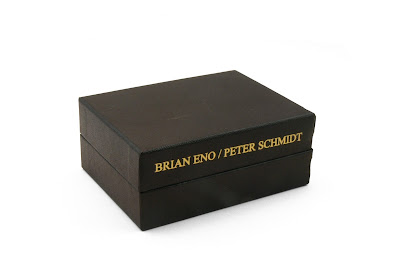
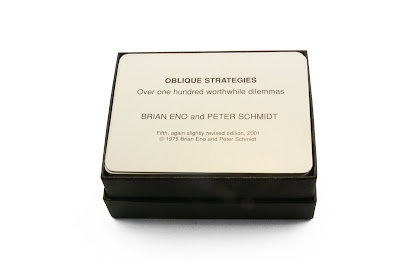
Oblique Strategies is a boxed set of cards created by Brian Eno and painter Peter Schmidt. The two met when Eno was a visiting lecturer at Ipswich art school in the late 1960s, and later became friends and frequent collaborators. Schmidt's images were used for the cover of Eno's LP Taking Tiger Mountain (by Strategy) and on the Eno & Fripp record Evening Star. Early copies of the 1977 album Before and After Science included four watercolour prints by Schmidt. I was once given a framed set as a Christmas present (by the owner of the record store where I worked) but they were water-damaged in a subsequent move and thrown away. In the liner notes Eno writes: "Apart from our collaboration on this record, Peter and I have been working together and comparing notes for some time. In 1975 we produced a boxed set of oracle cards called Oblique Strategies, which were used extensively in the making of this record."

When comparing notes, the artists discovered that they had both independently arrived at a system of using cryptic axioms to overcome artistic obstacles. Schmidt had created a wooden boxed piece called The Thoughts Behind the Thoughts in 1970*, and Eno was undoubtedly influenced by George Brecht's Wateryam, other Fluxus scores, and John Cage's use of the I Ching to compose music.

Subtitled Over one hundred worthwhile dilemmas, the first version of the Oblique Strategies was published in 1975, and is now in its fifth, open ended, edition. Recently an iPhone app was released, and individual cards have been printed as t-shirts. The cards in the series each contain an instruction which can be used to break a creative deadlock. Eno has reportedly used them when recording his own projects, and also when producing albums for bands such as U2 and Coldplay. Some of the cards are specific to music, but most are open ended. Eno writes:

"These cards evolved from separate observations of the principles underlying what we were doing. Sometimes they were recognised in retrospect (intellect catching up with intuition), sometimes they were identified as they were happening, sometimes they were formulated. They can be used as a pack, or by drawing a single card from the shuffled pack when a dilemma occurs in a working situation. In this case the card is trusted even if its appropriateness is quite unclear…"

In R.E.M.'s What's the Frequency Kenneth, Michael Stipe sings "Richard says 'withdrawl in disgust is not the same as apathy." He is likely referring to Richard Linklater, whose debut film Slacker featured a character handing out the cards to passers by. On their follow-up album Up, Stipe mentions both the I Ching and the Oblique Strategies by name, in the song Diminished.

The following images of the cards in use were found at Flickr and various other image hosting sites.

*see next post