Showing posts with label Bob Cobbing. Show all posts

Friday, June 12, 2026

Bob Cobbing | Sonic Icons


Bob Cobbing
Sonic Icons
London, UK: Writers Forum Press, 1970
62 pp., 20.5 x 25.5 cm., staple-bound
Edition size unknown


Sonic Icons is the 9th publication from Writers Forum Press, a group that began meeting in 1952 and continues today, long after the death of Bob Cobbing, its founder. Concerned with the "limits of poetry", the group began publishing in the early sixties. Initially it self-published members writing and later would also publish work by John Cage, Allen Ginsberg, P.J. O'Rourke, Maggie O'Sullivan, Brion Gysin and many others. 

Sonic Icons  is a hand-made collection of Cobbing’s typewriter poems, printed on a variety of coloured papers, with a rubber-stamped cover. The book is considered a landmark in Cobbing's work, but also in visual poetry in general - a moment when concrete poetry gestured towards the performative sound poetry. 

The yellow-page poem Beethoven Today, above, is reprinted in the 2015 book BOOOOOK: The Life and Work of Bob Cobbing

Already scarce -I’ve never seen an image of another copy - the provenance of this one makes it particularly noteworthy - it is signed and dedicated by Cobbing to bpNichol, whose name he misspells:  “For Barry, greetings from Bob, 2 Nov 1970”. 


"Bob Cobbing is a senior and major exponent of the international concrete poetry movement in Great Britain. What is immediately impressive about his large body of work, in comparison with that of other poets in the field, is its range, and the published texts, which are freestanding visual poems, are also scores for vocal performance as sound poems. One of Cobbing's titles, Sonic Icons, stresses the interdependence of the two sides of his work through its appropriate anagram. His division of labor between self-publishing and performance ensures the unity of a creative project of great importance, yet his quest for new materials, techniques, and processes remains undiminished in energy and innovation."
- Robert Sheppard


"The publication of Sonic Icons in 1970 signalled a level of sophistication that was to become a trademark of Cobbing's visual and sound poetry from that point onwards. It was another pivotal moment for Cobbing's art."
- Mark Anthony Jackson


"I centre that in Sonic Icons, but one could place it in several other titles—in this case we have the intermediate stages resulting from new properties that Cobbing’s work accreted—for example, the idea of the graphical being readable into utterance; the idea of text on the page as being a landscape."
- Lawrence Upton


"Owning the means of production (the office duplicator, the photocopier) meant that Cobbing could conflate the processes of writing, design and printing. Performing regularly meant that he could heal the split in concrete poetry between those who presented silent icons, most famously Ian Hamilton Finlay, and those who developed the art of pure sound, such as Henri Chopin. Cobbing's anagrammatic title Sonic Icons was emblematic.

[...]

Between 1963 and 2002 Writers' Forum published more than 1,000 pamphlets and books, many of them his own work, but he was also generous as a publisher to younger writers, such as Lee Harwood and Maggie O'Sullivan. He issued texts by John Cage and Allen Ginsberg, and by fellow concrete poets, such Frenchman Pierre Garnier and Italian Arrigo Lora-Totino, both of whom were guests at the workshop in the 1990s."
- The Guardian


Thursday, August 22, 2024

Bob Cobbing | Sensations of the Retina


Bob Cobbing
Sensations of the Retina 
Toronto, Canada: Ganglia Press, 1978
[16] pp., 8 3/4 x 11 1/8”, loose leaves
Edition of 200


Eight unbound A4 leaves (most double-sided) housed inside a translucent blue plastic folder. Published as grOnk 15 by the publishing imprint founded by bpNichol and Dave Aylward.
 
Available for $100 US, from The Idea of the Book, here


Tuesday, January 30, 2024

David Toop / Max Eastley | New And Rediscovered Musical Instruments


David Toop / Max Eastley
New And Rediscovered Musical Instruments
London, UK: Obscure Records, 1975
12” vinyl LP
Edition size unknown


Released on December 5th, 1975 (alongside Obscure Records #1, 2 and 3), New And Rediscovered Musical Instruments features four tracks from Max Eastley on side A and three from David Toop on side B. 


“Brian suggested an array of five stereo microphones on stands to record the sound of the [kinetic sculpture] Metallophone, producing multi-channels on the studio mixer. I realized that the instrument had been transformed into another medium where choices could be made regarding dynamics and equalization. We made two recordings: one by Brian and one by me. Brian said he liked the first part of my recording and the second part of his and so this is what finally appeared on the record.”
- Max Eastley, 2023


"At that time, '73 and' 74, I became aware that there were a number of us making instruments. Max Eastley was a good friend and he was making instruments, Paul Burwell and I were making instruments, Evan Parker was making instruments, and we knew Hugh Davies, who was a real pioneer of these amplified instruments. Paul and I had also got interested in making books. We’d been working with Bob Cobbing, the sound poet, since the beginning of the 70s, and Bob had this press called Writers Forum. And Bob would do a book in an evening: Christmas Day, he’d do a book. He was just like, “Do you want to do a book?” “Yeah, OK,” “Let’s get going” – he was that kind of character. It was very inspiring to us – we were much younger, of course. But it made us realise you can do this. Never mind that nobody’s interested in it in the mainstream media.

I had the idea to do an anthology about instrument-making. At that time, Paul was at Ealing College of Art, studying art: basically, he was doing that to use the facilities. In other words, if we wanted to do a book, then we could do it there.

What happened after that? I think I sent one to Brian Eno. I don’t know how I got to know his address, but I sent one to him. He called me up and he said, “I really like the book, and I’m starting a new label, would you liked to do something?” It was a tricky situation for me, because I’ve always had this thing in my life of a tension between collaboration, which was extremely important to me, and then being alone. Make of that what you will! I think Paul and I had come to the end of a phase of working together. We were very close, we were sort of like brothers in a way, but I was beginning to feel I wanted to do something beyond that. So, I think what I did really was quite dishonourable, in the sense that I said to Brian, “Well, I want to do it solo.” It’s one of those things in my life I’m not particularly proud of. But I had ideas about music and sound and listening and time and so on that I wanted to pursue as an individual, and by doing that book, Brian opened the door, and he decided to do a record based loosely on the book, and Max was the obvious candidate. In fact, I asked Paul, and Hugh Davies, who was also in the book, to play, and Paul graciously agreed to that. It makes me feel even guiltier.

I was at a time of my life of making choices, I suppose: am I a writer, am I a visual artist? And when I was a teenager. I thought I would be a film-maker. Am I a musician? If so, what kind of musician am I?”
- David Toop, 2016


Sunday, January 2, 2022

Bob Cobbing | Sonic Icons


Bob Cobbing
Sonic Icons
London, UK: Writers Forum Press, 1970
62 pp., 20.5 x 25.5 cm., staple-bound
Edition size unknown

Sonic Icons is the 9th publication from Writers Forum Press, a group that began meeting in 1952 and continues today, long after the death of Bob Cobbing, its founder. Concerned with the "limits of poetry", the group began publishing in the early sixties. Initially it self-published members writing and later would also publish work by John Cage, Allen Ginsberg, P.J. O'Rourke, Maggie O'Sullivan, Brion Gysin and many others. 

Sonic Icons is a hand-made collection of Cobbing’s typewriter poems, printed on a variety of coloured papers, with a rubber-stamped cover. The book is considered a landmark in Cobbing's work, but also in visual poetry in general - a moment when concrete poetry gestured towards the performative sound poetry. 

The yellow-page poem Beethoven Today, above, is reprinted in the 2015 book BOOOOOK: The Life and Work of Bob Cobbing

Already scarce, the provenance of this copy makes it particularly noteworthy - it is signed and dedicated by Cobbing to bpNichol, whose name he misspells:  “For Barry, greetings from Bob, 2 Nov 1970”. 


"Bob Cobbing is a senior and major exponent of the international concrete poetry movement in Great Britain. What is immediately impressive about his large body of work, in comparison with that of other poets in the field, is its range, and the published texts, which are freestanding visual poems, are also scores for vocal performance as sound poems. One of Cobbing's titles, Sonic Icons, stresses the interdependence of the two sides of his work through its appropriate anagram. His division of labor between self-publishing and performance ensures the unity of a creative project of great importance, yet his quest for new materials, techniques, and processes remains undiminished in energy and innovation."
- Robert Sheppard


"The publication of Sonic Icons in 1970 signalled a level of sophistication that was to become a trademark of Cobbing􏰂's visual and sound poetry from that point onwards. It was another pivotal moment for Cobbing􏰂's art."
- Mark Anthony Jackson


"I centre that in Sonic Icons, but one could place it in several other titles—in this case we have the intermediate stages resulting from new properties that Cobbing’s work accreted—for example, the idea of the graphical being readable into utterance; the idea of text on the page as being a landscape."
- Lawrence Upton


"Owning the means of production (the office duplicator, the photocopier) meant that Cobbing could conflate the processes of writing, design and printing. Performing regularly meant that he could heal the split in concrete poetry between those who presented silent icons, most famously Ian Hamilton Finlay, and those who developed the art of pure sound, such as Henri Chopin. Cobbing's anagrammatic title Sonic Icons was emblematic.

[...]

Between 1963 and 2002 Writers' Forum published more than 1,000 pamphlets and books, many of them his own work, but he was also generous as a publisher to younger writers, such as Lee Harwood and Maggie O'Sullivan. He issued texts by John Cage and Allen Ginsberg, and by fellow concrete poets, such Frenchman Pierre Garnier and Italian Arrigo Lora-Totino, both of whom were guests at the workshop in the 1990s."
- The Guardian

Friday, April 6, 2018

Bob Cobbing | a b c d e f g h i j k l m n o p q r s t u v w x y z a s o u n d p o e m s e q u e n c e


Bob Cobbing
a b c d e f g h i j k l m n o p q r s t u v w x y z a s o u n d p o e m s e q u e n c e
London, UK :  Writers Forum, 1965
56 pp., 23 x 17.6 cm., staple-bound
Edition size unknown

The 7th in the "Writers Forum Poets" series, this title consists of a sequence from a to z of sound poems to be read aloud. Typed pages in card cover.

Cobbing (along with John Rowan and Jeff Nuttall) founded the Writers Forum in the early sixties to publish his own work, and the work of other authors/artists working in the field of sound and visual poetry. Between 1963 and Cobbing's death in 2002, Writers' Forum published over one thousand pamphlets and books including works by Bill Bissett, John Cage, Paul Dutton, Allen Ginsberg, Brion Gysin, Steve McCaffery, bpNicol, P. J. O'Rourke, Betty Radin, Richard Tipping, Lawrence Upton, Jiri Valoch and many others.


Sunday, September 24, 2017

To Steve McCaffery from Bob Cobbing


Bob Cobbing to Steve McCaffery, October 13, 1990, from the Granary Books archive:

“Unexpectedly printed your The Entrift for a Writers Forum launch last weekend...It makes a nice little book. I read it at the launch and it went down well with the audience. Because I did it in a hurry, I didn’t check for errors, apart from correcting the ones you already marked — there are a few, I think, so I’ll ask you to do a proof read and let me know what to correct, in time for the second edition. (I did only 60 copies of the first edition, and they'll soon go."


Wednesday, May 18, 2016

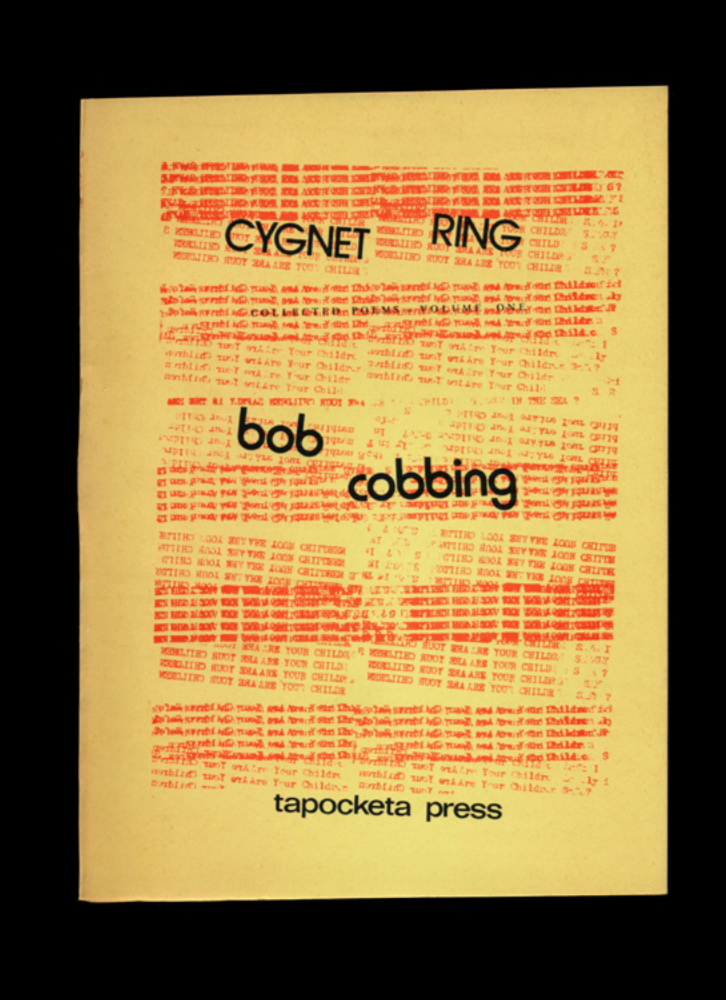
Bob Cobbing | Cygnet Ring: Collected Poems – Volume One


Bob Cobbing
Cygnet Ring: Collected Poems – Volume One
London, UK: tapocketa press, 1977
[32] pp., 4to., softcover
Edition size unknown

The first collection of Cobbing's work, this volume contains forty-three poems in total, and the six cut-ups that Cobbing created between 1956 and 1964.

Available from Tenderbooks here, or at Offprint London this weekend, at the Tate Modern.

Saturday, January 23, 2016

Boooook: The Life and Work of Bob Cobbing


William Cobbing and Rosie Cooper [eds]
Boooook: The Life and Work of Bob Cobbing
London, UK: Occasional Papers, 2015
208 pp., 17 x 24 cm., softcover
Edition size unknown


Founded by Sara De Bondt and Antony Hudek in 2008, Occasional Papers is 
a non-profit publisher of  books devoted to the histories of architecture, art, design, film and literature. They have produced works by Stephen Willats and John Latham, as well as titles on artists' ephemera (the catalogue to the MoMA Library exhibition Please Come to the Show) and concrete poetry (Notes From the Cosmic Typewriter).

Their most recent title, Boooook: The Life and Work of Bob Cobbing, is the first comprehensive overview of the life and work of the pioneering British poet and publisher. Cobbing, who died at the age of 82, fourteen years ago, has been called "the major exponent of concrete, visual and sound poetry in Britain."

Edited by grandson William Cobbing and Rosie Cooper, the volume takes its title from the name of a planned but never opened bookstore. Cobbing had managed the legendary Better Books on Charing Cross Road from 1965 to 1967, and when it closed he found a location a few blocks away that could house a bookstore on the ground floor and a dedicated projection space and auditorium in the basement. Start-up funds were raised and promotional materials were printed, but a noisy party the day before the lease was to be signed gave the landlord cold feet and he cancelled the agreement.

Prior to his involvement with Better Books, Cobbing founded Writers Forum, which operated as a small imprint, workshop and writers' network. Between 1963 and 2002 Writers' Forum published more than a thousand books and pamphlets, including works by John Cage, Ian Hamilton Finlay, Allen Ginsberg, Brion Gysin, poet Maggie O'Sullivan and satirist P. J. O'Rourke. Cobbing also published recordings of sound poetry by Henri Chopin and Francois Dufrene.

This dedication to publishing allowed his own work to blur the processes of writing, design and printing. His poems were typed, mimeographed (on his preferred Gestetner), photocopied, letter-pressed, and screen printed. His style was sometimes labelled 'dirty concrete', a sub-category of the genre that Derek Beaulieu defines as "concrete poetry which foregrounds the degenerated, the broken and the handmade".

His work on the page was often the springboard for a performance which involved stretching language ("until it broke" notes the book's editors) through the deployment of shouts, sneezes, hisses, and groans. He produced several albums, collaborating with abAna, Birdyak and David Toop. One of his best known works, ABC In Sound, was recorded for the BBC Radiophonic Workshop and broadcast January 7th, 1966.

"We are aided in our search by sophisticated instruments, the microphone and tape-recorder," he told Source magazine in 1970. "Our human voices extend the range of the tape-recorder’s abilities by their demands upon it. Conversely, the tape- recorder’s treatment of the voice teaches the human new tricks of rhythm and tone, power and subtlety . . . We are in a position to claim a poetry which is musical and abstract: but, however hard we try to do so, can we escape our intellect? No, but in the poetry of pure sound, yes."

Cobbing is well-known in sound and concrete poetry circles, and will be familiar to many in the artists' books community through his inclusion in various important anthologies. Alongside these activities, Boooook emphasizes Cobbing's efforts as an organizer and impresario. “We wanted to highlight his position as a key player in some of the most important moments and movements of the British avant garde,” write Cooper and Cobbing. "Such a large part of Bob's work was about facilitating other people, setting things in motion rather than promoting himself."

Cobbing collaborated with Gustav Metzger to present a series of projects for the legendary Destruction in Art Symposium in 1966. The three-day event featured lectures and performances by artists affiliated with Fluxus (George Maciunas, Yoko Ono, Robin Page), Happenings (Al Hansen, Wolf Vostell), Sound Poetry (Henri Chopin) and Viennese Actionism (Günter Brus, Otto Mühl, Hermann Nitsch). Who guitarist Pete Townsend was reportedly in the audience (he was a student of Metzger's) and became inspired to later destroy his guitar on stage as a form of "auto-destructive art", thus inventing a rock concert trope that continues unabated, fifty years later.

Some of the DIAS events took place at Better Books, including a programme titled ‘Cinema 65’, which led to the formation of the London Filmmakers’ Co-op. A year prior the store hosted a reading by Allen Ginsberg that led to the International Poetry Incarnation. Boooook highlights these connections and the key roles Cobbing played in a variety of artistic and counter-cultural events in the sixties.

The title is illustrated with numerous reproductions of artworks and ephemera (documents, posters, poems, film stills, etc.) and features contributions by the editors, Adrian Clarke, Arnaud Desjardin, Sanne Krogh Groth, Will Holder, Gustav Metzger, Marc Matter & Tris Vonna-Michell, David Toop, Steve Willey, Andrew Wilson and Maxa Zoller.

The book is the culmination of a year-long programme of events that happened under the umbrella name Bob Jubilé. It kicked off with an exhibition titled ABC in Sound at the Exhibition Research Centre, and also included numerous performances, a symposium, and a conversation with Kenneth Goldsmith. For more information, visit http://www.bobjubile.org.

Boooook: The Life and Work of Bob Cobbing is available from the publisher, here, for £20.

Tuesday, December 8, 2015

Holiday Recommendations Guest Post #7: Steve Clay


William Cobbing and Rosie Cooper [eds]
Boooook: The Life and Work of Bob Cobbing
London, UK: Occasional Papers, 2015
208 pp., 17 x 24 cm., softcover
Edition size unknown
Available from the publisher, here, for £20.

"Bob Cobbing (1922-2002) was an important and influential British poet internationally known for his work in concrete, visual and sound poetry. Boooook: The Life and Work of Bob Cobbing, edited by William Cobbing and Rosie Cooper, is a very useful archival project, which presents and discusses the full range of Cobbing’s participation in such enterprises as Better Books, the London Film-maker’s Coop, and Writers Forum with contributions from Adrian Clark, Gustav Metzger, and David Toop among many others. Boooook is thoroughly illustrated with photographs and examples of Cobbing’s work and beautifully produced by Occasional Papers in London. Readers interested in Bob Cobbing will take note of another publication from Occasional Papers, Notes from the Cosmic Typewriter: The Life and Work of Dom Sylvester Houdéard."


Steve Clay is a curator, editor, archivist, and publisher of Granary Books. He is co-author of A Secret Location on the Lower East Side: Adventures in Writing 1960–1980 and co-editor of A Book of the Book: Some Works and Projections About the Book & Writing. He lives in New York City. “The Book Undone: Thirty Years of Granary Books” is on view at the Rare Book and Manuscript Library, Columbia University through January 29, 2016. For details go to: http://www.granarybooks.com

Sunday, October 25, 2015

Bob Cobbing | E & O Poem


Bob Cobbing
E & O Poem
London, UK: Self-published, 1970
12 pp., 4to., staple-bound
Edition of 60 signed, numbered and dated copies


Thursday, October 15, 2015

The Art of Typewriting


[Marvin Sackner, Ruth Sackner]
The Art of Typewriting
London, UK: Thames & Hudson, 2015
352 pp., 25 x 31.5 cm., hardcover
Edition size unknown


In 1979, Marvin Sackner discovered a book on the top shelf at Jaap Rietman's New York bookstore and excitedly turned to his wife: "Ruth, this is what we are collecting. It even has a name". The book was An Anthology of Concrete Poetry, edited by Fluxus artist Emmett Williams and released by the Something Else Press in 1967. The volume presented the first international overview of the medium, collecting works by Eugen Gomringer (Switzerland), Dieter Rot (Iceland), Daniel Spoerri, Claus Bremer and Hansjörg Mayer (Denmark), Bob Cobbing (England), bp Nichol (Canada), and many others. It was reissued last year by Primary Information, and can be downloaded for free, here.

Five years later, in 1972, the Something Else Press released Typewriter Poems, edited by Peter Finch. "As far as I know it was the very first book to anthologize typewriter work," Finch told me over email last year. Unlike An Anthology of Concrete Poetry, the slim Typewriter Poems concentrated entirely on British artists.

Typewriter Art followed in 1975, edited by Alan Riddell, an Australian poet who grew up in Scotland and was introduced to Concrete Poetry by one of it's most celebrated practitioners, Ian Hamilton Finlay. It is now long out of print. Darren Wershler-Henry, a Montreal-based poet and cultural critic who was once the senior editor at Coach House Books, wrote The Iron Whim: A Fragmented History of Typewriting, in 2005. Last year graphic design scholar Barrie Tullett published Typewriter Art: A Modern Anthology.

The Sackner's The Art of Typewriting, gathering hundreds of works by both artists and poets, is the largest overview to date. The works come from the Ruth and Marvin Sackner Archive of Concrete and Visual Poetry, which exists in their home (it has been suggested that they exist in it) in Miami, Florida. Their archive of books, critical texts, periodicals, ephemera, prints, drawings, collages, paintings, sculptures, objects, manuscripts, and correspondence relating to Concrete Poetry contains over 75,000 items. Amassed over four decades, it is the largest collection in world.

The couple met on a blind date when Ruth was studying English at the University of Pennsylvania. They married in 1956 and had three children. They were together for almost sixty years. Ruth died in her sleep last Saturday, at the age of 79.

“Miami lost, today, one of its real cultural giants,” South Florida art collector Dennis Scholl told the Miami Herald. “Ruth was one of those people who really cared about culture in our community. Together they built the greatest collection in the world. That is a hard thing to do.”

Marvin Sackner, now retired, was a successful pulmonologist who also invented medical devices. The royalties from these inventions provided the couple with the money ("play money" they called it) to invest in their art collection. Their holdings, while all text-based, include a wide variety of techniques, including hand-written artists' books, rubber-stamped works, artists' stamps and mail art.

The Art of Typewriting focuses on the works from their collection made with the manual typewriter. A chapter titled "A History of Ornamental and Art Typewriting", begins with a history of the machine itself, patented in 1869 and available commercially a few years later. Somewhat ironically, a condescending advertising campaign ("easy enough for a woman!") actually led to an influx of women in the workforce. In 1874, less than 4% of US clerical workers were women. Fifteen years later that number had climbed to 74%.

Unfortunately, the female artists in the book don't fare as well - by rough estimate their work makes up less than 20% of the almost 600 colour reproductions. Several of the earliest examples in the collection, however, were produced by women, including the first example of typewriter art ever published in a periodical. The work, an image of a butterfly, was by Flora F.F. Stacey, an English stenographer who had been 'drawing' with the typewriter for many years before winning an open competition in 1898.

Canadians, often omitted from international surveys, or represented by a token inclusion, fare much better here. The book features work by Derek Beaulieu, Earle Birney, bill bissett, jw curry, Paul Dutton, David W. Harris (also known as David UU), Steve McCaffery, bp nichol, and Mark W Sutherland. Interestingly, all but the latter come from the country's poetry, not visual art, communities.

Following the introductory texts is an expansive plate section, illustrating key works by over 200 poets and visual artists, beautifully rendered. These are divided into sub-sections, including sound poems, punctuation pictures, overtyped characters, canceled texts, textured texts, patterns, three dimensional objects, maps, erotica, love poems, typed artists books and many others.

Some categories work better than others. The 'erotica' is mostly nude photography with typewriter character shading, and the 'political' section includes a rudimentary tank fashioned out of slashes and dashes. The thirteen pages of 'typed representations of artistic works' features tributes and parodies of paintings and sculptures by Jasper Johns, Vincent Van Gogh, Mark Rothko, Jackson Pollock, Robert Rauschenberg, Brancusi and Mondrian. The 'sound poems' scores resonate simply from the suggestion that they be read aloud. Here solo works by nichol and Dutton (half of the Toronto sound poetry group The Four Horsemen) are included, alongside works by Bernard Heidsieck and Ernst Jandl.

But I find myself most drawn to the works at the extreme ends of the categorization: unstructured, expressive works and simple, restrained gestures. There are several pieces, for example, by Tom Edmonds, a concrete poet who died in his late twenties in 1971. They are striking dense, messy layered pages that appear almost three-dimensional. Inversely, the stark pieces in the 'punctuation pictures' section, benefit from their limitations. A simple and beautiful work by Claus Bremer retypes the alphabet twenty-six times, each time starting one space in but ending in the same place, a hard right margin. The characters that do not fit are overtyped. The work is part of his book Texte un Kommentare, which can be seen in the Youtube video below.

The Art of Typewriting is rounded out by an extensive bibliography and twenty-nine pages of illustrated biographies, including Tom Phillips (one of the Sackner's all-time favorites), Mary Ellen Solt, Emmett Williams, Carl Andre, Henri Chopin and Bob Cobbing.

An interesting, and undoubtedly costly, feature of the volume is that no two covers are alike. The book’s layout was created by the London-based graphic design studio Graphic Thought Facility, who utilized an algorithm to ensure that a unique combination of front and back image graces each copy
of the book.

The Art of Typewriting serves as a useful introduction to the art form, an essential addition to any library dedicated to the subject and a fitting tribute to Ruth Sackner. The book will be released by Thames and Hudson on the 26th of October. It can be pre-ordered now, from Amazon, for $45.18, here.

Images from the Sackner's home, published earlier this year in Apartemento, to accompany an interview with Leah Singer, can be seen here.


Thursday, January 9, 2014

Futura. Poesia Sonora


[Various Artists]
Futura. Poesia Sonora 
Milano, Italy: Cramps Records, 1989
5 CD box set
Edition size unknown

Often touted as the "most comprehensive anthology focused on past and contemporary sound poetry currents ever produced", this collection was originally released as 7 LP box set in 1978. Edited by Arrigo Lora-Totino, the collection also comes with a book featuring historical, biographical and bibliographical notes, in both Italian and English.

The collection is divided into the following subcategories:

The Futurist Declamation
Zaum: Transmental language
French Simultaneism
Forerunners and Dadaists in Germany
The howl: Antonin Artaud
The howl: the Ultra-Lettrists
and
Sound poetry today

An Antonin Artaud recording from 1947 warrants its own category (or initial full side of one of the seven LPs) and other artists featured in the historical sections include Filippo Tommaso Marinetti, Vladimir Majakovskij, Pierre-Albert Birot, Hugo Ball, Tristan Tzara, Marcel Janco, Richard Huelsenbeck, Kurt Schwitters, Henri Chopin, and Bernard Heidsieck. "Sound poetry today" features Gerhard Ruhm, Brion Gysin, Paul De Vree, Bob Cobbing, Isidore Isou, and Maurizio Nannucci, amongst others.

Reviewers have suggested that the CDs sound as if they were sourced from the LP release, not the original master tapes.