Dick Higgins, [edited by Steve Clay, Ken Friedman]
Intermedia, Fluxus and the Something Else Press: Selected Writings
New York City, USA: Siglio Press, 2018
364 pp., 7.25" x 9.75”, paperback
Edition size unknown
Typically in the month of December I solicit “Holiday Recommendations” from artists, curators, critics, collectors, publishers, etc. These posts are intended as a kind of “Gift Guide” for books, multiples or editions that are still in print, at their original price. There wasn’t time this year, but this post can happily serve as my own personal “Holiday Recommendation” - a long overdue collection of writings by the (should-be-more) legendary Dick Higgins.
Dick Higgins died twenty years ago, following a performance of his Danger Music #3, in Quebec City. In the two decades since his death at age 60, there have been no substantial publications1 dedicated to celebrating his innumerable contributions to contemporary culture. Higgins was an artist, an author, a performer, a poet, a printmaker and scholar. He co-founded one of the most important art movements of the last hundred years and arguably the most important publisher of artists’ books, ever. He wrote and edited forty-seven titles, including plays, poetry, and scholarly works.
His curriculum vitae - containing sections such as Visual Art, Music & Sound Art, Movies & Videotapes, and Conferences - was fifty pages long.
Born in 1938, in Jesus Pieces in the UK, to American parents, Higgins was raised in the United States, throughout New England. In 1957 he dropped out of Yale and moved to New York City, where he studied composition under John Cage at the New School of Social Research. Other students in his class included Al Hansen, George Brecht and Allan Kaprow, the “grandfather of Happenings”. Higgins performed in Kaprow’s first ever Happening, in 1959.
In 1960, he married artist Alison Knowles. They would divorce ten years later and then remarry fourteen years after that. He described their relationship as “extremely autonomous” in a letter he wrote to me in the mid-nineties. He was known for penning lengthy candid letters, so much so that they often necessitated the phrase “not for publication” carefully typed at the top of the page.
Higgins and Knowles travelled with George Maciunas to Wiesbaden, Germany to help launch and promote Fluxus publications, and to participate in the Wiesbaden festival in 1962 that is often considered a key event in the founding of Fluxus.
A year later, frustrated by Maciunas’ inability to publish Higgins’ manuscript in a timely manner, he and Knowles founded the Something Else Press. The importance of the SEP cannot be overstated. The success rate and significance of the Press is unrivalled. (My own small publishing venture is named in tribute - The Nothing Else Press)2.
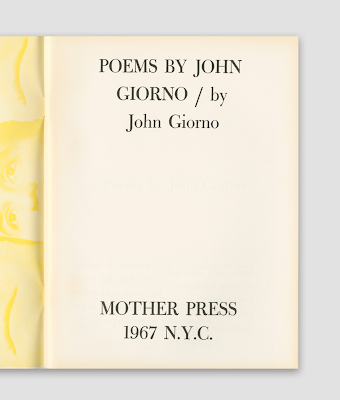
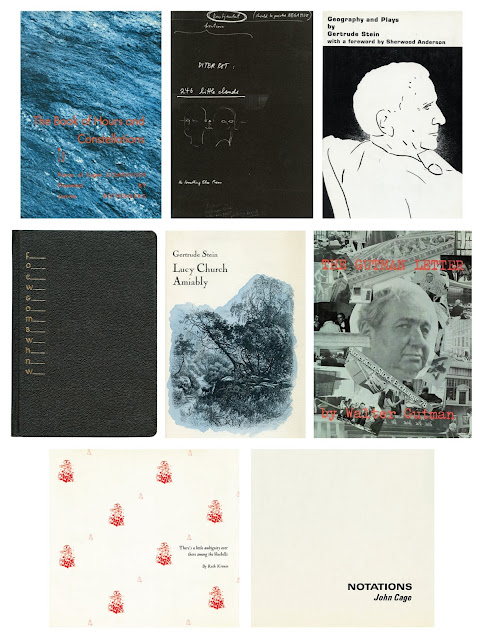
In addition to publishing artists' books and writings from some of the most interesting and important artists of the time (George Brecht, Robert Filliou, Claes Oldenburg, Ray Johnson, Daniel Spoerri, Ian Hamilton Finlay, Geoffrey Hendricks, Dieter Roth) they also published projects by composer John Cage and his partner, dancer Mercer Cunningham; found poetry by Bern Porter, concrete poetry by Emmett Williams and many others; writings by Higgins’ former music teacher Henry Cowell, music criticism by Richard Meltzer; experimental poetry and prose by John Giorno and Brion Gysin; and reprints of classic works by Gertrude Stein and Marshall McLuhan.
One of the most radical and important contributions to the field of artists books, however, was the way Something Else Press titles were bound - conventionally. Bucking the trend of elaborate and delicate artists’ books with alternate bindings and affixed feathers, etc., Higgins insisted on clothbound, library-standard binding, published in large enough edition sizes that they could end up in bookstores across the country, and be purchased for library collections. The present accessibility of these titles is big part of the important legacy the Press left behind.
Artist Ken Friedman served as the general manager of the Something Else Press between 1970 and 1971, and is the co-editor/author of this new volume of his former mentor’s collected writings. Once the youngest member of Fluxus, Friedman would later have a successful international career as an academic in San Diego, New York, Copenhagen, Melbourne, and currently Shanghai. He is the the author of several important texts on Fluxus, including The Fluxus Reader, an early scholarly look at the group from 1998.
In their new compendium’s introductory essay, he compares the importance of Dick Higgins to that of Marcel Duchamp or John Cage:
“While less famous, Higgins abstracted and concretized the profound artistic and intellectual ferment of an era as Duchamp and Cage did. Higgins was a bold experimental artist. He was also a quiet , tireless contributor to the world of ideas. By shaping an innovative stream of of exhibitions, projects and publications, he became a pivotal figure in the network of idea-based artists who he attracted and with whom he interacted.”
Friedman and Steve Clay have gathered almost two-dozen texts by Higgins, including essays that Higgins penned for Something Else Press newsletters and catalogues, and an excerpt from the long essay Postface, which was (the flip-side of) the first title published by the SEP. Also included is an essential illustrated checklist of Something Else Press titles. This entry distinguishes itself from the must-own Annotated Bibliography by Peter Frank by consisting primarily of Higgins’ own words (amassed from newsletters and various writings) as well as for including the non-books published by the Press, such as prints, posters, buttons, balloons, and Kaprow’s classic artist record How to Make a Happening.
Of further interest, there are several pages listings of titles that were never published by the Press, but only “Announced, Promised or Alluded To”. These were mostly items that were including in the “forthcoming titles” section of the newsletters, which never materialized, and were never accounted for. Examples include: Selected Poems by Claes Oldenburg, Collected Writings by Erik Satie and The Book of Breething by William S Burroughs.
The interdisciplinary department where I teach at the University of Guelph is named Extended Media and before that was called Extended Practices, and I believe is another name change is in the works. Many other schools refer to similar departments by the term Higgins coined: “Intermedia”. The University of Iowa, Arizona State University, the University of Maine, the Roski School of Fine Arts, Concordia University in Montreal, the Herron School of Art and Design, The University of Oregon, the Edinburgh College of Art, and recently York University in Toronto all offer degrees in Intermedia.
Higgins’ 1966 essay Intermedia is included in Selected Writings, reprinted in facsimile like much of the writings here:
“Much of the best work being produced today seems to fall between media. This is no accident. The concept of the separation between media arose in the Renaissance. The idea that a painting is made of paint on canvas or that a sculpture should not be painted seems characteristic of the kind of social thought--categorizing and dividing society into nobility with its various subdivisions, untitled gentry, artisans, serfs and landless workers--which we call the feudal conception of the Great Chain of Being. This essentially mechanistic approach continued to be relevant throughout the first two industrial revolutions, just concluded, and into the present era of automation, which constitutes, in fact, a third industrial revolution.”
Co-editor Steve Clay writes in the introduction that “Higgins’ essays on Fluxus and Intermedia range over a period of nearly thirty-five years, from the urgency of Postface (1964) to the well-considered backwards glance of Fluxus: Theory and Reception (1987/1998)”.
Clay is an editor, curator, and archivist, as well as the publisher of Granary Books. Like the Something Else Press, Granary Books brings together artists, writers and poets to explore verbal/visual relations, as well as publishing the occasional scholarly look at artists’ publications, such as The Century of Artists' Books by Johanna Drucker and Clay’s own When Will the Book be Done?
The latter is likely inspired by Higgins’ own work The Strategy of Each of My Books, an analytical inventory of the artist’s own published output. This text includes the now-legendary (and possibly presumed apocryphal) story of how The Something Else Press got it’s name. Disenchanted with Maciunas and the delays, he returned home from a bar one night and announced to his wife that they had founded a press, called The Shirtsleeves Press. “That’s no good,” she said, “…call it something else”. That evening Higgins penned the Something Else Manifesto.3
The final section of the book are texts from Higgins extensive histories of Pattern Poetry, Visual Poetry and Sound Poetry, and rounding out the volume are a couple of letters to contemporaries: the Toronto poet Steve McCaffery and the “grandfather of mail art” Ray Johnson. In the latter, Higgins asks Johnson to reply (“post haste”) and include his name and the title of his SEP book written in black crayon, for use as the spine of the volume:
T
H
E
P
A
P
E
R
S
N
A
K
E
Lastly, there are eleven “snapshots” by Higgins’ and Knowles’ daughter, Hannah, a Fluxus scholar in her own right (she is the author of Fluxus Experience, published by the University of California Press in 2002). She writes about Higgins moving out of the family home after punching his stepfather in the nose, and of several important first meetings. Her father met Ray Johnson at the E-pit-o-me cafe, after mistaking him for Jasper Johns. They developed a life-long friendship and it was one of Johnson’s friends who introduced Hannah’s parents:
“Dorothy Podber had told her I was gay, but this didn’t seem to bother her any. I decided to concern myself with the girl behind the eyes, and to let the plumbing take care of itself in it’s own way. So I lost my virginity with a woman, and, finding how much I cared for her, there didn’t seem to be much point in going back.”4
The first meeting between Higgins and Fluxus impressario George Maciunas is also recounted: composer Richard Maxfield introduced them, referring to Maciunas as a “cryptophilic designer with an art gallery and lots of ambition.” Hannah toes the family line that Maciunas’ contributions to Fluxus are typically overstated. His “significant role” in Fluxus should not be “completely denied”, she writes.
And lastly, she writes of her father’s untimely death:
“In Quebec, Dick had a high old time. On October 25th, 1998, he was interviewed about Intermedia and was honoured, and he conversed with young people and contemporaries alike. I’ve seen the interview. It is haunting - he looked gray, like wet plaster, but seemed to be enjoying the conversation […] The next morning he failed to show up for breakfast at the local diner. That was unlike him. His friend, Fluxus artist Larry Miller, who had been with him the day before, took off that morning to find him. He found him dead from a heart attack. Dick had been getting ready for bed. He was found nude on the floor, with a book about General Lee at his side. It was a great, if early, death that was commemorated in many venues, among them the Whitney Museum and the Judson Church.”
Like Granary Books, publisher Siglio Press also seem to take some cues from Higgins’ publishing legacy. Since founding a decade ago by Lisa Pearson (complete with a manifesto of their own), the “fiercely independent” imprint has published both poetry and artists’ books, as well as returned some previously unavailable important titles back into print (including two titles that originated with the Something Else Press: John Cage’s Diary: How to Improve the World (You Will Only Make Matters Worse) and Ray Johnson’s The Paper Snake).
This new labour of love corrects twenty years of neglect. Intermedia, Fluxus and the Something Else Press: Selected Writings is a necessary addition to any art bookshelf, but particularly those interested in publishing, Fluxus, concrete poetry, Intermedia and most of the subjects covered in this blog.
1. I have one slim volume that I bought in Mexico a couple of years ago, in Spanish.
2. Proposed by John Goodwin who I once organized an exhibition of Something Else Press titles with, and who was aware of my other interest in empty galleries, blank canvases, silent music, etc.
3. (“We can talk about a thing but we can never talk a thing. It is always something else.”).
4. In 1982 Higgins wrote “I’ve slept with sufficient men and women to know that love’s more important than sex or gender”.