Showing posts with label William S Burroughs. Show all posts

Saturday, November 22, 2025

You're A Hook: The 15 Year Anniversary of Dial-A-Poem (1968-1983)


[Various Artists]
You're A Hook: The 15 Year Anniversary of Dial-A-Poem (1968-1983)
New York City, USA: Giorno Poetry Systems, 1983
12” vinyl record
Edition size unknown


A collection of authors, poets, musicians and composers collected to celebrate the 15th anniversary of the Dial-A-Poem project, and the (tenth, eleventh?) anniversary of the record label. 


Side One
1. John Giorno: (Last Night) I Gambled with My Anger and Lost (Greene Street Recording, New York, August 1983)
2. William S. Burroughs: “Old Man Bickford” from The Place of Dead Roads (Kabuki Theater, San Francisco, February 25, 1983)
3.  Laurie Anderson: Song from America on the Move (The Nova Convention, New York, April 29, 1977)
4. Philip Glass: A Secret Solo (Big Apple Studios, New York, April 29, 1977)

Side Two
1. Lenny Kaye: No Jestering (The Place, Eugene, Oregon, May 9, 1978)
2. Patti Smith: “7 Ways Of Going” from The Histories of the World (New York, January 1, 1975) / Fire of Unknown Origin (The Nova Convention, New York, December 1978)
3. Jim Carroll: From The Basketball Diaries (Giorno Poetry Systems, New York, March 30, 1969)
4. Frank Zappa:  The Talking Asshole (The Nova Convention, New York, December 2, 1978)
5. Allen Ginsberg: Father Death Blues (ZBS Media, Fort Edward, New York, February 28-March 1, 1981, courtesy of Hammon Music Enterprises


"In 1961 I was a young poet who hung out with young artists like Andy Warhol, Bob Rauschenberg and Jasper Johns, as well as with members of the Judson Dance Theatre. The use of modern mass media and technologies by these artists made me realize that poetry was 75 years behind painting and sculpture, dance and music. And I thought, if they can do it, why can't I do it for poetry. Why not try to connect with an audience using all the entertainments of ordinary life: television, the telephone, record albums, etc? It was the poet's job to invent new venues and make fresh contact with the audience. This inspiration gave rise to Giorno Poetry Systems” 
- John Giorno


Thursday, April 3, 2025

James Riddle | E.S.P. Fluxkit


James Riddle
E.S.P. Fluxkit
New York City, USA: Fluxus, 1966
3.5 x 4.75 x .75 cm.
Edition size unknown


A plastic box with a George Maciunas designed label containing a number of coloured cards. An instruction sheet reads: “DOP Instructions/Blindfold yourself securely and rub your fingers lightly over the colored papers. With practice you can learn to distinguish between the colors.”

In a letter to Paul Sharits dated July 1966, Maciunas wrote “Fluxus has no position on [William S.] Burroughs or psychedelics. Jim Riddle (a flux man) is very interested in psychedelics, ESP, LSD, etc. has done two Flux events last summer. One was ESP event across the country (by mail). Interesting results. [Brion] Gysin piece included for itself, not for his position on junk”.  

Jon Hendricks' Fluxus Codex notes that E.S.P. Fluxkit was "issued as an individual edition, and is a component of some Fluxkits and most copies of Flux Year Box 2”. It was also produced as an envelope edition (see earlier post, here, and below). 

The work - which originally was offered for sale for $3.00 - is held in numerous collections, including the Walker, MoMA, The University of Iowa Libraries, and Harvard Art Museum.


Tuesday, June 27, 2023

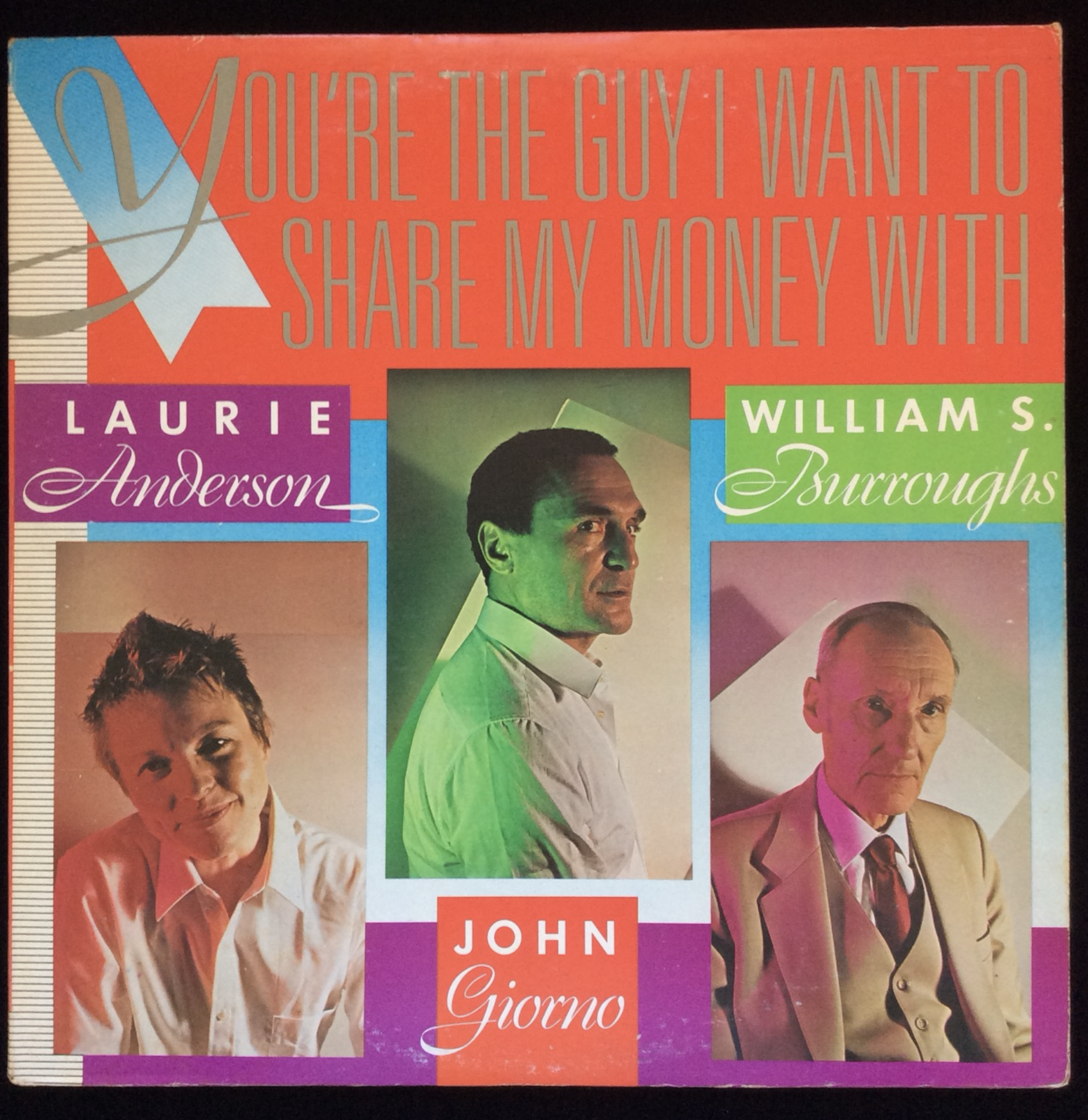
You're the Guy I Want To Share My Money With


Laurie Anderson/John Giorno/William S Burroughs
You're the Guy I Want To Share My Money With
New York City, USA: Giorno Poetry Systems, 1981
Vinyl LP/Audio Cassette
Edition size unknown


A cassette and double LP released in 1981, with the CD following in 1993 (with inconsistent track listing across the three formats). The recording was the tenth release from the Giorno Poetry Systems, and the second to feature Giorno and Burroughs. It was was recorded during the "Red Night" spoken word tour of 1981. Most of Anderson's material came from her magnum opus United States, and live versions of some tracks, such as "It Was Up in the Mountains", would also be included in her later 5-LP release, United States Live. This was Anderson's first major album release predating her solo debut, Big Science, by a year.

Whereas many of the Giorno Poetry Systems LPs had covers designed by visual artists (Les Levine, Keith Haring, Gary Panter, Robert Williams, etc.), this record was designed by George Delmerico, the late art director for the Village Voice newspaper.

Anderson's contributions to the LP include "Born, Never Asked", "Closed Circuits", "Dr. Miller", "It Was Up In The Mountains", "For Electronic Dogs", "Structuralist Filmmaking" and "Drums." Burroughs' tracks include "Introducing John Stanley Hart; He Entered The Bar With The Best Intentions", "Progressive Education", "The Wild Fruits", "Mr. Hart Couldn't Hear The Word Death" and others. Giorno is represented by two longer tracks: "Completely Attached To Delusion" and the epic "I Don't Need It, I Don't Want It, And You Cheated Me Out Of It".

The LP was a multi-grooved record, so depending on where the needle landed on the record listeners would hear either an Anderson, Burroughs or Giorno track.


"I toured with William Burroughs and John Giorno in 1981 when our collaborative double album, You’ re the Guy I Want To Share My Money With, was released and I loved hanging out with them. This is when I learned to talk to audiences directly. Burroughs was a master of this. In his Thanksgiving Prayer, he recites a litany of American acts of violence, ignorance and hatred, and at the very end intones in his most condescending voice, “You always were a headache and you always were a bore.” This sudden and jarring use of “you” was shocking. I began to try it out in my own work: This is your captain. Have you lost your dog? It suddenly opened new realms. Jump out of the plane. There is no pilot. Language that could boss, instruct and command. I was suddenly in touch with the audience in a whole new way."
- Laurie Anderson


Thursday, January 19, 2023


Brion Gysin was born on this day in 1916. 


Monday, January 16, 2023

Arthur Kleinjan | Paris Looks


Arthur Kleinjan
Paris Looks
Rotterdam, The Netherlands: Veenman Publishers, 2001
28 pp., 16 x 10 cm., accordion fold
Edition size unknown


This unassuming artist book - now over twenty years old - reminds me of a scene in Don DeLillo’s White Noise, which inexplicably didn't make it into Noah Baumbach's disappointing recent film adaptation. The characters in DeLillo's novel visit a tourist site known as “the most photographed barn in America.” Signs announcing the attraction dot their route, and when they arrive there are forty cars and a tour bus ahead of them, in a makeshift lot. 

“No one sees the barn,” Murray tells Jack. “Once you’ve seen the signs about the barn, it becomes impossible to see the barn. Being here is kind of a spiritual surrender. We see only what the others see. The thousands who were here in the past, those who will come in the future. We’ve agreed to be part of a collective perception. This literally colors our vision. A religious experience in a way, like all tourism.” 

The tourist photographers are not taking pictures of a barn, “They are taking pictures of taking pictures.”

In Paris Looks, tourists pose for the cameras of friends and family, in front of a monument that the artist is perched atop, surreptitiously taking his own photographs of the subjects. The ostensible subject matter of the snapshots - the object they are posing in front of - is missing from these pictures, like the unseen barn. The famously photogenic Paris - a place that consistently ranks atop lists of the most photographed cities in the world, becomes anonymous in Kleinjan's document. 

DeLillo returns to the idea of collective perception later in the book, when discussing the Nuremberg Rallies and Elvis Presley concerts. “They were there to be a crowd.”

Once in my mid-teens I was watching the TV news and during the closing credits clips played of the Rolling Stones' stadium performance from the night before. Jagger and the rest of the band were so isolated from each other, possibly fifty feet apart. A spec on the stage from the cheap seats. The mix was poor, the performance rote and predictable. It looked and sounded terrible. The broadcast then cut to vox-pop interviews with attendees, all proclaiming the concert excellent, some naming it a lifetime highlight. 

I thought about the inevitability of enjoyment in those situations: once you've paid a hundred dollars and drove forty minutes and paid more for parking and you've got a babysitter on the clock at home, you pretty much have to enjoy yourself. The sunk costs are too high. 

What I failed to recognize is that a big part of what they enjoyed was being in a crowd. Being part of something bigger, maybe historic. Not just all of the people in the crowd with them that night, but the "thousands who were here in the past, those who will come in the future." Because you aren't just in the crowd, you are the crowd. Like the persuasive commuter billboard that reads "You are not in traffic, you are traffic". 

The Rolling Stones were not the product, they were the venue. We are the product. Most big tech companies exploit this.1 We provide the content (on Twitter, Youtube, Facebook, Instagram, this site, etc.) and they sell it back to us.2

It's a different form of consumerism than the type DeLillo wrote about. When White Noise was written consumerism felt less intrinsic - still something we could step back from and examine. Now it's too much of a given, too entrenched, written into our DNA. Mark Fisher could have been talking about White Noise when he wrote “It's easier to imagine the end of the world than the end of capitalism.” 3

Where Baumbach's adaptation fails to rise to the of quality of his best works (like The Squid and the Whale, The Meyerwitz Stories, etc) is that it's too faithful to the book. White Noise wasn't intended as a period piece, it took place at the time it was written. But the film spends considerable resources to set the story in the eighties - tracking down era-appropriate automobiles and stocking the shelves of the grocery store with brands and logos of the time. Why not swap out smart phones for tv sets and have the film take place in present day? 

Surely we are supposed to draw these parallels ourself. The director knows the audience has just endured its own airborne toxic event, and four years of a president who loves nothing more than basking in the glow of large rallies. Why not lean in here, and put a personal stamp on the proceedings? 

The novel has been optioned for years, and was generally considered to be "unfilmable", but trickier titles have been successfully adapted before, with a bit of bold vision. 

Laurence Sterne's Tristram Shandy was thought to be unfilmable, given that it's a nine volume book with so many digressions that the titular character is not yet born in the first few. But Michael Winterbottom's A Cock and Bull Story employed a film-within-a-film structure to work around the difficulties of the "first post-modern novel", published in 1759. 

“The novel does not obviously lend itself to adaptation for the screen” William S. Burroughs said of his 1959 book Naked Lunch, yet David Cronenberg found a way in by adding elements from the author's life. 

The bold genius of Salo is that Pasolini took a book written in the 18th century and set it in the waning days of Benito Mussolini's regime in the Republic of Salò, during World War II.  The transposition of the setting and era from France in 1785 to fascist Italy in the spring of 1944, is more important to the work than the foregrounded depravity. 4

Baumbach's White Noise is not without its charms. The family dynamic - with each child more TV and media literate than the previous - is well-handled, with the overlapping dialogue threatening to become a type of white noise itself. And I would happily pay to watch a two-hour performance of Don Cheadle and Adam Driver as competing professors, attempting to best each other with the knowledge of their subject (Elvis and Hitler, respectively). 

Unfortunately, the film is riddled with tonal inconsistencies and a third act5 that falls entirely flat. In a novel, good prose can sustain some introspection after a major event, in a film it feels like an extended go-nowhere coda. 

It's clear that I've used this space to unpack a film that I watched last night instead of writing about a little-known artist book from 2001. But I think back often to Kleinjan's simple formal exercise that shares some concerns with DeLillo's concept of the "most photographed barn". 6

His camera captures private moments that are out in public. Their stiff and awkward gestures suggest the subjects are "physically aware of themself becoming a photograph" and are "pulling themselves out of the real and into the performed."7 Kleinjan employs no selection process and the artist doesn't know any of his subjects - they are chosen only because they are being photographed by others. 

What they share is the crowd, they are featured here because they wanted to join the throngs of other tourists - past and present - who were photographed beside the same monument. A picture taken not only to prove that you were there, but to prove that you were there, also. 


1. Art Fairs, too. The galleries pay to display their artists' work and the public pays to come see it. The fair organizers provide only the venue, and reap all the rewards. 
2. Not just through premium subscriptions but via advertising, and the personal data we relinquish. 
3. The quote is actually from Fredric Jameson, though Fisher popularized it and returned to the idea several times in his work. It is also sometimes misattributed to Slavoj Žižek. 
4. As well as drawing a correlation between fascism and libertinage and tackling the abuse of power inherent in both, the film is often read as - like White Noise - an indictment of the dangers of consumerism. 
5. Strangely, the third act reminds me of David Cronenberg's work - with the dreamlike neon, out-of-character violence and chilly synth soundtrack. 
6. The two most-photographed homes in America are said to be the White House and the Brady Bunch home. The Bradys appear in both, in a little known TV movie shot in Toronto called The Brady Bunch in the White House
7. Arthur Kleinjan


Saturday, November 13, 2021

Sylvere Lotringer, RIP


Sylvere Lotringer, the French born literary critic and cultural theorist who founded the journal Semiotext(e) died last week, at the age of 83. 

Lotringer was in an editorial collective with Georges Perec, played chess with John Cage and published books about David Wojnarowitz, Nancy Spero and Antonin Artaud. 

In 1978 he hosted The Nova Convention, a tribute to William S Burroughs that featured John Giorno, Laurie Anderson, Philip Glass, Frank Zappa, Les Levine, Patti Smith, John Cage, and others (see earlier post, here). Three years prior Lotringer organized the Schizo Culture event. 

As a professor at Columbia for 35 years, his students included filmmaker Kathryn Bigelow, art critics Tim Griffin and John Kelsey, and poet Ariana Reines. 

He appears as a fictionalized version of himself in Kathy Acker's Great Expectations and My Mother: Demonology, in Eileen Myles' Inferno, and in I Love Dick, Alien & Anorexia and Torpor by Chris Kraus, his wife. He was portrayed by Griffin Dunne in the recent TV adaptation of I Love Dick

Lotringer died on Monday in Baja California, after a long illness.


"A sizeable portion of young artists are critical of the art institutions, and of the kind of life they offer, but do they really want to change the way their own world is being run? At this point it is being handed down to them ready-made and they struggle to fit in it as best they can. Today’s art world embodies all the excesses of private enterprise and the neo-liberalist economy. Whether or not the global acceleration and fragmentation that we are experiencing can be resisted is a moot question. Technological progress comes to us as a by-product of the military industry, and it seems to be irreversible. Resistance is preempted from the start and invoking it is at best a kind of mantra, a stance-a “resist-stance”-meant to assuage the general sense of powerlessness. Although Foucault indicated that every power relation is reversible, in Discipline and Punish he himself only mentioned the word “resistance” once, and without specifying it. There’s no such thing as resistance in general. One always resists something. When power is diffused throughout the entire society, everything becomes reversible and ambivalent. There is no easy way out. The question would be how could artists invent forms of resistance that would be specific to art, but not limited to it? Let’s take the example of Duchamp. He resisted the gallery system and came up with the idea of the ready-made. The ready-made was an active response to his own environment. Getting art out in the world, turning the world into a gallery. It was an impertinent idea. This was what Dada’s strategy was about. It was the end of gallery art. But the system jumped back and turned this iconoclastic idea into another fetish. The entire American art sprung out of this idea. It may not be what Duchamp had in mind, but this is what his idea became. It changed the way art was being made, but it also gave the art gallery system a new boost. The irreverent gesture was made reactive. That may explain why Duchamp stopped making art and became the “thin” artist, an artist who doesn’t make art. He was regaining the initiative and thumbing his nose again at the art world and its system of value. It was a disappearing act, but an act all the same. He kept his studio empty, and worked in his studio next door. Whether he actually stopped making art or not is irrelevant. He kept making art in his own terms. The end of art had already happened, but it took another half century to become a reality. The gallery system was a dead end, but it became all the more powerful for all that. Duchamp’s real art was staying below the radar. It was the art of resisting."


Sunday, August 15, 2021

The Nova Convention


[Various Artists]
The Nova Convention
New York City, USA: Giorno Poetry Systems, 1979
Gatefold 2LP set/double cassette
Edition size unknown


In 1978, Semiotext(e) founder Sylvere Lotringer approached John Giorno about organizing a tribute to William S Burroughs, bringing together European and American academics for a series of seminars, celebrating the writer as a "philosopher of the future", someone who best understood postindustrial society.

Giorno was more interested in a counterculture event that would feature musicians, poets, novelists and artists alongside academics, maybe a star attraction. Keith Richards was added to the bill at the last minute to meet the final requirement, ensuring that the event quickly sold out. 

Titled The Nova Convention, the event took place between November 30th and December 2nd, 1978, in the East Village at the Entermedia (the former fabled Phoenix Theater, now the Village East Cinema). The "convention" featured music performances, readings, screenings and panel discussions, that sought to grapple with some of the implications of Burroughs' writings and influence. 

The audience was made up of academics, students, publishers, writers, artists, punks and people wanting to see the Rolling Stones guitarist. However, complications from his Toronto heroin arrest prevented Richards from attending. 

Philip Glass performed a minimalist solo work on the synthesizer, and was booed. Burroughs friend and associate Brion Gysin took the stage next, with the audience shouting "Where's Keith?"

Frank Zappa was recruited at the last minute to appear in place of Richards. Too late to arrange his band, he agreed to read from talking asshole scene from the Burroughs classic Naked Lunch

Patti Smith appeared next - nervous to follow Zappa - in a fur coat and iguana-skin cowboy boots. During her introduction a heckler shouted, "Tell it to the iguana." Smith is reported to have surreptitiously masturbated onstage through a slit in her coat pocket, to maintain her command over the audience. 

"I know you guys came in to see Keith," she told them, breaking the news for the first time. "Well, Keith ain't here. He's on a plane right now between L.A. and Toronto. He asked me to tell you all that if anybody wants their money back they can come and get it right now." She then proceeded to pull some crumpled bills out of her pocket, but no one approached to claim them. 

Sick with bronchitis, Smith was unable to sing but instead played clarinet and electric guitar, despite not being proficient on either. The New York Times review described her playing as "with virtually no technique in the conventional sense but with a certain understanding of the kind of effects that were within her grasp."

John Giorno - an always excellent performance poet - read two emotional and moving works and a young Laurie Anderson gave a presentation about the future, her voice electronically pitch-shifted. Anderson, Burroughs and Giorno would later team up for a spoken word tour together, and Burroughs appeared in Anderson's breakthrough film Home of the Brave

Burroughs received a warm welcome for his readings. Even when his subject matter is challenging, Burroughs' arresting voice, midwestern accent and haunting persona could be counted on to captivate an audience. He also provided the keynote lecture, and appeared on a panel discussion with Gysin, Timothy Leary, and Robert Wilson, moderated by artist Les Levine. 

The series was originally produced by Giorno Poetry Systems for WBAI radio, and released the following year as a double LP. 


Side One
1. Terry Southern – Vignette of Idealistic Life in South Texas
2. William S. Burroughs – Keynote commentary & Roosevelt After Inauguration
3. John Giorno – Eating The Sky
4. Patti Smith – Poem For Jim Morrison & Bumblebee

Side Two
1. William S. Burroughs – Benway
2. Philip Glass – Building, excerpt from Einstein On The Beach by Robert Wilson & Philip Glass
3. Brion Gysin – Kick That Habit, Junk Is No Good Baby, Somebody Special & Blue Baboon
4. Frank Zappa – The Talking Asshole
5. William S. Burroughs – From The Gay Gun: "This Is Kim Carson," "Just Like The Collapse Of Any Currency," & "The Whole Tamale"

Side Three
1. William S. Burroughs – What The Nova Convention Is About
2. Ed Sanders – Hymn To Aphrodite from Sappho
3. John Cage – Writing For The Second Time Through Finnegans Wake
4. Anne Waldman – Plutonium Ode & Skin Meat Bones

Side Four
1. Laurie Anderson & Julia Heyward – Song from America On The Move
2. Allen Ginsberg & Peter Orlovsky – Punk Rock, Old Pond; Feeding Them Raspberries To Grow, & Nurses Song
3. William S. Burroughs, Brion Gysin, Timothy Leary, Les Levine & Robert Anton Wilson – Conversations


Sunday, January 31, 2021

Brion Gysin | Dream Machine


Brion Gysin
Dream Machine
[no city]: Self-published, 1985
117.4 by 30.2 by 30.2 cm.
Edition size unknown


Signed, dated and inscribed to Keith Haring, this copy of Brion Gysin’s most celebrated work was offered for sale in the Sotheby's auction "Dear Keith: Works from the Personal Collection of Keith Haring" from October of last year. 

Haring happened upon the Nova Convention, in 1978 and subsequently read The Third Man by Gysin and William S Burroughs. The "Cut-up" method made a lasting impression on Haring, who was then a student. Eight years later Haring and Gysin collaborated on Fault Lines, a limited-edition artist book with writings by Gysin and drawings by Haring. 

Haring's copy of the Dream Machine was estimated to sell for between six and eight hundred dollars. The hammer price was almost thirty-three thousand US dollars. 


“I think a lot of people learned a lot of things from Brion. Unfortunately, much of his importance has been un-recognized or at least un-acknowledged. I feel lucky to have met him and enjoyed a few years of his long life. He is a legend. Brion’s writings and especially his paintings have helped me understand myself and my work in very important ways. He was difficult to keep-up with – a kind of saint from the underworld or (other world)? He understood my work (and life) in a way that only he could, because he lived it. His paintings give my paintings historical precedent.

He has been called the ‘grandfather of graffiti’ because of his ‘writing paintings’. Crossing the gap between East and West, he turned calligraphy into a kind of surrealist writing. From his expulsion from the Surrealist group by Andre Breton (for being gay) to his years spent in Morocco and Paris, he has been an “outsider”. Usually written out of history instead of into it.

Brion sometimes complained of this sort of conspiracy of un-acknowledgement, but I think inside he knew that it was the source of private personal satisfaction. Being popular, he knew, had its drawbacks. In a way, his purity and “otherness” was preserved and almost exalted by being “the outsider”. As usual, time will tell of his contributions and he will be respected for generations to come.

It seemed to me that Brion had done…everything (been everywhere) and somehow came out on top, but not knowing which end the top was on. I will miss Brion, but I hope he lives on, in ways, through me and through the things I learned from him. If I could accomplish a portion of the things he has, I would be happy.”
- Keith Haring, Journal entry dated July 26, 1986