Showing posts with label Shigeko Kubota. Show all posts

Saturday, July 23, 2022

Shigeko Kubota | Flux Medicine


Shigeko Kubota
Flux Medicine
New York City, USA: Fluxus, ca. 1966
10 × 12 × 2.5 cm.
Edition size unknown


One of only two editions produced by the artist for Fluxus (the other being Flux Napkins, here), Flux Medicine falls into a few categories of the boxed object Fluxkit. These include  'nothing' (Nam June Paik's blank leader as Zen For Film, Ben Vautier's Flux Holes), futility (George Brecht's Closed on Mondays) and the non-functional (Ken Friedman's Flux Corsage). 

The work also reflects the biography of George Maciunas, who served as the publisher and the designer. In 1965 Maciunas produced a work called Flux Mystery Medicine, which consisted of bottled pills, possibly in water. Only a photograph of this work is known to exist. It likely stems from Maciunas' fascination with medicine and the fact that he would buy food with the labels torn off at a discount price. Consuming unidentified canned food is one thing, but random pills is altogether a lot more sinister. 

Discarding his empty pill containers via Fluxkits likely appealed to his sense of humour, also (see the less known variation on John Chick's Flux Food, here, and his own work One Year). 

The better version (a square white box, included in copies of Flux Yearbox 2) is entirely made up of empty pill capsules. Less to unpack, but somehow more elegant. 

The label features one of Maciunas' more simple and effective designs. Unlike the usual vintage graphics and unusual typefaces he employed, this cover label features a carved plaster disk approximately 6.3 × 6.3 cm in diameter, photographed to look pill size. The original, and the mechanical design below, are housed at the Museum of Modern Art, as part of the Silverman Collection. 

Kubota died on this day in 2015, at the age of 77.


Tuesday, May 10, 2022

Shigeko Kubota | Marcel Duchamp and John Cage / Reunion


Shigeko Kubota
Marcel Duchamp and John Cage / Reunion
Japan: Takeyoshi Miyazawa, 1970
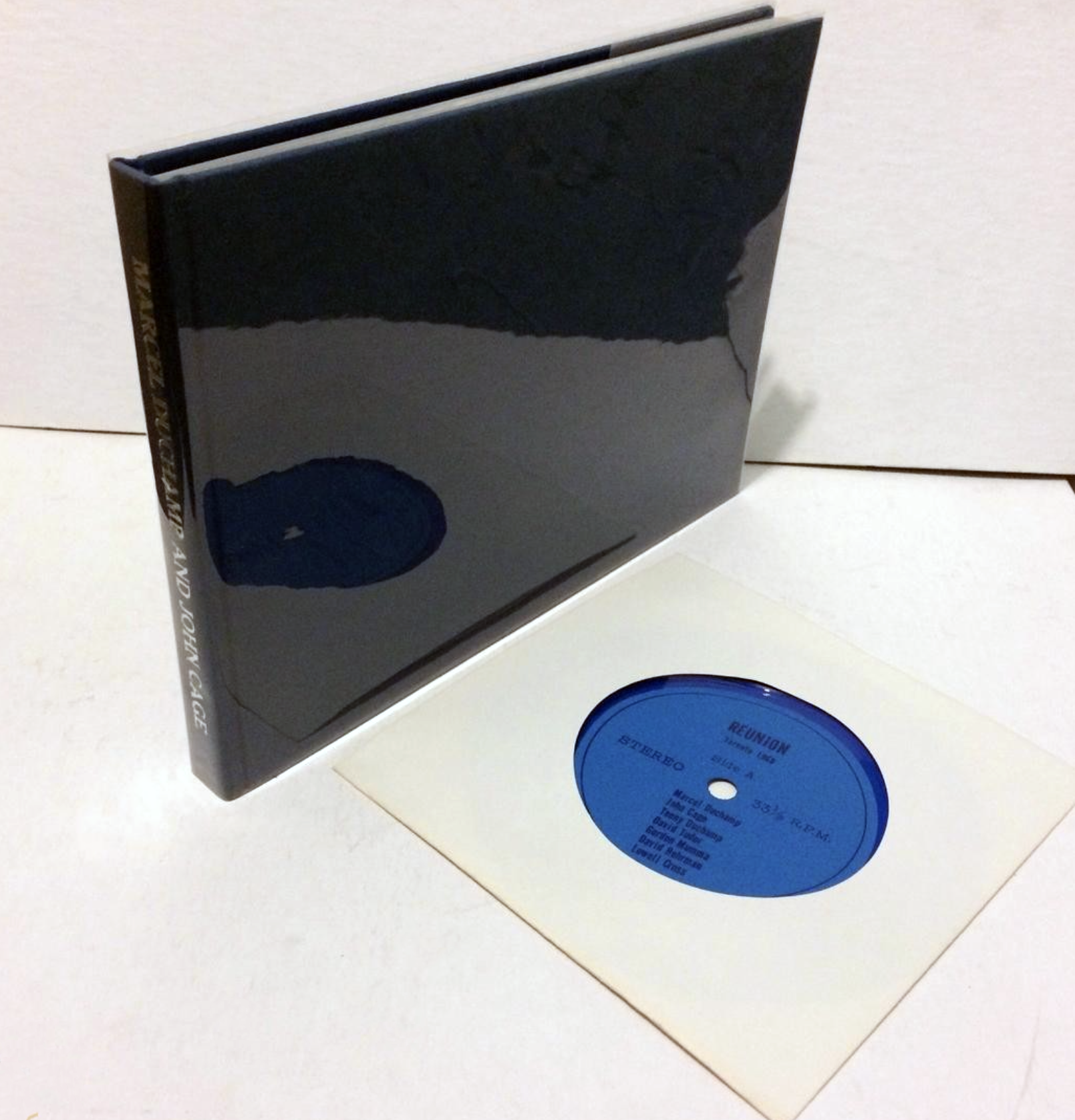
174 pp., 16.2 x 21.9 cm., hardcover in slipcase
Edition of 500 numbered copies


On March 5th, 1968, at the Ryerson theatre in Toronto, Marcel Duchamp and John Cage played chess in front of an audience. The chess board - designed by Lowell Cross (see quote below) - was wired to transmit sound and light. Other musicians involved include David Tudor, Gordon Mumma, and David Behrman. 

Duchamp reportedly quickly beat Cage, and the rest of the four-and-a-half-hour event featured his wife Teeny Duchamp playing against the composer. Towards the end the performers were said to have outnumbered the remaining audience. 

William Littler, music critic for the Toronto Star ,declared the event “mighty boring" and his colleague  Robert Fulford found it “infinitely boring”.  Kenneth Winters, writing for the now defunct Toronto Telegram wrote that the “fusty, dusty, illustrious visitors are just about sufficiently fossilized for reverent immurement in a university". The Globe and Mail didn't consider the evening important enough to send a reviewer. 

Subsequently, Reunion has gone on to become legendary - two giants of the 20th century appearing together, one of them for the last time on stage (Duchamp died a few months later, at the age of 81). One of my favourite pieces in my collection of ephemera is the yellow ticket for this event, though I wasn't able to track it down for this post. 

Artist Shigeko Kubota's video practice included many works made in tribute to Marcel Duchamp (and her husband Nam June Paik made many in tribute to John Cage). Her documentation of this event was later developed into three works - this book, a videotape and a video sculpture, ranging from 1970 to 1975. 

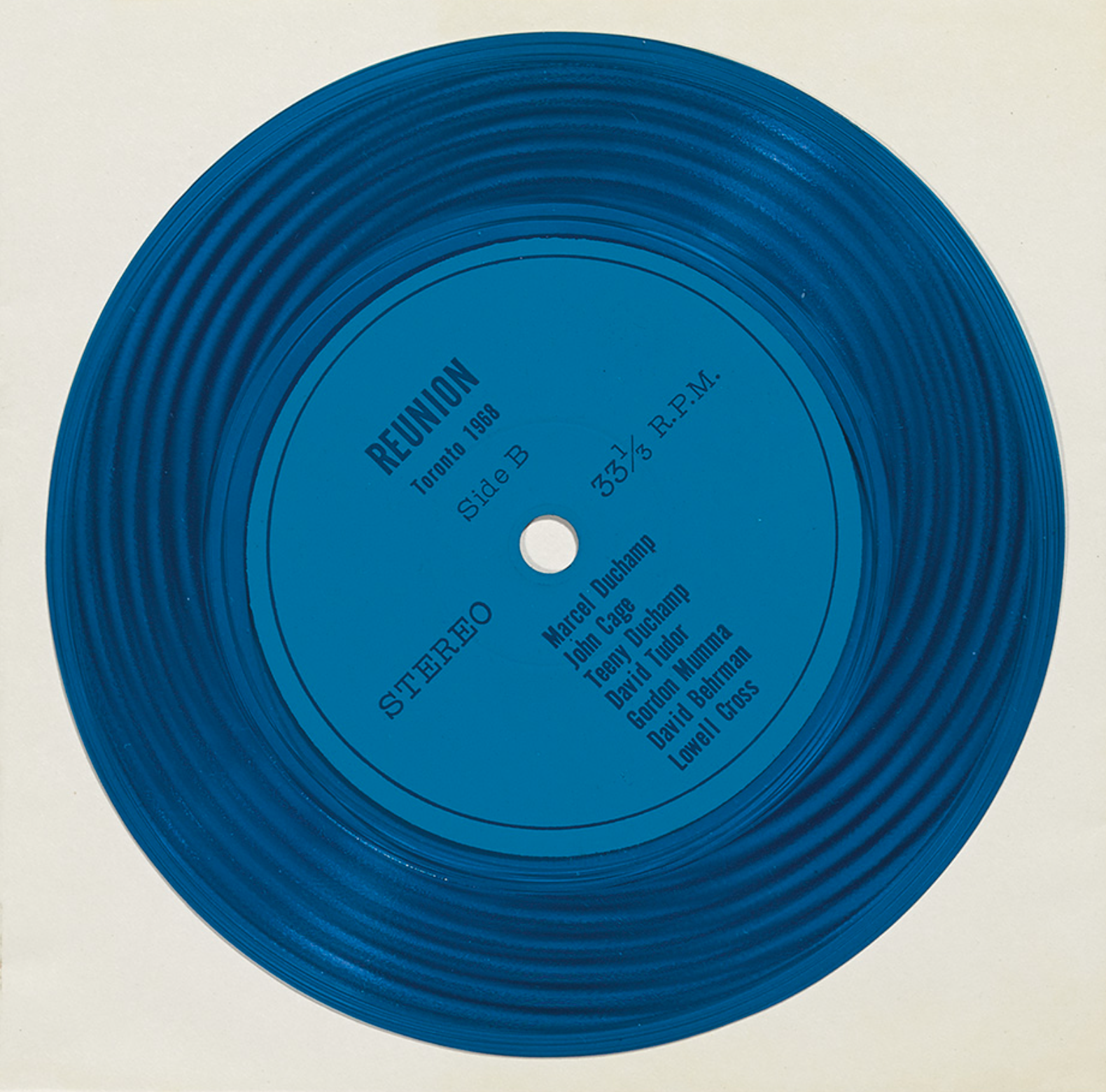
The book features a series of photographs she took during the night, a text by Cage titled "36 Acrostics re and not re Duchamp", and a flexi-disk with two short excerpts of the performance. These represent the only publicly released recordings of Reunion

Released in an edition of 500 copies, the book is incredibly scarce and is valued at between three and five thousand dollars. 


"One cold evening in late January or early February 1968, John Cage telephoned me at the Spadina Road apartment in Toronto where my wife Nora and I lived. He had already heard the results of electronic sound-motion produced by the circuitry of my “Stirrer”. Cage asked if I would build for him an electronic chessboard that would select and spatially distribute sounds around a concert audience as a game unfolded. Because I was in the process of completing my graduate work at the University of Toronto, at first I politely refused his request. He said, “Perhaps you will change your mind if I tell you who my chess partner will be.” After I said “OK – ,” Cage said, “Marcel Duchamp.”

Cage told me that he was naming the piece Reunion because he wanted to bring together artists with whom he had been affiliated in the past in a homey but theatrical setting. He and Duchamp would play chess at center stage, and the moves of the game would result in the selection of sound sources and their spatial distribution around the audience. Duchamp would sit in a comfortable easy chair (Cage would be content with an ordinary kitchen chair); Teeny would sit close by and watch; my “oscilloscopic” TV sets, on stage, should be in operation; and the chess aficionados at center stage would drink wine and smoke – Duchamp, cigars; Teeny and Cage, cigarettes. All the while, Cage’s composer-collaborators Behrman, Mumma, Tudor, and I would provide the electronic and electroacoustical sounds of the concert experience. Clearly, Reunion was to be a public celebration of Cage’s delight in living everyday life as an art form. 

[...]

Chess had been part of Duchamp’s everyday life for decades, and in the 1960s it became part of Cage’s everyday life, too. The composer had revered Duchamp since their first meeting in 1942, but kept his distance “out of admiration.” Cage eventually found enough courage to ask Duchamp for chess lessons, essentially as a way of getting to know him [9]. The setting for Reunion on the Ryerson Theatre stage – with the imposing chair for Duchamp, the cigars and cigarettes, the wine and chess – was an obvious imitation of the scene at the Duchamp’s second-floor New York townhouse."
- Lowell Cross 


“I met Duchamp on an American Airline flight to Buffalo for the opening of ‘Walkaround Time’ by Merce Cunningham. It was a cold winter in 1968. The airplane couldn’t land at the airport in Buffalo because there was a blizzard from Niagara Falls. We landed at the airport in Rochester, then took a bus to Buffalo. In Toronto later in 1968, I photographed Marcel and John Cage playing chess at the ‘Reunion’ concert.”
- Shigeko Kubota

Monday, August 2, 2021

Shigeko Kubota


Shigeko Kubota was born on this day in 1937.

Thursday, January 7, 2021

Shigeko Kubota | Fluxnapkins/Fluxus 1


Shigeko Kubota
Fluxnapkins
New York City, USA: Fluxus, 1965
9.5 x 12 x1.5 cm.
Edition size unknown

A plastic box with a label designed by George Maciunas. Enclosed are four tissue napkins, each collated with a different colour cutout of a woman's face (eyes, lips, etc.).

The work first appeared in a manilla envelope, in Fluxus 1, with the title Napkin for Next Supper.  It was initally included anonymously, and later credited to Kubota. 

The boxed version was advertised in numerous Fluxus newsletters and price lists, varying from $1 to $8.00.

Thursday, July 23, 2015

Shigeko Kubota, RIP


Japanese Fluxus artist (and widow to Nam June Paik) Shigeko Kubota died today in Manhattan, at the age of 77.


Thursday, October 30, 2014

Hi Red Center | Bundle of Events


Hi Red Center
Bundle of Events
New York City, USA: Fluxus, 1965
56.2 x 43.2 cm (un-crumpled poster)
Edition size unknown

Like many early Fluxus editions, George Maciunas had conceived this as a "complete works by" project. Edited by Shigeko Kubota and designed by Maciunas, the double-side poster features documentation of the Japanese group's various "events and exhibits". These include performances such as Cleaning Event, where the trio washed city streets by hand.

Continuing Genpei Akasegawa’s series of bundled objects wrapped in rope or fabricated 1,000-Yen-Notes (and possibly referencing Marcel Duchamp's poster design for the DADA 1916 - 1923 exhibition, below), the poster was also sold crumpled and rolled, tied together with rope.

The poster version seems to have sold for fifty cents, and the crumpled version for $5.00. It was also included in various Fluxus anthologies and kits. The above examples are in the collection of the MOMA and Harvard, including the third image, which is Genpei Akasegawa’s prototype.

Hi Red Center consisted of Akasegawa, Natsuyuki Nakanishi, Jiro Takamatsu. The name was based on the meanings of the first kanji of each of their surnames — “taka” (high), “aka” (red) and “naka” (center).

Genpei Akasegawa died last week. Brief obituaries can be read in ArtNet, here, and The Japan Times, here. Details of a retrospective of Hi Red Centre activities at the MOMA last year can be found here. Their Mystery Can multiple can be seen here.