Showing posts with label Nan Goldin. Show all posts

Thursday, August 6, 2026

Skateboards


Artists skateboards (some produced posthumously) by Jean-Michel Basquiat, Bill Burns, Larry Clark, Nan Goldin, Keith Haring, Mike Kelley, Harmony Korine, Yayoi Kusama, Faith Ringold, and Christopher Wool. 


Monday, August 19, 2024

Nan Goldin | I’ll Be Your Mirror compact mirror


Nan Goldin
I’ll Be Your Mirror compact mirror
New York City, USA: Whitney Museum of American Art, 1996
4.8 x 8.4 cm.
Edition size unknown

A promotional make-up mirror produced alongside the 1996 Whitney exhibition I’ll Be Your Mirror, which covered the first two decades of Nan Goldin’s career.


Tuesday, July 25, 2023

Witnesses: Against Our Vanishing


[Nan Goldin]
Witnesses: Against Our Vanishing
New York City, USA: Artists Space, 1989
32 pp., 23 x 15.5 cm., softcover
Edition size unknown


When recalling battles to abolish the National Endowment for the Arts, many will likely picture Robert Mapplethorpe with a whip in his asshole, or Karen Finley naked and smeared with chocolate. Or maybe Andres Serrano's Piss Christ, a photograph of a crucifix submerged in urine. 

But this slim catalogue to an exhibition curated by Nan Goldin also set off a firestorm of controversy, and ended up being dramatically torn apart in protest, in the US Senate. 

Senator Jesse Helms is often seen as the main villain in the battle to protect the NEA and artistic freedom (see images outside of Artists' Space, below) and he was truly a reprehensible character, by any measure. He opposed food stamps, needle exchange programs, civil rights, disability rights, environmentalism, feminism, gay rights, affirmative action, and access to abortions.1

But Helms had many allies in the US government when it came to attacking the National Endowment for the Arts. 

As far back as 1981, Ronald Reagan intended to push Congress to defund the NEA entirely, in part because it was thought to be "easy to defeat".2 Oddly, conservative Reagan allies such as actor and NRA spokesperson Charlton Heston and Joseph Coors, of Coors Brewery, convinced the president that continuing support was important and necessary. 

Most of the attempts that followed were based on outrage against perceived slights to Christianity, and attacks on queer artists. Pat Robertson urged Congress to put an end to federal support of “obscenity, pornography and attacks on religion”, taking out newspaper ads and using his 700 Club Television show to promote the dismantling of the NEA. 

Pat Buchanan - during his 1992 campaign for the Republican nomination- promised to shut down the NEA and "fumigate" the building. 

In the case of the Nan Goldin curated 1989 show Witnesses: Against Our Vanishing, it was the not the exhibition itself, but the exhibition catalogue, that drew political condemnation. More specifically, the exhibition catalogue essay. Goldin commissioned David Wojnarowicz to write a text for the accompanying booklet, and the resulting “Postcards from America: X-rays from Hell” pulled no punches. 

Wojnarowicz responded to the AIDS-themed exhibition with a rage-filled text almost designed to erupt in controversy. The two passages that most offended the right are about Helms and Cardinal John O'Connor, whose views were somewhat more liberal than those of Jesse Helms. 

Cardinal O'Connor opposed capital punishment, military intervention and increased military budgets. He advocated on behalf of the poor and the homeless and was staunchly pro-union. He endorsed a national hate crime law that included crimes motivated by sexual orientation, and led a 1990 funeral Mass for James Zappalorti, a gay man who was murdered on Staten Island. 

However, O'Connor also opposed the teaching of safe sex in schools, and the distribution of condoms to prevent AIDs. He subscribed to the Catholic teaching that homosexual acts are never permissible, while homosexual desires are "disordered" but not in themselves sinful. He was also opposed to abortion. 

Wojnarowicz wrote: 

"On the table is today’s newspaper with a picture of cardinal O’Connor saying he’d like to take part in operation rescue’s blocking of abortion clinics but his lawyers are advising against it. This fat cannibal from that house of walking swastikas up on Fifth Avenue should lose his church tax-exempt status and pay retroactive taxes from the last couple centuries. Shut down our clinics and we will shut down your ‘church.’ I believe in the death penalty for people in positions of power who commit crimes against humanity, i.e., fascism. This creep in black skirts has kept safer-sex information off the local television stations and mass transit advertising spaces for the last eight years of the AIDS epidemic thereby helping thousands and thousands to their unnecessary deaths."

and about Helms: 

"I’m beginning to believe that one of the last frontiers left for radical gesture is the imagination. At least in my ungoverned imagination I can fuck somebody without a rubber or I can, in the privacy of my own skull, douse Helms with a bucket of gasoline and set his putrid ass on fire or throw rep. Willliam Dannemeyer off the empire state building. These fantasies give me distance from my outrage for a few seconds. They give me momentary comfort. "

Coming only months after the Piss Christ controversy, right-wing politicians, the Catholic church, and the American Family Association waged scorched-earth campaigns against public funding for artists. 

Senator Al D’Amato dramatically tore the slim volume apart in the Senate, calling it a “deplorable, despicable display of vulgarity.”3

Feeling the pressure, NEA chairman John Frohnmayer withdrew a $10,000 grant to Artists' Space, on November 8th, 1989, citing the politically charged nature of the exhibition: “what had been presented to the Endowment by the Artists Space application was an artistic exhibition. We find, however, in reviewing the material now to be exhibited, that a large portion of the content is political rather than artistic in nature.”

This raised alarms that a new NEA provision aimed at denying federal funds to artworks judged obscene would be broadened to include political censorship.

On November 17th, the National Endowment for the Arts partially restored the grant, stipulating that the funds were for the exhibition, not the catalogue. The catalogue printing costs were covered by the Robert Mapplethorpe Estate.4


Witnesses: Against Our Vanishing is valued at over $800, but the Smithsonian have archived the book in full, here


1. Jesse Helms bitterly opposed federal financing for AIDs research and treatment, believing it was God's punishment for homosexuals. "There is not one single case of AIDS in this country that cannot be traced in origin to sodomy," he declared. 

In 1993, he is reported to have said to Senator Orrin Hatch in an elevator "Watch me make her cry. I'm going to make her cry. I'm going to sing 'Dixie' until she cries," and then proceeded to sing the racist song about "the good life" during slavery to Carol Moseley Braun, the first black woman in the Senate. He was one of only three senators to vote against the confirmation of Ruth Bader Ginsburg to the Supreme Court.

2. Easy to defeat in theory (not as necessary as roads, schools, emergency services, the social safety net, etc), arts funding often survives because of the arts' community's natural access to the media and - ultimately - because cutting arts funding doesn't significantly alter the bottom line of a country's budget. 

3. Incidentally, D’Amato is the last Republican to have represented New York in the U.S. Senate. Five years ago - at the age of eighty - he was recorded berating his wife while she was recovering in hospital

4. Mapplethorpe had just died, in March of that year. 


Monday, March 13, 2023

Nan Goldin | The Ballad of Sexual Dependency


Nan Goldin
The Ballad of Sexual Dependency
New York City, USA: Aperture Books, 1986
144 pp., 25.2 x 22.8 cm., hardcover
Edition size unknown


Mock-ups for Goldin's classic photo book, from the Laura Poitras documentary All the Beauty and the Bloodshed, which explores Goldin's career and her battle to have the Sackler family name removed from museums around the globe. 

The film was nominated for the Best Documentary Oscar, but lost last night to Toronto filmmaker Daniel Roher's Navalny, about the poisoning of Russian opposition leader Alexei Navalny. 

The Ballad of Sexual Dependency is screening now on HBO. 


Friday, February 3, 2023

Nan Goldin | The Ballad of Sexual Dependency


Nan Goldin
The Ballad of Sexual Dependency
New York City, USA: Aperture Books, 1986
144 pp., 25.2 x 22.8 cm., hardcover
Edition size unknown


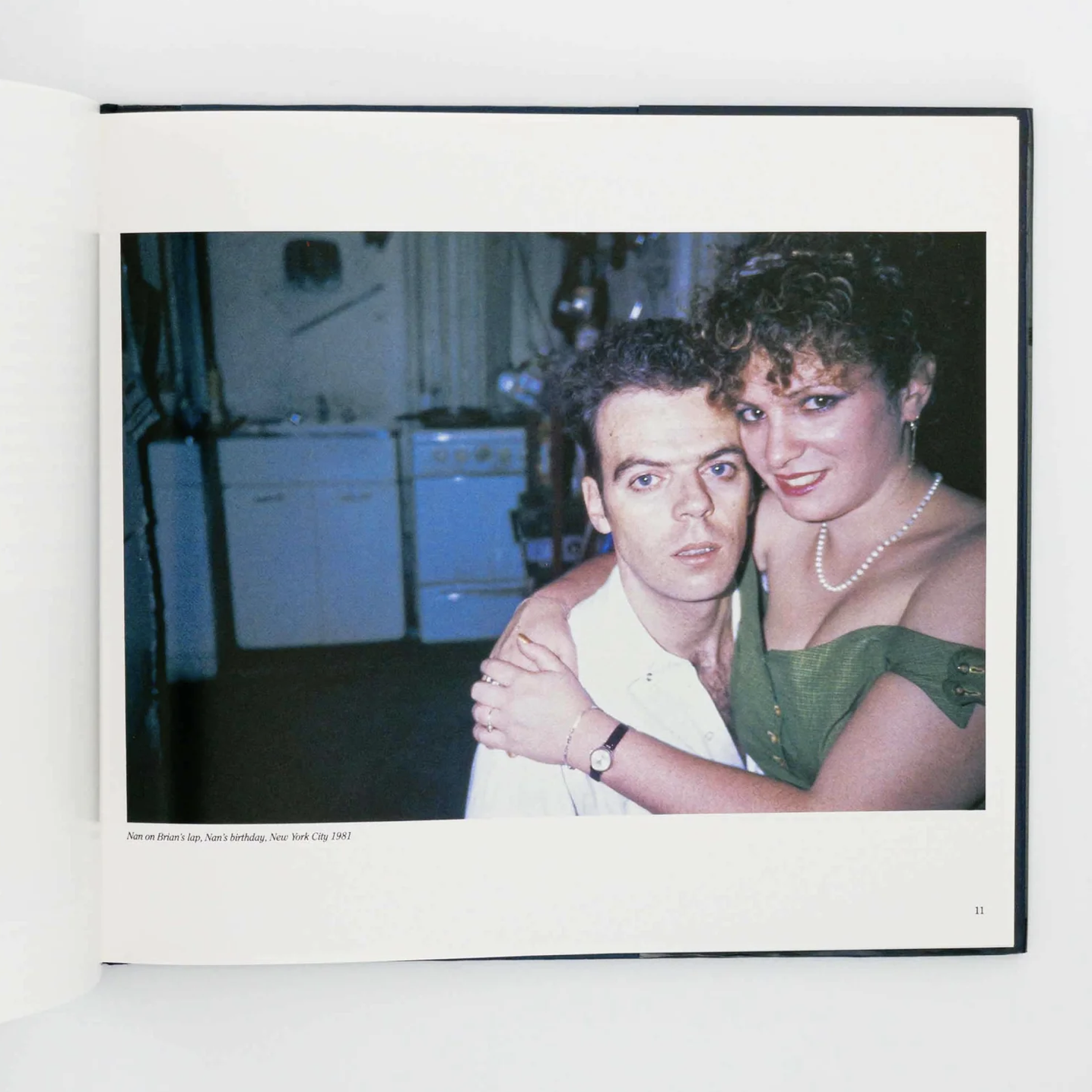
Titled after a song from The Threepenny Opera by Bertolt Brecht and Kurt Weill ("Ballade von der sexuellen Hörigkeit"), The Ballad of Sexual Dependency began as a slide show that Goldin would perform live, alongside songs by James Brown, Maria Callas, Nina Simone, The Velvet Underground  and Screamin’ Jay Hawkins. 

The slides were deeply personal photographs she had taken of herself, and her friends and lovers in the Lower East Side of Manhattan. They are featured primping, posing, dancing, bathing, fucking, getting married and raising children. They suffer the ravages of AIDs, drug abuse and domestic violence. 

If the original live presentations reappropriated the rec room family slide show, the 1986 Aperture book does the same for the family photo album.

"The Ballad of Sexual Dependency is the diary I let people read,” Goldin wrote. “The diary is a form of control over my life. It allows me to obsessively record every detail. It enables me to remember.” 

Accolades for the book are numerous. Andrew Roth calls it "perhaps the most influential photography book since Diane Arbus' 1972 monograph." Martin Parr wrote "like most of the great photobooks, it is an honest, troubling, passionate, deeply poetic mirror held up to our times." Guardian critic Sean O'Hagan calls the book a "a benchmark for all other work in a similar confessional vein." Lucy Davies, in The Telegraph, said it "would come to influence a generation of fledgling photographers, who fell into her truth-telling wake."

Village Voice critic J. Hoberman named the original slide show as one of his favourite films of 1985, calling it "a near-definitive portrait of a particular Lower East Side bohemia". 

Mock-ups of the book appear in the new documentary All the Beauty and the Bloodshed, which played in town last night, as do excerpts from the slide show, and other slide show works from throughout Goldin's career. 

The Oscar-nominated film serves as both a biography of the artist and her work, but also of her activism, specifically in battling to have museums prevent allowing the Sackler family to whitewash their reputation through donations. The most powerful sequences are when Goldin and other survivors of the opiate crisis confront the billionaire Sacklers during a Perdue Pharma bankruptcy hearing over Zoom. 

One of the best known images from the book is a self portrait from 1984 of the artist with two black eyes, after being beaten by her boyfriend, who appears on the cover of the book with her. In All the Beauty and the Bloodshed Goldin describes the assault in agonizing detail. He punched her in the face, in the nose, but ultimately seemed to be directing his rage at the photographer's eyes. A friend arrived and the beating stopped. "She saved my life," Goldin recounts. 

She also describes how this ex-boyfriend tried to prevent the book from being published, as did her father. Her parents worried that the recounting of her older sister's suicide would implicate them. 

"I think the wrong things are kept private," Goldin says in the film, a common refrain from panel discussions and interviews with the artist. 

In the introduction to the book she writes "I sometimes don't know how I feel about someone until I take his or her picture... I want the people in my pictures to stare back. I want to show exactly what my world looks like, without glamorization, without glorification."


Tuesday, May 25, 2021

Top Stories Exhibition


Top Stories was a prose periodical featuring experimental writing by women authors and artists. The series included staple-bound booklets by Jenny Holzer, Kathy Acker, Laurie Anderson, Pati Hill, Mary Kelly, Cookie Mueller, and others. The series also included visual contributions by artists such as David Armstrong, Joe Gibbons, Nan Goldin, Peter Hujar, Gary Indiana, Richard Prince and Leslie Thornton. 

The series was published by Hallwalls Contemporary Arts Center in Buffalo, New York, an artist-run centre founded by Charles Clough, Robert Longo, Diane Bertolo, Nancy Dwyer, Larry Lundy, Cindy Sherman and Michael Zwack in 1974. 

The 29 publications produced between 1978 and 1991 are now the subject of the an exhibition at The Netherlands Kunstverein. Complete sets of the series are somewhat rare, but not too prohibitively expensive that they needed to be displayed as rare objects under glass. This allows the museum to avoid the typical trappings of archival shows, and instead display the works on a magazine rack. The press release invites visitors to "browse, smell, read and touch the material for yourself."

In addition to the publications, the show features a newly commissioned two-channel film by Peggy Ahwesh, unpacking the Top Stories archives. Parallel to the exhibition, is the publication of Tense,  a never-realized publication by Lucy Lippard and Jerry Kearns from 1984. It will be launched during Amsterdam Art Weekend, towards the end of the exhibition.


"As I listen to Turyn speaking to Ahwesh about Top Stories #9: Kathy Acker (1981), I pick up the issue in question and flip through it. In the film, Turyn describes how she took care of the imagery for this issue herself, after Acker wrote her a letter saying that she wanted ‘the photographs to undermine the text’. In response, Turyn walked through Manhattan, from 57th Street to Chelsea, with Acker’s text, New York City in 1979, in mind, taking photos that – while showing no direct connection to the text – similarly evoke the unique social landscape of Times Square. The chapbook is bookended by two photographs of a clothed woman sitting on a chair, with only her lower half visible. On the first page, her legs are closed and, in the last, they are wide open. Turyn initially thought the chapbook should finish with the image of the woman’s legs closed to signify the end of the book, but Acker wanted it the other way around, arguing: ‘Literature should be open-ended.’ It’s something that could also be said of this exhibition, which, through its pared back yet insightful presentation, shows the importance of letting writers speak for themselves, offering an experience that is as open-ended as Acker intended her work to be."

- Julia Mullié, Frieze

Wednesday, February 26, 2020

Artists4Bernie


As of today, more than 2500 artists, curators, critics,  musicians, writers, and arts professionals have formally endorsed Democratic frontrunner Bernie Sanders for president of the United States. Among them: Hito Steyerl, Jeff Koons, Damián Ortega, Kader Attia, Kara Walker, Kim Gordon, Martha Rosler, Nan Goldin, Anicka Y, Nicole Eisenman, Karen Azoulay, Lawrence Abu Hamdan, Steve Reinke, Ryan McGinley, Parker Ito and Moyra Davey.

In addition to visual artists, the letter was signed by actress Chloë Sevigny, filmmaker Jim Jarmusch and musicians Devendra Banhart, M.I.A, Kim Gordon, and Michael Stipe.

The letter quotes Sanders commitment to the arts: "You have my promise that as president, I will be an arts president. I will continue to advocate strongly for robust funding of the arts in our cities, schools and public spaces. Art is speech. Art is what life is about."Conversely, each of Trump's annual budgets have declared the National Endowments for the Arts and the Humanities as 'wasteful and unnecessary funding'.

The Artists4Bernie campaign was launched by DIS, Mohammed Salemy, and Jennifer Teets. See the signatures at the website, here:

https://artists4bernie.org

Tuesday, December 27, 2016

100 Greatest Photobooks


The Source Photographic Review ranks the top photobooks, with Robert Frank's The Americans at number one, Evidence by Larry Sultan and Mike Mandel at #2, followed by Nan Goldin's The Ballad of Sexual Dependency. Other titles on the list include Sol Lewitt's Autobiography, Self Portrait by Lee Friedlander, Larry Clark's Tulsa, Common Sense by Martin Parr, Untitled Film Stills by Cindy Sherman and Ed Ruscha's Every Building on the Sunset Strip.

See the complete list here:

http://www.source.ie/photobook/greatest.html