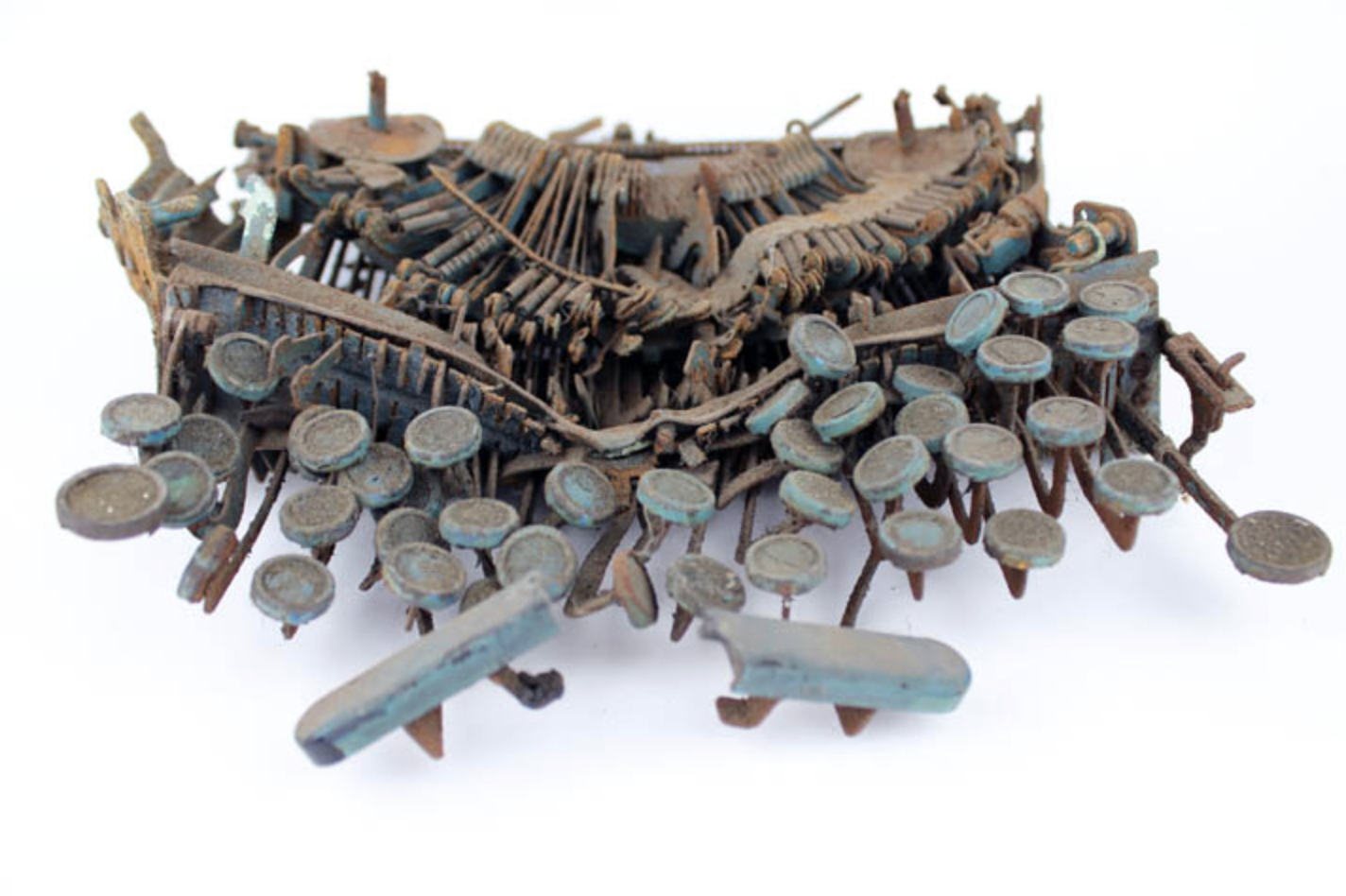
After thirty entries I’m going to put the typewriter posts to bed, not because I’ve exhausted them, but them me.
Showing posts with label Jean Toche. Show all posts
Saturday, June 20, 2026
Sunday, June 22, 2025
Faith Ringgold | Peoples Flag Show
Faith Ringgold
Peoples Flag Show
New York City, USA: Self-published, 1970
45.7 × 61 cm.
Edition size unknown
Last week Donald Trump revived calls for demonstrators who burn American flags to be sentenced to a year in prison.
"I happen to think if you burn an American flag, because they were burning a lot of flags in Los Angeles, I think you go to jail for one year, just automatic," he told the New York Post.
Currently flag burning is neither unlawful nor unconstitutional, but Senator Josh Hawley responded to Trump’s statements by proposing a bill that would create stiffer penalties for rioters who burned American flags.
Stephen Radich (1922 - 2007) was a New York gallerist charged with desecrating the American flag. From 1960 to 1969, he operated the Stephen Radich Gallery, where he exhibited works by Yayoi Kusama, George Sugarman, Dmitri Hadzi and others.
In December of 1966 he presented an exhibition of works by Marc Morrel, which incorporated American flags as a protest against the Vietnam War. Morrel, a former marine, produced soft sculptures with titles like "The United States Flag in a Yellow Noose” and "The United States Flag as a Crucified Phallus”.
The exhibition came to the attention of the New York City police, and Radich was charged and convicted of "casting contempt on the American flag”1. He was ordered to pay a fine of $500 (which would amount to almost five thousand dollars today, adjusted for inflation), or face sixty days in jail.
At the time, Jon Hendricks was the was the director of the gallery at Judson Memorial Church in Greenwich Village. He organized an event with his Guerrilla Art Action Group collaborator Jean Toche, and Faith Ringgold. They distributed a flyer titled “Call for Work for People’s Flag Show,” writing:
“As a challenge to the repressive laws governing so-called flag desecration, concerned artists and citizens are asked to participate in an exhibition, on Nov. 9th, 1970. The exhibition will run through Nov. 14th. Artists may not retain their conspicuous silence in times such as these. All participants should please limit their contribution to one piece. The delivery date for all work is Sunday afternoon, Nov. 8… Your voice is your sole defense against repression.”
Over a hundred and fifty works were submitted to The People’s Flag Show. These included a flag baked into a cake, a flag made of commercial pop cans, and a flag in the shape of a penis. Kate Millett draped a flag over a toilet bowl. Yvonne Rainer performed a nude dance with flags, and Abbie Hoffman spoke while wearing the flag skirt that he had been arrested for two years prior. Hendricks and Toche (below) burned a flag just prior to the exhibition opening, in the church’s courtyard.
The Attorney General ordered the exhibition closed on November 13th - only a day earlier than planned - and Hendricks, Toche and Ringgold were arrested, charged with desecration of the flag. They became known as the Judson 32, and were convicted and fined $100 each.3
"In 1970, there was a Flag Show that took place at the Judson Memorial Church on Washington Square Park, for which Faith designed the poster and I wrote the words. The show, after massive participation on the part of artists in New York, was closed by the Attorney General's office. Faith, Jon Hendricks and Jon Toche were arrested and charged with Desecration of the Flag. As a consequence, they were dubbed the Judson 3. They were subsequently vindicated of all charges on Appeal by lawyers who were assisted by the American Civil Liberties Union. It was an important case for Freedom of Speech among Artists. In this poster, Faith further develops her increasingly sophisticated use of words and lettering in art, as well as the image of the American Flag.”
- Michele Wallace, the artist’s daughter
1. Radich appealed his conviction to the United States Supreme Court, which, in 1971, returned a tie vote. Eventually, in 1974, a federal judge overturned the conviction.
2. Jean Toche was arrested again in 1974, this time by the FBI. He was charged with mailing a kidnapping threat to New York's Metropolitan Museum of Art. The threat, in the form of a flyer, called for the kidnapping of "museum trustees, directors, administrators, curators and benefactors”. He maintained his practice of combining mail art tactics with radical politics until his death in 2018.
Ringgold died at her New Jersey home, on April 13, 2024, at age 93. Jon Hendricks became the world’s leading scholar on Fluxus and remains the curator and archivist for Yoko Ono.
3. Like Radich, their fines were also overturned with support from the New York Civil Liberties Union.
Sunday, December 8, 2024
Structure No. 1, Spring 1968
John J. Sharkey
Structure No. 1, Spring 1968
London, UK: Structure Publications, 1968
24 pp., 25.5 x 20.5 cm., staple-bound
Edition size unknown
The debut issue of Structure magazine laid out it’s mission as follows:
"Structure will attempt to explore the concepts of potential environmental structures and their actual realisation in social terms, art of play. It will also explore the structural elements of environments as well as the creative possibilities and aesthetic extensions into dance, theatre, music, poetry, colour and light."
However, the first issue - of what was intended as a quarterly journal - was also its last.
The twenty-four page magazine featured Dick Higgins' Some Graphis Mirrors (see below), Jeffrey Shaw’s "expanded cinema environment and eventstructure” work Corpocinema, artist/activist Jean Toche's Manifesto 1 for a Theatre of Human Destruction, poetry by editor John J. Sharkey and works by Al Hansen, Theo Botschuiver, Jack Collom, Brendon O'Regan, Ivor Davies, Jackie Cassen, Rudi Stern, John J Lobell, Michael Steiner, Stephen Willats and others.
The front and back cover feature images by Dutch photographer Pieter Boersma of inflatable works by the Event Structure Research group (ERG).
The issue is somewhat scarce and typically sells for a few hundred dollars. If securing the rights wasn’t a complete nightmare, someone should publish a compendium of single-issue magazines of the ‘avant-garde’.
Monday, November 8, 2021
Jean Toche | I Piss on the Arts
Jean Toche
I Piss on the Arts
Cologne, Germany: Edition Hundertmark, 2001
16 pp., 15 x 21 cm., staple-bound
Edition size unknown
Jean Toche was a Belgium-born artist who relocated to New York City in the mid-sixities, where he lived until his death in 2018. He was arrested several times for his artworks and activism, including once by the FBI, for sending letters threatening kidnapping to the Metropolitan Museum of Art.
I ended up on his mailing list for a couple of years (possibly through our shared friend Jon Hendricks, who Toche founded the Guerrilla Art Action Group with - see earlier post, here).
This meant getting at least one postcard in the mail every single day. I have boxes of them. It also meant receiving a series of self-published publications in the mail almost weekly (see Stephen Perkins’ Artists Periodicals site for examples).
I remember being curious as to how he could possibly afford the postage and printing costs. He would have been in his late seventies at the time, possibly early eighties. I sometimes wondered if Yoko Ono offered her support to his practice (Hendricks is her longtime curator and she has been known to funnel cash to some radical politics in the past).
One of the items I received - more than once, I recall - is I Piss On the Arts. The thin, grey artist book is the penultimate title in the Edition Hundertmark booklet series. Toche also produced the 45th and final issue, Waiter There's A Terrorist In My Soup, a year later.
The cover features a petition it asks the reader to sign and distribute, declaring that you, too, “Piss on the Arts”. Inside are examples of the types of postcards Toche was distributing at the time. Statements like:
"It is mean and despicable to support the death penalty. The majority of Americans supports the Death Penalty."
and
"Increasingly, Global Business replaces Democracy. Burn that Proxy and Speak out!".
or calling for war tribunals to “issue an arrest warrant for former President George Bush, former Prime Minister Margaret Thatcher, former President Bill Clinton, Prime Minister Tony Blair”, etc. etc.
It all seems reasonable enough, sometimes quaint even, and anticipates the current reckoning happening in the art world in regards to its seemingly indifferent stance in the face of political upheaval (which of course just calls back a few decades ago to groups like the Art Workers Coalition, for example).
But when these were arriving daily in the mail, I do recall worrying if I was featured on some governmental lists of potential agitators (previous to this I was cc'd on death threats a distant acquaintance would send to arms manufacturers, so it didn't feel like an overly paranoid fear).
I piss on the arts is available from the publisher, here, for 16 Euro.
Friday, February 5, 2021
Guerrilla Art Action Group | Action-Interview at WBAI Radio Station-N.Y.
Guerrilla Art Action Group
Action-Interview at WBAI Radio Station-N.Y.
New York City, USA: Primary Information, 2018
12” Vinyl LP, 43:12 minutes
Edition of 500
Originally broadcast on WBAI Radio in New York City in 1970, and released on vinyl by Edizioni Lotta Poetica thirteen years later, this spoken word Action-Interview is the latest release by Primary Information, who have been re-printing important artists’ publications for the last twelve years.*
WBAI is a non-commercial, listener-supported radio station with an emphasis on progressive politics. Broadcasting at 99.5 FM in New York City (from a transmitter atop the Empire State Building) the station first went on the air in 1941, and by the 1970’s was an influential force in leftist politics and culture on the airwaves.
The station’s adventurous programming included a round-the-clock live reading of Tolstoy’s epic novel War And Peace, which took over four days and two-hundred readers to complete; and an uncensored broadcast of George Carlin's iconic Seven Dirty Words routine, at two in the afternoon, no less. The latter led to a Supreme Court ruling which to this day dictates the government’s right to regulate the airwaves against indecency.
The station has presented the work of many contemporary artists, particularly those whose work crosses over into poetry, performance, music, dance and theatre, including Vito Acconci, John Cage, John Giorno, Philip Glass, Joan Jonas, Meredith Monk, Yvonne Rainer, Willoughby Sharp, Robert Wilson, and numerous others.
The Guerrilla Art Action Group was formed in October 1969 by artists Jon Hendricks and Jean Toche. Hendricks - now the curator of Yoko Ono Exhibitions and one of the leading authorities on Fluxus - had then been serving as the director of the Judson Gallery at the Judson Memorial Church in New York City, initially as a requirement for his Conscientious Objector status, to avoid conscription to fight in the Vietnam War.
During this time he curated numerous now-legendary Destruction Art events at the liberal church, including a garden performance where Hermann Nitsch gutted a lamb, Lil Picard burned feathers and images of war, and Charlotte Moorman - performing Nam June Paik’s One for Violin - smashed the instrument over the head of a spectator protesting that the violin should be given to a music student instead of being destroyed.
When Hendricks co-curated the Destruction in Art Symposium USA 68, he invited Jean Toche to participate. Toche had attended the original DIAS in London, two years prior (destroying typewriters with a hammer, alongside Al Hansen). Born in Bruges, Belgium in 1932, Toche relocated to the USA in his early thirties, where he became active in the radical political art scene, staging happenings and publishing manifestos. The FBI described him as a "professional troublemaker, foreign agitator, peacenik, dirty commie, flag burner, big tall burly bearded hairy man".
Hendricks and Toche were part of the Art Workers’ Coalition, a loose association of artists, writers, and cultural workers founded in 1969 around shared commitments to social action and the reform of art institutions. Other members included Carl Andre, Robert Barry, Gloria Greenberg Bressler, Selma Brody, Mark Di Suvero, Hollis Frampton, Dan Graham, Hans Haacke, Joseph Kosuth, Naomi Levine, Sol LeWitt, Lucy Lippard, Lee Lozano, Barnett Newman, Lil Picard, Faith Ringgold, Seth Siegelaub, and Michael Snow.
Not unexpectedly, the large group (there were reportedly over 300 members at one point) became increasingly fractured. Hans Haacke noted "What one wants, the other objects to strenuously; e.g. one wants to destroy museums, the other wants to reform them or to use the museums as they are for his own artistic ends, and the third simply wants a piece of the pie."
Hendricks and Toche formed the Guerrilla Art Action Group, one of many AWC splinter groups, which also included WASABAL (Women Art Students and Artists for Black Artists’ Liberation), the Black & Puerto Rican Emergency Cultural Coalition, the Art Strike, the Emergency Cultural Government, and WAR (Women Artists in Revolution). The GAAG began with the intention of staging actions that could reach a wider public than the insular audience for political performance art. ''If I could have stopped the war with a painting, I would have done that; but I'm not a good painter,'' Hendricks told the New York Times in 1997.
Whereas the Artists Workers Coalition were primarily interested in artists' rights, the Guerrilla Art Action Group were interested in artists' responsibilities. And the responsibilities of art institutions.
The radio broadcast was made just a few months into the activities of the GAAG, but already the group had spilled blood in the lobby of the MoMA to demand the Rockefellers resign from the board of the museum, due to their involvement in weapons manufacturing for the Vietnam War. They had also demanded that the MoMA sell a million dollars worth of art from their collection and distribute the funds to the poor, and close their doors for the remainder of the war in Vietnam. They asked the director, John Hightower, to host a press conference and announce "I am guilty, I am guilty, I am guilty" while they poured beef blood over his head. Unsurprisingly, none of these things happened.
Billed as an Action-Interview, the audio on the LP consists entirely of members of the GAAG (Toche and Hendricks are joined by member Poppy Johnson, and Laurin Raiken, from the Art Workers Coalition and the New York Free Theatre) making statements and posing questions. The topics - virtually all of which still resonate with conversations still taking place today - include the problematic relationship between art and business, art and the military, art and class, art and community, and art and race.
Some of these statements are broad enough to be considered directed at the general public ("As long as we have business values, we will have racism and poverty") whereas others are clearly designed to have artists rethink their own complicity in the moral failings of institutions ("What is more important to you? To exhibit in a museum, or to fight for the human rights of the oppressed?", "Is it more important to you to sell your painting, or help human beings?").
"Today artists are egomaniacs" reminds one of Hendricks' connection to French artist Ben Vautier, who made the artists' ego a subject of long-term investigation. "Culture should deal with process, not objects" reaffirms his connection to the conceptual art he was exhibiting at the Judson, and to his longstanding professional relationship with Yoko Ono, one of the progenitors of conceptual art.
A few of the other queries, at random:
"How long will you accept being the repressed lackey of society’s manipulations?"
"Are you guilty of being a repressor?"
"Do you think an artist is more important than another human being?"
"Are you on some kind of ego trip?"
"Are you a prostitute?"
"Are you one of those pimps who makes his wife work so that he can paint all day long?"
"Should western culture have a monopoly on culture?"
"Shouldn’t people have control over their own culture, whatever race they belong to?"
"Do you work for a racist institution?"
"Do you think that art should serve the function of cleansing the image of murderers?"
"Are you guilty of supporting racist and repressive cultural institutions?"
"How long will you accept being the oppressed lackey of society’s manipulators?"
"Are not most artists concerned with being part of the cultural mafia at any cost?"
"Are you ready to fight against the subversion of culture by business?"
"Have you decided that the present cultural and cultural institutions are oppressive?"
"Do you enjoy being the creative toy of an elite?"
"Are you guilty of being such a toy?"
"If you are involved, shouldn’t you renounce it?"
"And babies?"
That last question was the title of a poster that Hendricks produced as part of the Artist's Poster Committee of Art Workers Coalition. One of the most enduring protest images from the era, the poster featured the now infamous My Lai Massacre picture taken by combat photographer Ronald L. Haeberle on March 16, 1968, overlaid with a distressed font which quotes four harrowing words from a Mike Wallace CBS News interview with a US Soldier named Paul Meadlo, who participated in the massacre:
Q. So you fired something like sixty-seven shots?
A. Right.
Q. And you killed how many? At that time?
A. Well, I fired them automatic, so you can’t- You just spray the area on them and so you can’t know how many you killed ‘cause they were going fast. So I might have killed ten or fifteen of them.
Q. Men, women, and children?
A. Men, women, and children.
Q. And babies?
A. And babies.
The MoMA had initially agreed to fund and circulate the poster, but was vetoed by the president of the Board of Trustees, William S. Paley, who reportedly "hit the ceiling" when he saw the poster proofs. Paley was the chief executive office of the CBS radio and television networks at the time and he and fellow board member Nelson Rockefeller were both "firm supporters" of the war and had backed the Nixon administration. MoMA withdrew their funding and issued a press release which stated that the project was outside the "function" of the museum, which could not take a position on any matter not directly related to a specific function of the institution.
This was the institutional environment that the GAAG were working in, silent on the subject of war, race, class and gender, while taking money from corporations that profited from the status quo of these very issues.
The recording was originally released by Edizioni Lotta Poetica and Studio Morra as part of their Radio Taxi series, which also featured audio works by Henri Chopin, Jackson Mac Low, Philip Corner, Bernard Heidsieck, Hermann Nitsch, and others. Primary Information present the gatefold sleeve in near facsimile to the original, with the complete text of the performance and a cover photograph by Hendricks' wife Joanne.
The work is an effective example of agit-radio, with the phrasing of the questions sometimes feeling like an interrogation. The last ten minutes or so consists entirely of a man (Hendricks?) shouting out the word "help" over and over again. Listening the other night, I felt compelled to turn the volume down to avoid alarming my neighbours,
Hearing it broadcast live in 1970 would have been considerably more discomforting.
The disk is currently on sale for only $10 US at Primary Information, here.
*Other Primary Information audio re-issues include How to Make a Happening by Allan Kaprow, the UJ3RK5 Live From The Commodore Ballroom, and Canciones de Cadaques by Dieter Roth and Richard Hamilton.
Monday, July 9, 2018
Jean Toche, RIP
Jean Toche, artist, activist and co-founder of the Guerrilla Art Action Group, was found dead in his home by the police, this afternoon.
Wednesday, May 2, 2018
Guerrilla Art Action Group | Action-Interview at WBAI Radio Station-N.Y.
Guerrilla Art Action Group
Action-Interview at WBAI Radio Station-N.Y.
New York City, USA: Primary Information, 2018
12” Vinyl LP, 43:12 minutes
Edition of 500
Originally broadcast on WBAI Radio in New York City in 1970, and released on vinyl by Edizioni Lotta Poetica thirteen years later, this spoken word Action-Interview is the latest release by Primary Information, who have been re-printing important artists’ publications for the last twelve years.*
WBAI is a non-commercial, listener-supported radio station with an emphasis on progressive politics. Broadcasting at 99.5 FM in New York City (from a transmitter atop the Empire State Building) the station first went on the air in 1941, and by the 1970’s was an influential force in leftist politics and culture on the airwaves.
The station’s adventurous programming included a round-the-clock live reading of Tolstoy’s epic novel War And Peace, which took over four days and two-hundred readers to complete; and an uncensored broadcast of George Carlin's iconic Seven Dirty Words routine, at two in the afternoon, no less. The latter led to a Supreme Court ruling which to this day dictates the government’s right to regulate the airwaves against indecency.
The station has presented the work of many contemporary artists, particularly those whose work crosses over into poetry, performance, music, dance and theatre, including Vito Acconci, John Cage, John Giorno, Philip Glass, Joan Jonas, Meredith Monk, Yvonne Rainer, Willoughby Sharp, Robert Wilson, and numerous others.
The Guerrilla Art Action Group was formed in October 1969 by artists Jon Hendricks and Jean Toche. Hendricks - now the curator of Yoko Ono Exhibitions and one of the leading authorities on Fluxus - had then been serving as the director of the Judson Gallery at the Judson Memorial Church in New York City, initially as a requirement for his Conscientious Objector status, to avoid conscription to fight in the Vietnam War.
During this time he curated numerous now-legendary Destruction Art events at the liberal church, including a garden performance where Hermann Nitsch gutted a lamb, Lil Picard burned feathers and images of war, and Charlotte Moorman - performing Nam June Paik’s One for Violin - smashed the instrument over the head of a spectator protesting that the violin should be given to a music student instead of being destroyed.
When Hendricks co-curated the Destruction in Art Symposium USA 68, he invited Jean Toche to participate. Toche had attended the original DIAS in London, two years prior (destroying typewriters with a hammer, alongside Al Hansen). Born in Bruges, Belgium in 1932, Toche relocated to the USA in his early thirties, where he became active in the radical political art scene, staging happenings and publishing manifestos. The FBI described him as a "professional troublemaker, foreign agitator, peacenik, dirty commie, flag burner, big tall burly bearded hairy man".
Toche now lives in Staten Island and remains active with political art mailings and publications such as I Piss On The Arts and Waiter! There’s a Terrorist in My Soup. For a couple of years I was on his mailing list and received almost daily denouncements of George Bush and the Iraq War, in the form of hand-made postcards.
Hendricks and Toche were part of the Art Workers’ Coalition, a loose association of artists, writers, and cultural workers founded in 1969 around shared commitments to social action and the reform of art institutions. Other members included Carl Andre, Robert Barry, Gloria Greenberg Bressler, Selma Brody, Mark Di Suvero, Hollis Frampton, Dan Graham, Hans Haacke, Joseph Kosuth, Naomi Levine, Sol LeWitt, Lucy Lippard, Lee Lozano, Barnett Newman, Lil Picard, Faith Ringgold, Seth Siegelaub, and Michael Snow.
Not unexpectedly, the large group (there were reportedly over 300 members at one point) became increasingly fractured. Hans Haacke noted "What one wants, the other objects to strenuously; e.g. one wants to destroy museums, the other wants to reform them or to use the museums as they are for his own artistic ends, and the third simply wants a piece of the pie."
Hendricks and Toche formed the Guerrilla Art Action Group, one of many AWC splinter groups, which also included WASABAL (Women Art Students and Artists for Black Artists’ Liberation), the Black & Puerto Rican Emergency Cultural Coalition, the Art Strike, the Emergency Cultural Government, and WAR (Women Artists in Revolution). The GAAG began with the intention of staging actions that could reach a wider public than the insular audience for political performance art. ''If I could have stopped the war with a painting, I would have done that; but I'm not a good painter,'' Hendricks told the New York times in 1997.
Whereas the Artists Workers Coalition were primarily interested in artists' rights, the Guerrilla Art Action Group were interested in artists' responsibilities. And the responsibilities of art institutions.
The radio broadcast was made just a few months into the activities of the GAAG, but already the group had spilled blood in the lobby of the MoMA to demand the Rockefellers resign from the board of the museum, due to their involvement in weapons manufacturing for the Vietnam War. They had also demanded that the MoMA sell a million dollars worth of art from their collection and distribute the funds to the poor, and close their doors for the remainder of the war in Vietnam. They asked the director, John Hightower, to host a press conference and announce "I am guilty, I am guilty, I am guilty" while they poured beef blood over his head. Unsurprisingly, none of these things happened.
Billed as an Action-Interview, the audio on the LP consists entirely of members of the GAAG (Toche and Hendricks are joined by member Poppy Johnson, and Laurin Raiken, from the Art Workers Coalition and the New York Free Theatre) making statements and posing questions. The topics - virtually all of which still resonate with conversations still taking place today - include the problematic relationship between art and business, art and the military, art and class, art and community, and art and race.
Some of these statements are broad enough to be considered directed at the general public ("As long as we have business values, we will have racism and poverty") whereas others are clearly designed to have artists rethink their own complicity in the moral failings of institutions ("What is more important to you? To exhibit in a museum, or to fight for the human rights of the oppressed?", "Is it more important to you to sell your painting, or help human beings?").
"Today artists are egomaniacs" reminds one of Hendricks' connection to French artist Ben Vautier, who made the artists' ego a subject of long-term investigation. "Culture should deal with process, not objects" reaffirms his connection to the conceptual art he was exhibiting at the Judson, and to his longstanding professional relationship with Yoko Ono, one of the progenitors of conceptual art.
A few of the other queries, at random:
"How long will you accept being the repressed lackey of society’s manipulations?"
"Are you guilty of being a repressor?"
"Do you think an artist is more important than another human being?"
"Are you on some kind of ego trip?"
"Are you a prostitute?"
"Are you one of those pimps who makes his wife work so that he can paint all day long?"
"Should western culture have a monopoly on culture?"
"Shouldn’t people have control over their own culture, whatever race they belong to?"
"Do you work for a racist institution?"
"Do you think that art should serve the function of cleansing the image of murderers?"
"Are you guilty of supporting racist and repressive cultural institutions?"
"How long will you accept being the oppressed lackey of society’s manipulators?"
"Are not most artists concerned with being part of the cultural mafia at any cost?"
"Are you ready to fight against the subversion of culture by business?"
"Have you decided that the present cultural and cultural institutions are oppressive?"
"Do you enjoy being the creative toy of an elite?"
"Are you guilty of being such a toy?"
"If you are involved, shouldn’t you renounce it?"
"And babies?"
That last question was the title of a poster that Hendricks produced as part of the Artist's Poster Committee of Art Workers Coalition. One of the most enduring protest images from the era, the poster featured the now infamous My Lai Massacre picture taken by combat photographer Ronald L. Haeberle on March 16, 1968, overlaid with a distressed font which quotes four harrowing words from a Mike Wallace CBS News interview with a US Soldier named Paul Meadlo, who participated in the massacre:
Q. So you fired something like sixty-seven shots?
A. Right.
Q. And you killed how many? At that time?
A. Well, I fired them automatic, so you can’t- You just spray the area on them and so you can’t know how many you killed ‘cause they were going fast. So I might have killed ten or fifteen of them.
Q. Men, women, and children?
A. Men, women, and children.
Q. And babies?
A. And babies.
The MoMA had initially agreed to fund and circulate the poster, but was vetoed by the president of the Board of Trustees, William S. Paley, who reportedly "hit the ceiling" when he saw the poster proofs. Paley was the chief executive office of the CBS radio and television networks at the time and he and fellow board member Nelson Rockefeller were both "firm supporters" of the war and had backed the Nixon administration. MoMA withdrew their funding and issued a press release which stated that the project was outside the "function" of the museum, which could not take a position on any matter not directly related to a specific function of the institution.
This was the institutional environment that the GAAG were working in, silent on the subject of war, race, class and gender, while taking money from corporations that profited from the status quo of these very issues.
The recording was originally released by Edizioni Lotta Poetica and Studio Morra as part of their Radio Taxi series, which also featured audio works by Henri Chopin, Jackson Mac Low, Philip Corner, Bernard Heidsieck, Hermann Nitsch, and others. Primary Information present the gatefold sleeve in near facsimile to the original, with the complete text of the performance and a cover photograph by Hendricks' wife Joanne.
The work is an effective example of agit-radio, with the phrasing of the questions sometimes feeling like an interrogation. The last ten minutes or so consists entirely of a man (Hendricks?) shouting out the word "help" over and over again. Listening the other night, I felt compelled to turn the volume down to avoid alarming my neighbours,
Hearing it broadcast live in 1970 would have been considerably more discomforting.
The disk is currently on sale for only $16 US at Primary Information, here.
*Other Primary Information audio re-issues include How to Make a Happening by Allan Kaprow, the UJ3RK5 Live From The Commodore Ballroom, and Canciones de Cadaques by Dieter Roth and Richard Hamilton.
Subscribe to:
Posts (Atom)