Showing posts with label Charlotte Moorman. Show all posts

Wednesday, December 11, 2024

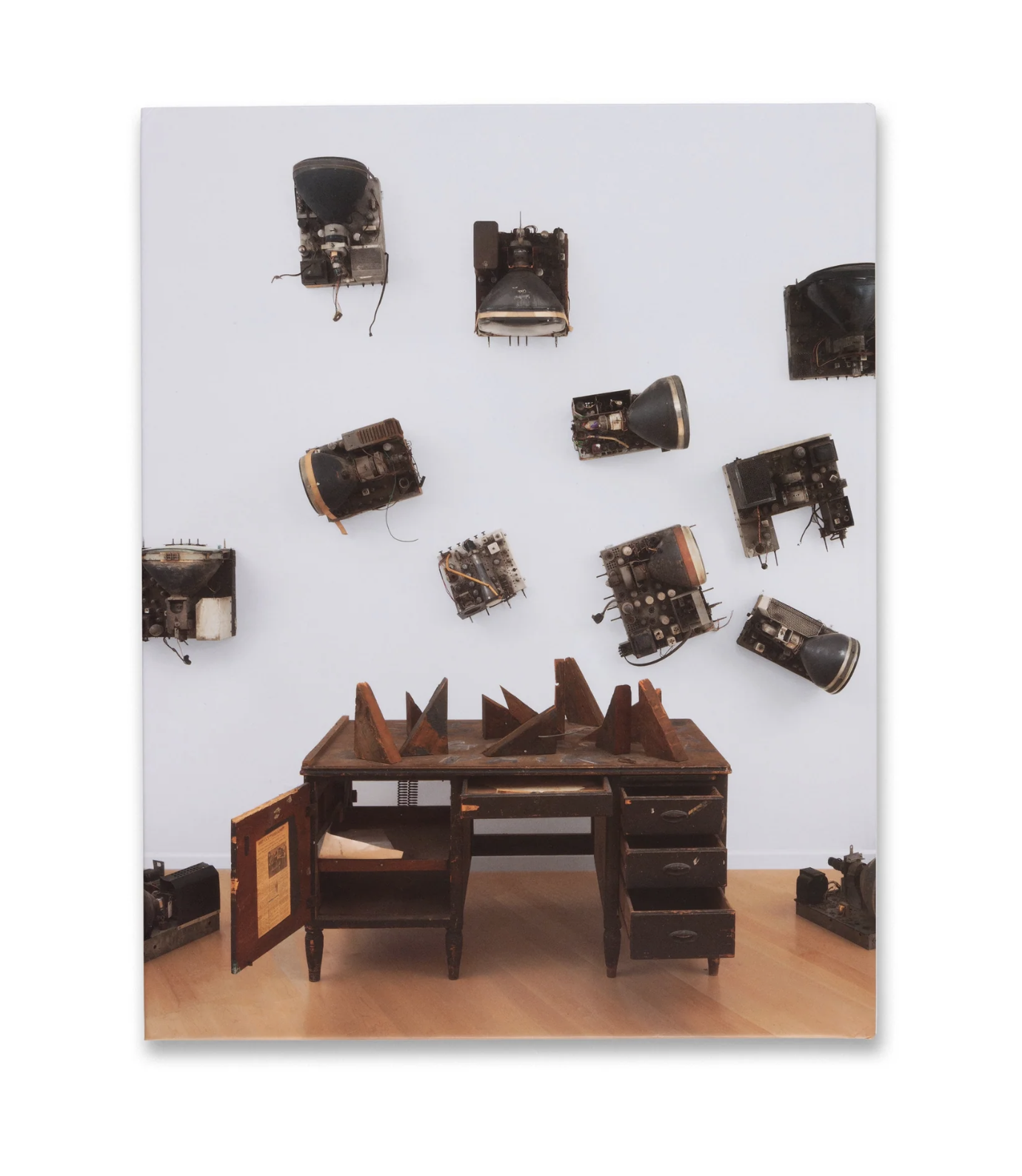
Nam June Paik: Art in Process


[Nam June Paik]
Nam June Paik: Art in Process
Los Angeles, USA: Gagosian, 2022
180 pp., 23.5 × 30.2 cm., hardcover
Edition size unknown


Published on the occasion of the two-part exhibition of the same name, curated by John G. Hanhardt, this volume surveys Paik’s work and reflects on the artist’s working method and the ideas and materials that inspired his art practice.

As the title suggests, the book highlights the centrality of process across Paik’s career—from the manipulation of television sets in the early 1960s to live global satellite telecasts and large-scale video sculptures. It includes collaborations with Joseph Beuys and Charlotte Moorman. 

Nam June Paik: Art in Process features essays by Hanhardt and Gregory Zinman, and extensive illustrations including numerous full-page plates and details, a foldout of the score for Paik’s Symphony for 20 Rooms (1961), as well as rarely seen archival photographs documenting Paik’s early performances by Peter Moore (1932–1993), dating from 1964 through 1977.


Thursday, November 18, 2021

Charlotte Moorman


Cellist and performance artist Charlotte Moorman was born on this day in 1933. Above are posters advertising her performances and events, including many famous collaborations with Nam June Paik, as well as for the Annual Avant Garde Festival of New York, which she founded. 


Sunday, November 8, 2015

Charlotte Moorman


Charlotte Moorman died on this day in 1991, at the age of 57, from Breast Cancer. Her friend Carolee Schneemann created this memorial page for her:

http://time.arts.ucla.edu/terminals/schneemann/moorman.html 

Tuesday, October 14, 2014

Topless Cellist: The Improbable Life of Charlotte Moorman


Joan Rothfuss
Topless Cellist: The Improbable Life of Charlotte Moorman
Cambridge, USA: MIT Press, 2014
448 pp., 7 x 9", hardcover
Edition size unknown

Carefully researched and profusely illustrated with a hundred black and white photographs, this portrait of Moorman 
chronicles her life from her youth in Little Rock, Arkansas (where she won “Miss City Beautiful” in 1952) through her notorious career as an artist and musician to her death from cancer in 1991. 

The book documents her performances, many of which saw her playing the cello in various states of undress. She also performed nude for Nam June Paik's Sonata for Adults Only and for Cut Piece, by Yoko Ono (who contributes the Introduction to the book). She also collaborated with John Cage, Joseph Beuys and several Fluxus artists, though none rival her life-long artistic partnership with Paik. 

Topless Cellist takes its name from a 1995 video Paik made in tribute to Moorman. Its title comes from a 1967 performance for which the pair achieved widespread notoriety. Paik had long felt that music was behind literature and painting in part because of the "purge" of sexuality. For his Opera Sextronique at the Film-Makers Cinematheque in New York, Moorman was to perform movements on the cello in various states of undress.

During the first movement of four movements, Moorman played Elegy by Jules Massenet wearing a bikini outfitted with blinking lights. For the second movement, she played International Lullaby by Max Matthews, topless. She was arrested mid-performance by three plainclothes police officers in the audience and charged with indecent exposure. The charges were dropped but she was fired from the American Symphony Orchestra. Moorman and Paik restaged the event for filmmaker Jud Yalkut's camera, though the film was not permitted to be shown in court.

Even without the scandalous performances, Moorman's place in New York's Avant Garde history was secured when she founded the Annual Avant Garde Festival in 1963. "No official could refuse her dream of an Avant Garde festival our city precincts", said friend and collaborator Carolee Schneemann, who also called her "bold, irrepressible and courageous". The Festival continued (though not exactly annually) until 1980.

Mooreman was diagnosed with breast cancer in the late 1970s. She underwent a mastectomy and continued performing through the 1980s, her health deteriorating. She died in New York City on November 8, 1991, at the age of 57. 

The just-released title is available from the publisher, here. For more information on Moorman, see previous post, here


Thursday, February 13, 2014

The World of Charlotte Moorman: Archive Catalogue


[Charlotte Moorman]
The World of Charlotte Moorman: Archive Catalogue
New York City, USA: Bound & Unbound, 2000
22 envelopes, 26.5 x 39 x 13 cm., boxed
Edition of 100

An archival box housing twenty-two envelopes which contain: a table of contents, a biography, a bibliography and three chronologies, including one on the collaborations Moorman made with Nam June Paik, for which she is perhaps best known. The remaining sixteen envelopes document the Annual New York Avant Garde Festival, which Moorman founded in 1963.

Edited by Barbara Moore, the catalogue accompanied an exhibition at Bound & Unbound between March and June of 2000. Moore runs Bound & Unbound and is also the executor of Moorman's estate. Her husband, photographer Peter Moore, took many of the photos of Moorman in performance that appear in the publication.

In 1967 Moorman received a modicum of notoriety as the "topless cellist" following an arrest and charges of indecent exposure while performing Paik's Opera Sextronique. She was given a suspended sentence.

For the Second Avant Garde Festival, Moorman had convinced the German composer Karl Stockhausen to permit a New York restaging of his performance piece, Originale, on the condition that Paik would reprise his role in the 1961 version as the "action composer". Other performers in the New York version included poet Allen Ginsberg, percussionist Max Neuhaus, composers James Tenney and Alvin Lucier, Allan Kaprow and several artists affiliated with the young Fluxus community (Dick Higgins, Jackson MacLow, Ayo, etc.). This meeting began the decades-long collaboration between Moorman and Paik, and also led to an ongoing feud with Fluxus 'pope' George Maciunas.

At the urging of Henry Flynt, Maciunas encouraged members of Fluxus to take a more overtly political stance, including picketing the premiere of Originale, on the basis that they considered Stockhausen a 'Cultural Imperialist' and "a characteristic European-North American ruling-class Artist". Some Fluxus artists participated in the protest, others crossed the picket lines to attend the event (Higgins did both). This created a fracture in the Fluxus group, with many artists associated with the subsequent festival events being excommunicated (sometimes only temporarily) by Maciunas.

The Avant-Garde Festival continued annually, in various locations (including Judson Hall, Central Park, the Staten Island Ferry, Shea Stadium, the World Trade Centre) until 1982, except for hiatus years of 1970, 1976 and 1979. Performers included John Cage, Morton Feldman, Yoko Ono, Carolee Schneeman, John Lennon, Alison Knowles, Richard Kostelanetz, Bill Fontana and many others.

Paik and Moorman continued to work together, with Paik creating many works specifically for her, including TV Bra for Living Sculpture (1969) and TV-Cello (1971). The pair performed and toured internationally together for many years. Paik believed that music was sixty-years behind literature and the visual arts in terms of its relationship to sexuality, and was determined to correct this (see poster, below). The discovery of an attractive Juilliard-trained cellist not adverse to disrobing for an audience must've felt a godsend.

Their work together (and many of her solo outings, such as the restaging of her roommate Yoko Ono's Cut Piece), positioned Moorman as a precursor to the body art of Carolee Schneeman, Hannah Wilke, Marina Abramowicz, Karen Finley and Vanessa Beecroft. One of Peter Moore's photographs documents a performance of Jim McWilliams' 1973 piece Candy,  in which Moorman is covered in chocolate and shredded coconut, predating the nude chocolate sauce performances that brought Finley notoriety a decade later.

McWilliams' created numerous other memorable pieces for her, including Sky Kiss, The Flying Cello and The Intravenous Feeding of Charlotte Moorman. In 1966, Joseph Beuys created Infiltration Homogen für Cello, a felt-covered violoncello, in her honour.

In the late 1970s Moorman was diagnosed with breast cancer. She underwent a mastectomy and continued treatment, but eventually succumbed to the disease on November 8th, 1991, at the age of 57.