Showing posts with label Ben Patterson. Show all posts

Saturday, September 27, 2025

Dust Out Of Brain


Henning Christiansen / Ben Patterson / David Moss
Dust Out Of Brain
Frankfurt, Germany: Museum Für Moderne Kunst, 1993
Audio CD, 60'57’'
Edition size unknown


A single track CD ( 60'57’’, recorded in Hamburg in 1993) housed in a plastic wallet tied with a wool. 

The regular edition uses green thread and Christiansen's "Save the Nature - use Fluxus” is rubber-stamped on the back. The signed edition uses white thread, and features a collaged addition (rubber-stamped and signed "Henning Christiansen 95") on the front, and handwritten number and notes on back. 

Henning Christiansen and Ben Patterson were both members of Fluxus. David Moss is an American percussionist, born in New York City in 1949.

The title reportedly refers to cannabis use. 


Tuesday, October 25, 2022

Fluxus Grappa


[Various Artists]
Fluxus Grappa
Molvena, Italy: M. Lunardon, 1993
36 x 51 x 10 cm.
Edition of 8 signed and numbered copies

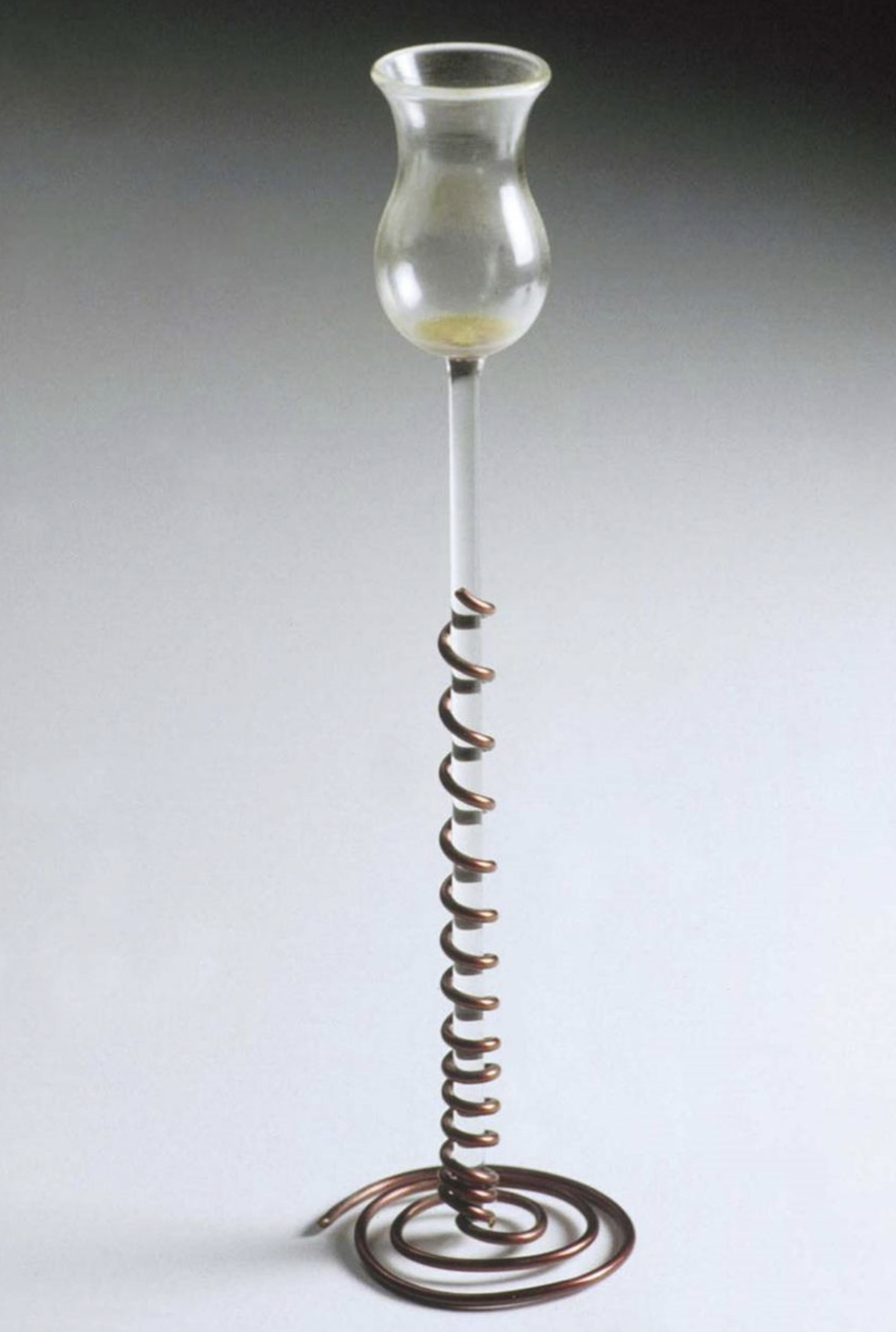
A serigraphed wooden box containing six glass blown works by artists affiliated with Fluxus: Philip Corner, Jean Dupuy, Geoffrey Hendricks, Alison Knowles, Ben Patterson and Emmett Williams. Each bottle is signed and numbered by the artist. 

The work was apparently initiated by collector Luigi Bonotto, and produced with the Italian Brandy manufacturer. 

In 1997, a second box was produced (see next post). 

Sunday, May 29, 2022

Ben Patterson


Benjamin Patterson was born on this day in 1934. He died June 25, 2016. Below is a birthday card to him from Takako Saito, 2011. 


Monday, May 23, 2022

Ben Patterson | Instruction No. 2 (Please Wash Your Face)


Ben Patterson
Instruction No. 2 (Please Wash Your Face)
New York City, USA: Fluxus, 1964
10 x 12 x 1.5 cm.
Edition size unknown


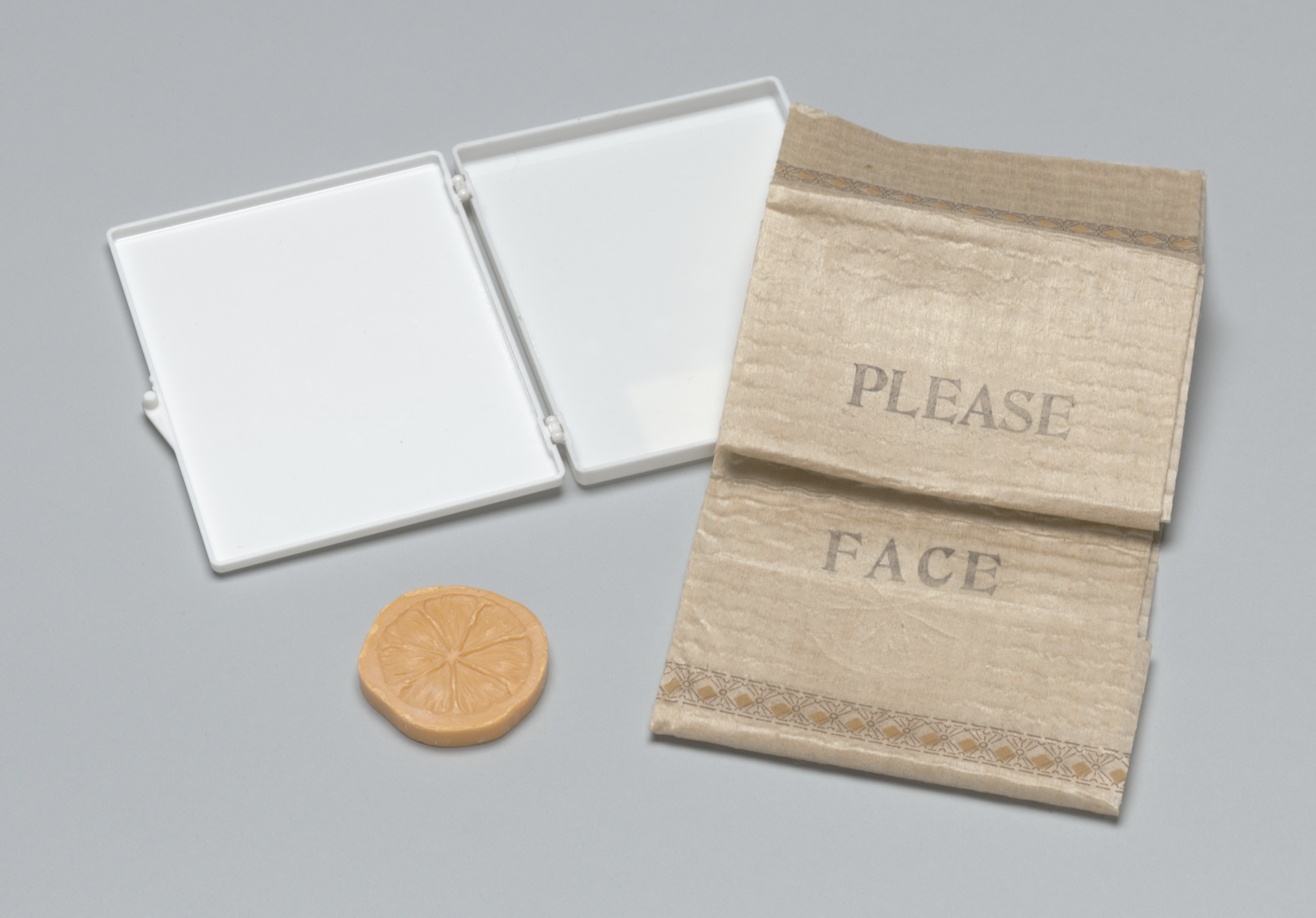
"Contained in a small plastic box was a paper towel, a small bar of soap, and the instruction 'Please wash your face,'" Patterson explained in the lead up to a 2011 performance of the work at New York's Third Streaming project space. "As far as I know, this will be the first performance of the piece with total audience participation. People will come to the stage — or optionally, to the bathroom — and wash their face. Afterward, there will be a moderated discussion on the subject: 'How is washing your face in public a work of art?'"

Fluxus advertised Instruction No. 2 as early as the fourth issue of the Fluxus newspaper (cc. fiVe ThReE), in 1964. It was made available both as an individual work (selling for $3.00) or as part of various Fluxkits. All consisted of a plastic box (typically white but sometimes clear) with the same George Maciunas designed label.  The paper towels were rubber stamped with the instructions/subtitle.

Instruction No. 1 - a series of dance instructions - was intended for publication through Fluxus, but never produced.


"Perhaps his simplest composition for action, Patterson’s Instruction No. 2 (1964) consists of a small plastic box containing a bar of soap in the shape and color of a lemon slice and a paper washcloth on which is stenciled, “Please wash your face.” With this work, Patterson transforms a habitual action that typically happens in the privacy of one’s home into a public performance. The work has been realized in various public settings, and yet Patterson noted the public’s resistance toward performing this activity: “In New York people were a bit hesitant one way or another, wondering whether or not they wanted to do this activity in public because it’s something that you normally do in the bathroom, in private.”  Instruction No. 2 asks participants to “concentrate one’s attention and focus on an everyday activity which is very important and taken for granted.” The work marks out an everyday activity as an artistic and collective action, blending art and life, which is at the core of Fluxus. Life is art. And Patterson knew exactly how to help us experience differently, appreciate, and find humor in life."

Tuesday, November 23, 2021

Joe Jones | Music Book


Joe Jones
Music Book
Cologne, Germany: Edition Hundertmark
[16] pp., 15 x 21 cm., staple bound
Edition of 500

Hundertmark published several works by the under-rated sound artist Joe Jones, including three compact disks, self-playing instruments and boxed editions. The 33rd in the booklet series features (similar to the Filliou title) examples of Jone's editioned works. It is prefaced by a text from Ben Patterson, titled The Discreet Charm of Joe Jone's Music Machines

Music Book is available from the publisher, here, for 16 Euro.


Monday, November 15, 2021

Ben Patterson Tells Fluxus Stories (From 1962 to 2002)


Ben Patterson
Ben Patterson Tells Fluxus Stories (From 1962 to 2002)
Berlin, Germany: Edition Hundertmark, 2002
13.5 × 12.5 × 2 cm
Edition size unknown


Fluxus truths, half-truths and exaggerations. The special, signed and numbered, edition of 20 comes with a toy rubber nose that one may put on to detect falsehoods:

"Maybe some are true and maybe some are false. If it is important for you to know which are which, please use the enclosed "nose - mask" to "sniff - out"  the falsehoods and/or exaggerations."
  
Available from Harry Ruhe’s Multiples store, here; 

Wednesday, January 6, 2021

Ben Patterson for Fluxus 1


Ben Patterson was introduced to classical music at a young age by his parents  - his mother was a trained pianist and his father a one-time professional violinist. He studied contrabass and composition at the University of Michigan, and graduated in 1956. His ambition was to be the first black American to perform with a major symphony orchestra, but he was unable to find employment. 

“In the end, even though such a famous conductor as Leopold Stokowski fought strongly on my behalf,” Patterson lamented in 2010, “America was not yet ready for a black symphony musician.” 

He moved to Canada to perform with the Halifax Symphony Orchestra from 1956 to 1958, and later with the Ottawa Philharmonic Orchestra. In 1960, he traveled to Cologne to meet up with Karlheinz Stockhausen, clutching an introductory letter from the German ambassador to Canada, who was related to the composer through marriage. 

Floored by Stockhausen's arrogance, Patterson said he “went into isolation for three days to ponder a more socially responsible way of making art”. Shortly afterwards a chance encounter with composer John Cage and pianist David Tudor resulted in an invitation to perform in a series of influential concerts held at the studio of artist Mary Bauermeister. Patterson performed Cage’s Cartridge Music on October 6, 1960, alongside Nam June Paik and Christian Wolff.

Patterson alerted George Maciunas to these events, which are typically seen as proto-Fluxus, and the pair began organizing festivals and performances in Germany including the Fluxus Internationale Festspiele Neuester Musik, held in Wiesbaden in September 1962. It was here that Fluxus was introduced to the world. 

Patterson performed his own composition, Variations for Double-Bass, from 1961. Inspired by Cage’s prepared-piano works and Chance Operations, the score was first derived by ink blots, but noted "however, there are many other satisfactory solutions." 

The score for Variations for a Double-Bass was reprinted in Fluxus 1, along with documentation photographs. His other contributions included Puzzle - Poem, Overture (vers. II-III), Lemon and Traffic Light. 

Patterson died in 2016 at the age of 82.


Monday, November 19, 2018

Benjamin Patterson | Methods & Processes


Benjamin Patterson
Methods & Processes
Paris, France: Self-published, 1962
27 x 18.8 cm.
Edition of 100


Benjamin Patterson was born in 1934 in Pittsburgh, and graduated from the University of Michigan, in 1956 with a Bachelor of Music. He performed as a double-bassist with the Ottawa Philharmonic Orchestra, a job he planned to return to after visiting Cologne and Paris in 1960.

During his travels he met John Cage, David Tudor, Merce Cunningham and Karlheinz Stockhausen (he found the latter insufferable) and eventually a number of artists who would go on to form Fluxus. Daniel Spoerri encouraged him to publish Methods & Processes and Robert Filliou gave him his first gallery exhibition (in the artist's hat). Patterson assisted George Maciunas in organizing the historic 1962 Fluxus Festival in Wiesbaden, and his interview with Emmett Williams became the first article ever published about the group. The first film documentation of Fluxus - news coverage by German Television - featured Patterson's performance of his Variations for Double-Bass.

Methods & Processes features some extremely discreet performance scores (such as a step-by-step instructional on walking) and also Lick Piece, a notorious Fluxus classic that is now wisely performed with both male and female subjects (see below).


"Works like Methods and Processes were very slippery, meant to infiltrate at a near-subliminal level and then exit, leaving behind little or no trace/evidence"
- Ben Patterson, From Black to Schwarz: Cultural Crossovers Between African America and Germany 


Benjamin Patterson
Methods & Processes
Tokyo, Japan: Gallery 360°, 2004
11 pp.,  21 x 15 cm., loose leaves
Edition of 500

A reprint of the extremely rare 1962 edition, produced in conjunction with Patterson's exhibition at Gallery 360°, "Ben Patterson interrupted Fairy Tales and other appropriate works".


Benjamin Patterson
Methods & Processes
Dijon, France: Les Presses Du Reel , 2011
2 pp., 18,5 x 27 cm / 27 x 126 cm (unfolded), softcover
Edition size unknown

Reprinted again, this time as a facsimile accordion-fold, in 2011, as part of the Incertain Sens series, which also includes works by Dieter Roth, Maurizio Nannucci, Robert Barry, Anne Mœglin-Delcroix, Herman de Vries, Peter Downsbrough, Jessica Stockholder and many others.

Available from the publisher, here, for €7.00.