Showing posts with label keys. Show all posts

Sunday, March 19, 2023

Yoko Ono | A Key To Open A Faded Memory


Yoko Ono
A Key To Open A Faded Memory
New York City, USA: Self-published, 1992
19 x 19 x 7 cm.
Edition of 40 signed and numbered copies


A glass key housed in a handmade cardboard box on a heart-shaped synthetic sponge. The title is handwritten on the cover, of a work that appears to have been gifted to friends. 


Yoko Ono | Glass Keys to Open the Skies


Yoko Ono's interest in clouds and skies are well documented, from the postcard work A Hole To See the Sky Through, to the 1970 film Apotheosis, to the 1985 Starpeace song "Sky People". Many of her instructional works, from Grapefruit and elsewhere, involved the sky: Sky Event For John Lennon, Sky Event II, Painting to See the Skies, scripts for films 10 and 11, etc., etc. Some of her earliest object works include Sky Machine and A Shovel to Dig a Hole for the Clouds to Drop In

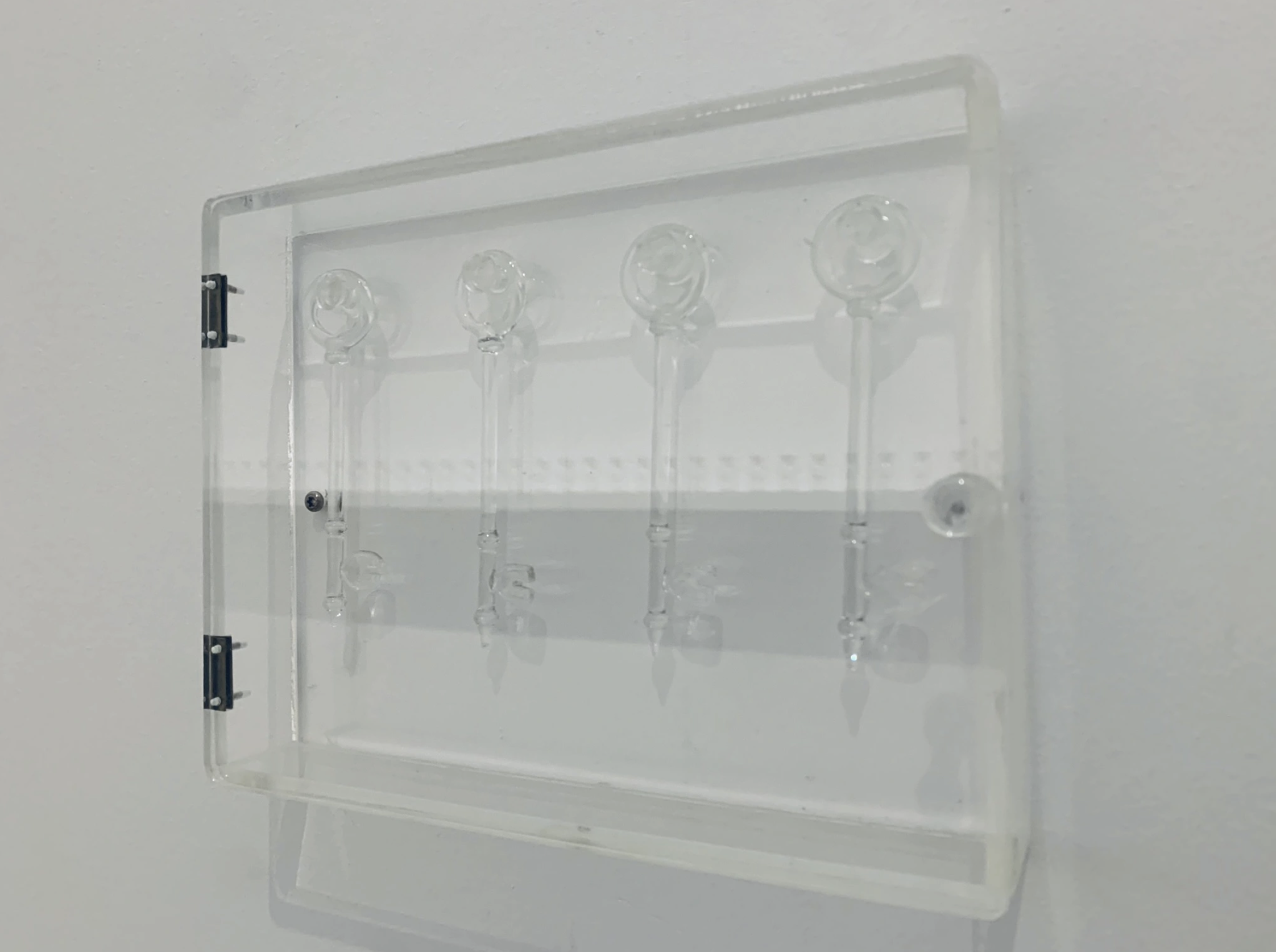
Glass Keys To Open The Skies is a work from 1966/67 featuring a set of four glass keys in a hinged plexiglass box. The work proposes a solution to unlocking something that is already open, but forever out of reach. 

Later versions and variations include a single key with a handwritten tag attached with twine, a plexiglass box version with eight keys instead of four, keys in hand knitted cases gifted to each of the Beatles, a single glass key included in the deluxe Everson catalogue box, a brass version of the above, a blue version in 2016, A Key To Open a Faded Memory, and A Key to Open the Universe. 

The first image above is a picture that Ono posted to Twitter in July of 2020, and it looks like a residential setting. The view from the window indicates it is not the Dakota - the Upper West Side apartment Ono first moved into fifty years ago - so it might be the rural upstate New York farm to which she has recently relocated. The 600-acre property was purchased in 1978 when Lennon had retired from music for five years and Ono was running their business. During the pandemic the artist - who turned 90 last month - reportedly left New York City behind for good, to live in the Catskills. 


"In the third room of Yoko Ono’s retrospective exhibition at the Japan Society in New York was a small Plexiglas case containing four glass keys. The piece, dated 1966, is titled Glass Keys to Open the Skies. Rhetorically, the work represents several impossibilities at once: that an elemental openness like the sky could be further opened, that a mechanism for doing this might exist, and that a glass key could instrumentalize crossing such a threshold. For Ono, the range of questions this concept triggers is what makes the keys a work of art. What she is reaching for is mystery, not absurdity. Her pieces require a viewer’s belief that the intangible about which she speaks is more than a personal imaginative act. She wants to offer a fresh source of creative possibilities that feel poetically transpersonal; her art is not just about herself but also about her vision of a collective universe. Despite the passage of almost 40 years, Ono’s work still seems radical, beautiful and not easy to characterize. Transmodern? Only a new word may fit what she was and is trying to do.

In contrast to so much contemporary art, the glass keys carry no irony and no self-conscious criticality. According to Ono herself, writing in 1988, they are reminiscent of the times in which they were made. “The air definitely had a special glimmer then. We were breathless from the pride and joy of being alive. I remember. . . carrying a glass key to open the sky.” As plainly as these words embody an imaginative grandiosity that was a common element in ’60s counterculture, they also reflect Ono’s basic verbal theatricality. Behind this lies a broader cultural platform on which the piece stands: her traditions, both Eastern and Western. Ono’s conceptual and performative gestures are hybrids, as dependent on Beat strategies and Japanese esthetics as they are self-consciously futuristic."
- J.W. Mahoney 

Yoko Ono | Blood Objects from Family Album


Yoko Ono
Blood Objects from Family Album
New York City, USA: UBU Gallery, 1995
17.5 x 10.2 cm.
Edition size unknown


A year after the founding of Ubu Gallery in 1994, Yoko Ono presented a solo exhibition there, comprising of two bodies of work. Works from the Franklin Summer 'automatic' pointillist drawings series sat alongside Family Album objects (bronzed versions of everyday items such as a splintered bat, a mirror, a high-heeled shoe, all splattered with blood red pigment). The latter recalled the image of her husband John Lennon's iconic glasses covered in his own blood after being shot in front of Ono outside their home in 1980, which adorned the cover of her first album after his murder. 

To promote the show is this brilliant bit of ephemera, which I think bests the works in the show. A house key is just as good a signifier of domesticity as a mirror or shoe, and all the better that it arrives for free in the mail, serving as the exhibition announcement. 

The true brilliance is the lack of expense: I suspect most households have a drawer full of keys that are no longer in use but that the owners are reluctant to discard. It reminds me of when Laurie Anderson performed on SNL in 1986 - she handed out expired batteries and house keys to the audience as a keepsake. 

Ono has also frequently made use of the key as an object to open the sky, or open the universe (see next post). 


Saturday, March 18, 2023

Levin Hegel | Keys to My Apartment


Levin Hegel
Keys to My Apartment
Toronto, Canada: Self-published, 2003-2008
House keys on keychain
Edition of 5 [+1 AP] signed and numbered copies


Published in an edition of five, with the proviso that every time the artist moves into another home, the edition will be update and remade. 


Vienna Pighin | Single Use Functioning House Key


Vienna Pighin
Single Use Functioning House Key
Toronto, Canada: ESA, 2017
5 x 2 cm.
Edition size unknown


This multiple - made when the artist was attending Etobicoke School of the Arts, a celebrated arts high school in the Toronto suburbs - consists of a resin cast replica of her own personal house-key, in the home where she lives with her parents and siblings. 

The accompanying key chain identifies the title, which suggests both a warm, welcoming gesture, and perhaps a bit of a sinister trap (particularly knowing her other work, which ranges from an oversized slap stick to temporary knuckledusters, all dealing with themes of violence). 

The title supports the latter reading, with perhaps the suggestion that the key itself could sustain more than one use, but that the user wouldn't have the opportunity. 


Friday, March 17, 2023

Paul Ramírez Jonas | Key to the City


Using the same subject matter as Jon Sasaki (see the post previous to last), Ithaca-based artist Paul Ramírez Jonas’s Key to the City is an elaborate work first made with Creative Time curator Nato Thompson and currently on it's fifth iteration. 

In the summer of 2010, Ramírez Jonas worked with the city of New York to replace 24 city locks so that they could all be opened with a single key. The artist then bestowed these "keys to the city" (a civic ornamental honour typically reserved for visiting celebrities and dignitaries) to everyday citizens. 

The participants, which numbered in the thousands, were encouraged to use their 'master' keys to access sites spread across the five boroughs, ranging from community gardens and cemeteries to restaurants, police stations and museums. The work becomes a portrait of the city, while also exploring notions of the trust, access and belonging. 


Jon Sasaki | 1:1 replica of a key to Mercer Union


Jon Sasaki
1:1 replica of a key to Mercer Union
Toronto, Canada: Mercer Union, 2015 
8.5 x 5.4 cm.
Edition size unknown


About a decade ago Mercer Union began producing multiples as part of their membership drive. I think we have projects by Jenine Marsh, Sandy Plotnikoff, and Oliver Husain, and there may be others. 

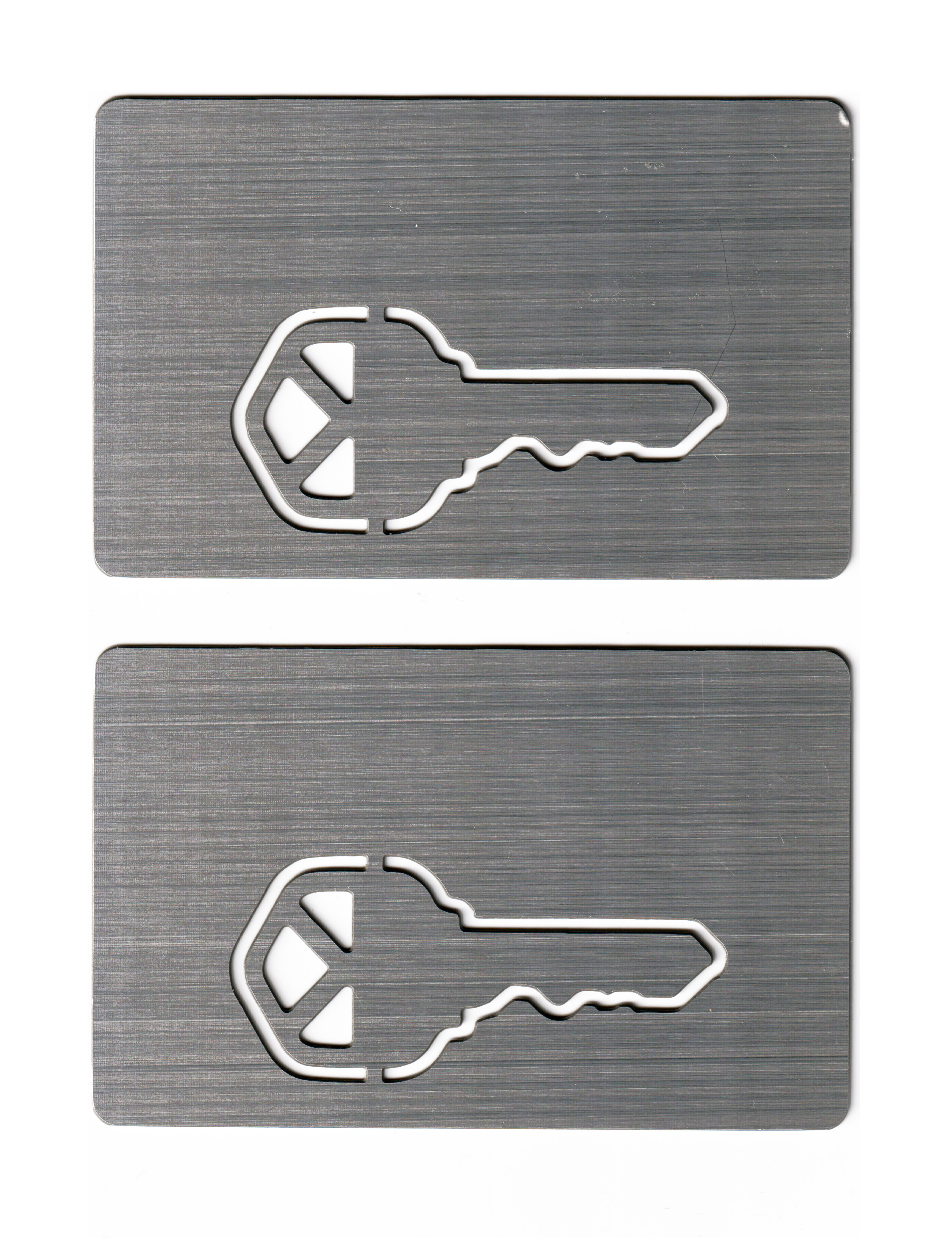
Jon Sasaki's edition addresses the context directly, providing a membership card of brushed stainless steel. From the card, members can pop out a replica of the gallery key and ostensibly gain access to the space any time of day or night. 

A related work by the artist is Gallery Key Hidden Outside the Gallery (
2012, ongoing), in which gallery keys are placed in "Hide-A-Key" rocks and concealed as effectively as the setting will permit. Installation views from the Art Gallery of Mississauga and the former Jessica Bradley Gallery, Toronto are below. 


Thursday, March 16, 2023

Douglas Gordon | Museum Keys


Douglas Gordon 
Museum Keys
Dublin, Ireland: The Irish Museum of Modern Art, 1992
15 × 38 cm.
Unlimited edition


If George Maciunas' collection of keys (see previous post) proposed the idea of random theft as a means to "purge the system", Douglas Gordon takes a more pointed approach, by invoking the art world. 

His 1992 work Museum Keys is a set of three printed envelopes containing a set of duplicate keys for the Museum of Modern Art in Dublin, as well as a set of blank keys, should the buyer wish to further duplicate (and distribute?) the keys. 

The Claire Fontaine collective produced a similar work (a stand-alone piece, not editioned) in 2006, called 371 Grand, which was a set of keys to open the Reena Spaulings gallery (see below). Jon Sasaki also explored similar ideas involving access and security in his work (see next two posts). 

Museum Keys is billed as an open edition but I've only come across a few copies online, accompanied by little or no information. Luckily, artist Ross Sinclair (a friend and collaborator of Gordon's) was able to send me photographs from an exhibition catalogue where he interviewed Gordon about the work, which I hope I have transcribed correctly:


Ross Sinclair: How did this work develop? 

Douglas Gordon: It came about through being in a situation that most artists find themselves in at some time. I was installing some work in a gallery last year and, as happens often, the gallery gave me a set of keys to let myself in and out of the building whenever I wanted. I couldn't help thinking how easy it would be to copy those keys. They might even have fallen into the wrong hands, if you know what I mean. 

RS: But it's not as if the wrong hands are going to the be the audience for the work. 

DG: You never know. 

RS: Who do you reckon is the audience for the work if it won't be the casual passerby

DG: Well, you have to aim for the audience that you anticipate. The people who will see the work in the museum, or those who might come across it later. ____ there to spend a bit of time on ideas. That's a situation that can be used to present the work which will involve those people's expectations and desires. 

RS: So what will the art lover get in this work? 

DG: They'll get a duplicate set of keys to the Museum of Modern Art in Dublin. I want to sell the keys as a cheap multiple to alter the significance of the originals. The originals are unique and valuable precisely because they're unavailable. I want them to be very available so that the more keys that go out the further the idea can travel, literally and conceptually. This element of distribution is emphasized by the fact that the multiple includes a set of blanks, so that whoever has a set of keys can go along to a key cutter and continue copying as many sets as they want. 

RS: Do you want to anchor the idea in the context of The Museum

DG: I hope that people who read the work will recognize the significance of the "keys to a museum". In recognizing this it can trigger off all the other ideas we might have about keys. 

RS: Yes, the key has a strong metaphorical value. Like in films and stories keys represent access, privilege, success, power, fulfillment, and so on. But the main implication seems to be a reconsideration of the status of The Museum. I mean, here we are being offered a set of keys to a repository of cultural and economic value. That's going to appear to some people as an odd thing to do. 

DG: The main focus of the work may appear to be the reconsideration that you're talking about. But the work needn't be limited to a pure critique of museumology. The motives are more pragmatic, less specific than that. I reckon that whilst I'm working in this museum I should try and do something here that might not be possible elsewhere. 

RS: So why the keys as opposed to anything else? 

DG: Out of all the museum accessories I could have chosen to work with, I chose the keys because they have this metaphorical and allegorical currency outside of, and as well in, the critique on the museum. It means that the keys can operate alongside all our ideas to do with relics. 


George Maciunas | Burglary Fluxkit


George Maciunas
Burglary Fluxkit
New York City, USA: Reflux Editions, c1981
2.2 × 10.2 × 12.1 cm.
Edition size unknown


While George Maciunas published countless boxed 'flux kits' by other artists (sometimes without their knowledge), he produced relatively few himself. His own multiple output was more likely to take the form of aprons, tattoos, face masks, stationery, postage stamps, or ping pong paddles. 

Alongside Excreta Fluxorum (varieties of animal excrement, labelled in Latin) Burglary Fluxkit is probably his best known boxed work. 

The above Reflux Edition (continued as an open edition, after his death, by Barbara Moore) is a clear compartmentalized box containing seven keys. It is packaged with a vintage Maciunas designed offset label, featuring images of tools. 

The 1971 original (see below) was sometimes clear, sometimes red, sometimes compartmentalized, other times not. The boxes contained found keys, mostly door keys but with some notable exceptions, such as a roller skate key. Kits included as many as two-dozen found keys, often broken. 

In typical Fluxus absurdist fashion, the keys are unlabelled and disconnected from their locks. The kit would prove fairly ineffective as an aid to robbery. But Mari Duvet argues in Corporate Imaginations: Fluxus Strategies for Living that the box's potential usefulness "tracked directly with Maciunas' ideas for purging the system". 

Somewhere I have a book on the subject art and theft, but I can't locate it on the shelves. If I recall correctly it features work ranging from Tom Friedman's Hot Balls to Janice Kerbel's bank heist work 15 Lombard StreetSeveral other artists (unwittingly or otherwise) later built upon the premise laid out by Maciunas with this work. For the rest of the week I'll post images of Artist Multiples involving keys, including projects by Douglas Gordon, Jon Sasaki, Yoko Ono, Levin Haegele, and Vienna Doria Pighin.